 30 Sep, 2026
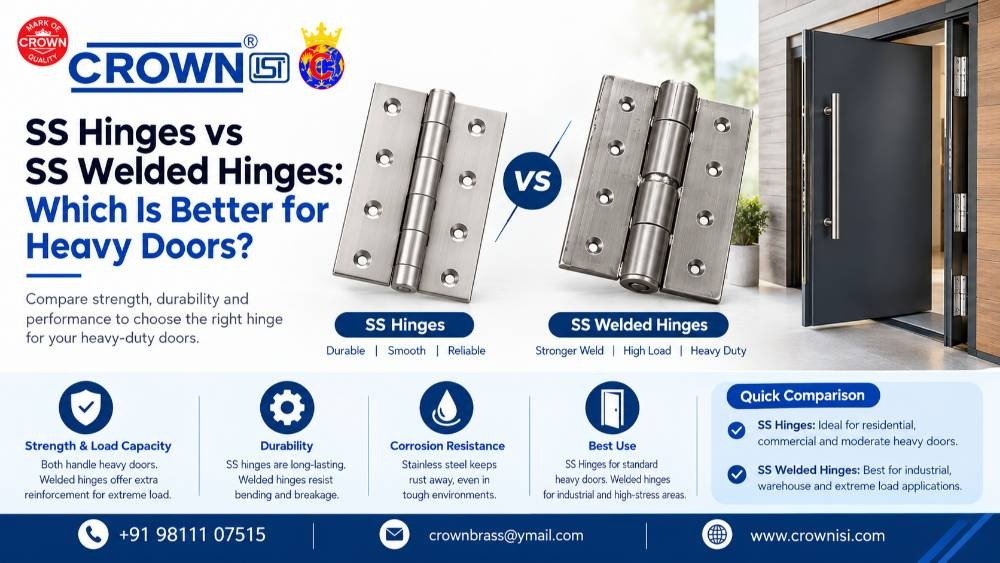
 For heavy doors where tamper resistance and a permanently retained hinge pin are priorities, SS welded-pin hinges can be a suitable choice. Standard SS butt hinges may be preferable where door removal and maintenance access are important. Load capacity depends on hinge size, thickness, material, number of hinges and installation—not simply on whether the pin is welded. For main entrance doors, security doors, and any heavy door where hinge-pin tampering is a concern, welded-pin hinges are worth considering. For interior doors, cabinets, and lighter applications, standard stainless steel hinges are often sufficient. Both types should conform to IS 12817:2020 and carry the BIS Standard Mark when covered by the applicable Quality Control Order.
What Are SS Hinges?
SS hinges are door hinges made from stainless steel. The most common type is the butt hinge, which has two rectangular leaves joined by a pin. One leaf is fixed to the door frame, and the other to the door itself. When the door opens, the leaves pivot around the pin.
Stainless steel is the preferred material for architectural hinges because it resists corrosion. Grade 304 stainless steel, which contains approximately 18% chromium and 8% nickel, is widely used for door hardware in India. It offers good corrosion resistance for most inland and humid environments. For coastal locations, Grade 316 may be specified.
Stainless Steel Hinges are available in different sizes and thicknesses. Common sizes include 75 mm, 100 mm, and 125 mm. Heavy-weight hinges typically have thicker leaves, such as 2.5 mm or 3.0 mm.
For covered products in India, stainless steel butt hinges must conform to IS 12817:2020 and bear the BIS Standard Mark under a valid licence, subject to applicable exemptions and transition provisions. You can view the BIS product manual for IS 12817:2020 for more details.
What Are SS Welded Hinges?
SS welded hinges are a type of stainless steel butt hinge where the hinge pin is welded into one leaf. This means the pin cannot be removed from the hinge. The two leaves are permanently joined by the welded pin.
The term "welded hinge" can refer to two different things in the hardware industry:
Welded pin hinges (butt hinges): The pin is welded to one leaf of a standard butt hinge. This is the type most commonly used for heavy doors, main entrance doors, and security applications. It is a stainless steel welded hinge in the sense that the pin is welded, not the hinge itself being welded to the door.
Weld-on hinges: These are hinges designed to be welded directly onto metal door frames and metal doors. They are used in industrial applications, shipping containers, and metal enclosures. These are different from welded pin hinges and are not the focus of this comparison.
When the term SS welded hinges is used in the context of architectural door hardware, it usually refers to welded pin butt hinges. The pin is welded into one leaf, so it cannot be conventionally driven out like a removable hinge pin.
How Welded Hinges Differ from Standard Butt Hinges
The difference between a standard SS hinge and an SS welded hinge is simple: the pin.
In a standard butt hinge, the pin is a separate piece that slides into the knuckles. It can be removed by tapping it out with a hammer and punch. This allows the door to be lifted off the hinges for maintenance, painting, or replacement.
In a welded hinge, the pin is permanently fixed. It is welded into one leaf, so it cannot be removed. The door cannot be lifted off the hinges. The two leaves remain permanently joined.
This difference has practical consequences:
| Feature | Standard SS Hinge | SS Welded Hinge |
|---|---|---|
| Pin removal | Possible | Not possible |
| Door removal | Door can be lifted off | Door cannot be lifted off |
| Security | Lower (pin can be pulled) | Higher (pin is fixed) |
| Tamper resistance | Lower | Higher |
| Maintenance access | Easier | More difficult |
| Long-term tightness | May loosen over time | Pin movement eliminated |
| Best for | Interior doors, cabinets | Main doors, security doors, heavy doors |
Table: SS Hinges vs SS Welded Hinges Comparison
| Factor | SS Hinges (Standard Butt) | SS Welded Hinges |
|---|---|---|
| Pin | Removable | Permanently welded into one leaf |
| Door removal | Possible by lifting off | Not possible |
| Security | Standard | High — pin cannot be conventionally driven out |
| Tamper resistance | Standard | High |
| Load capacity | Depends on size, thickness, material and number of hinges | Depends on size, thickness, material and number of hinges |
| Installation | Screwed into door and frame | Screwed into door and frame (pin is welded) |
| Maintenance access | Easy | More difficult |
| Ideal for | Interior doors, cabinets, light doors | Main doors, security doors, heavy doors |
| Conformity | IS 12817:2020 when covered | IS 12817:2020 when covered |
Load Capacity: Which Hinge Carries More Weight?
Load capacity is not determined by whether the hinge is welded or not. It is determined by several other factors:
Hinge size and thickness. A larger, thicker hinge carries more weight. A 100 mm hinge with 2.5 mm thickness is stronger than a 75 mm hinge with 1.8 mm thickness.
Number of hinges. Additional hinges can help distribute door loads, but the required number should be determined from the door weight, dimensions, hinge specification and manufacturer's installation guidance.
Door weight distribution. The upper hinge generally experiences a greater share of the door's load than the lower hinges, depending on the door geometry, hinge spacing and installation.
Material grade. Grade 304 generally offers better corrosion resistance than Grade 202, although the actual performance depends on the material specification, finish and environment. The grade affects long-term performance.
The key point is that welded hinges do not automatically have higher load capacity than standard hinges of the same size and thickness. The welding affects security and pin retention, not the basic load-bearing capacity.
For heavy doors, the practical advantage of welded-pin hinges is that they eliminate removable-pin movement as one potential source of play. Overall hinge performance still depends on hinge construction, installation, door loading and wear.
Security: Why Welded-Pin Hinges Resist Tampering
This is where welded-pin hinges have their clearest advantage.
On a standard butt hinge, the pin can be removed. A thief with a hammer and punch can knock the pin out of the hinge knuckles. Once the pins on the top and bottom hinges are removed, the door can be lifted away from the frame. This is a known method of forced entry.
On a welded-pin hinge, the pin cannot be conventionally driven out of the hinge like a removable butt-hinge pin, which can improve resistance to this type of tampering. There is no way to knock it out in the conventional manner. The door cannot be lifted off the hinges.
This makes SS welded-pin hinges worth considering for applications where hinge-pin tampering is a security concern, such as:
- Main entrance doors
- Security doors
- Doors on commercial premises
- Storerooms and strong rooms
- Any door where tamper resistance is important
For interior doors, bedroom doors, and bathroom doors, the security advantage of welded-pin hinges is less critical. Standard stainless steel hinges are sufficient for these applications.
Installation: Screws vs Welding
For the welded-pin architectural hinges discussed in this article, installation is typically by screws, just like a standard butt hinge. The difference is in the hinge construction, not the installation method.
Standard SS hinges are screwed into the door and frame. The pin is removable, so the door can be lifted off if needed.
SS welded-pin hinges are also screwed into the door and frame. The pin is welded, so the door cannot be lifted off. The installation process is the same. You do not need a welding torch to install a welded pin hinge.
The term "welded hinge" can cause confusion here. In the context of architectural door hardware, welded hinges usually mean welded pin hinges, not weld-on hinges. You install them with screws, just like standard hinges.
Weld-on hinges, by contrast, are welded directly onto metal surfaces. They are used in industrial applications, not typical architectural doors.
Maintenance and Longevity
Standard SS hinges may require occasional attention. The pin can be removed for cleaning or lubrication. If the hinge develops play, the pin can sometimes be replaced or adjusted.
SS welded-pin hinges require less attention to the pin because the pin cannot move. A welded-pin design eliminates removable-pin movement as one potential source of play, but overall hinge performance still depends on hinge construction, installation, door loading and wear.
However, welded-pin hinges still need cleaning and occasional lubrication. Dust and grime can accumulate in the knuckles and affect smooth operation. A small amount of compatible lubricant applied periodically will keep the hinge moving freely.
For heavy doors, the pin retention of welded-pin hinges is a significant advantage. A standard hinge that develops play can cause the door to sag. A welded-pin hinge that is properly sized and installed will help maintain its alignment by eliminating pin movement as a failure mode.
When to Choose SS Hinges
Choose standard stainless steel hinges when:
- The door is lightweight or medium-weight
- The door is an interior door, bathroom door, or cabinet door
- The door may need to be removed for maintenance, painting, or replacement
- Security is not a primary concern
- You want the option to replace the hinge without removing the door
- The budget is a consideration (standard hinges are generally lower cost than welded hinges of the same size)
Standard SS hinges are the default choice for most residential interior doors. They are easier to work with and provide adequate performance for typical applications.
When to Choose SS Welded Hinges
Choose SS welded-pin hinges when:
- The door is heavy (solid wood, fire door, or metal door)
- The door is a main entrance door
- Hinge-pin tampering is a security concern
- Tamper resistance is required
- The door is on a commercial premises
- You want to eliminate removable-pin movement as a failure mode
- The door is not expected to be removed frequently
For main doors where hinge-pin tampering is a concern, welded-pin hinges may be appropriate. The final selection should also consider door weight, hinge size, frame construction, security requirements and any applicable fire-door certification.
CROWN manufactures both welded and non-welded SS Butt Hinges and recommends welded hinges for main doors where security and pin retention are priorities.
Fire Door Considerations
Fire-rated doors have additional requirements that go beyond the hinge type.
A fire door is a complete assembly. The door leaf, frame, seals, closer, latch and hinges must all be compatible with the tested doorset. The hinge must be suitable for the specific fire door assembly, as confirmed by the applicable test evidence and certification.
Whether the hinge is welded or standard, it must be part of the tested or certified doorset. A welded-pin hinge is not automatically suitable for a fire door simply because it is welded. The hinge must meet the requirements of the fire door certificate.
For fire door applications, always refer to the doorset certification and the manufacturer's instructions. The BWF Fire Door Alliance states that hinges must comply with Annex B of BS EN 1935, and rising butt or spring hinges are not permitted in the specifications covered by its guidance. For Indian projects, the applicable fire-door requirements should also be checked against IS 3614:2021 and the specific tested/certified doorset documentation.
CROWN SS Hinges and Welded Hinges
CROWN Industries has been manufacturing door fittings and hardware for over 39 years. The company produces both standard SS Hinges and SS Welded Hinges under its stainless steel door accessories range.
From CROWN's published product information:
| Product | Code | Type | Size Range |
|---|---|---|---|
| Butt Hinges IS:12817 | CSS 126 | Medium / Heavy | 75mm – 150mm |
| Hinges Welding | CSS 127 | Medium / Heavy | 75mm – 150mm |
| Hinges Ball Bearing | CSS 128 | — | 100mm – 150mm |
CROWN states that it holds BIS Licence No. 8700097320 under IS 12817:2020 for stainless steel butt hinges. Buyers should verify the licence's current status and scope directly through the BIS portal before relying on the claim for procurement or project approval.
Whether a particular welded-pin hinge falls within the scope of IS 12817:2020 should be confirmed from its construction, product specification and applicable certification scope.
CROWN's published quality control information states that load testing, 200-hour salt-spray testing, and 50,000-cycle testing form part of its manufacturing process. These are additional product-level quality-control tests; buyers should request the applicable test documentation and compare the test method and acceptance criteria with the relevant standard.
For a detailed buying guide on stainless steel hinges, you can read the SS hinges buying guide on the CROWN blog. For information specific to SS 304 butt hinges, the SS 304 stainless steel butt hinges buying guide provides more detail. For heavy main doors, the SS butt hinges main doors guide covers types, sizes, and selection.
For projects that require documented evidence, CROWN can provide product datasheets and test information for the specific hinge model. You can learn more about the company on the About CROWN page.
Frequently Asked Questions
What is the difference between SS hinges and SS welded hinges?
The main difference is the pin. In standard SS hinges, the pin is removable. In SS welded hinges, the pin is permanently welded into one leaf and cannot be conventionally driven out. This affects security, door removal capability, and long-term pin retention.
Are welded hinges stronger than standard hinges?
Welded hinges are not necessarily stronger in terms of load capacity. Load capacity depends on hinge size, thickness, material grade, and the number of hinges used. The advantage of welded-pin hinges is that they eliminate removable-pin movement as one potential source of play, not that they carry more weight.
Can I use standard SS hinges on a heavy door?
Standard SS hinges can be used on heavy doors if they are correctly sized and enough hinges are used. However, for heavy main doors, welded-pin hinges are generally recommended because they provide better pin retention and resistance to tampering.
Can welded hinges be removed?
Welded pin hinges cannot be lifted off because the pin is fixed. The hinge itself is screwed into the door and frame, so the screws can be removed, but the door cannot be lifted off the hinges. This makes the door more secure but more difficult to remove for maintenance.
Do welded hinges need lubrication?
Yes. Like all hinges, welded hinges benefit from occasional lubrication. Dust and grime can accumulate in the knuckles and affect smooth operation. Apply a small amount of compatible lubricant periodically to keep the hinge moving freely.
Are SS welded hinges suitable for fire doors?
Welded-pin hinges can be suitable for fire doors, but only if they are part of the tested or certified doorset. The hinge must meet the requirements of the fire door certificate. Always refer to the doorset certification and manufacturer instructions.
What does "welded hinge" mean in the context of door hardware?
In architectural door hardware, "welded hinge" usually refers to a butt hinge where the pin is welded into one leaf. It does not mean the hinge is welded onto the door. These hinges are installed with screws, just like standard hinges.
How many hinges do I need for a heavy door?
The number of hinges depends on door weight, height, and width. As a general guide, three hinges are commonly used for standard doors. For heavier doors, additional hinges may be required. The manufacturer's instructions and the applicable standard should be checked.
Can I mix welded and standard hinges on the same door?
It is not recommended to mix welded and standard hinges on the same door. For consistent security and performance, use the same type of hinge throughout. If security is a concern, use welded-pin hinges on all hinge positions.
What is IS 12817:2020?
IS 12817:2020 is the Indian Standard for Stainless Steel Butt Hinges. It is the third revision of the standard and specifies requirements for materials, dimensions, manufacture, finish, and performance. It covers six types of stainless steel butt hinges.
Final Thoughts
For heavy doors, SS welded-pin hinges are generally the better choice when tamper resistance and pin retention are priorities. The welded pin cannot be conventionally driven out, which provides higher security and eliminates removable-pin movement as one potential source of play. This is particularly important for main entrance doors, security doors, and any door where tamper resistance matters.
For lighter doors, interior doors, and applications where the door may need to be removed for maintenance, standard stainless steel hinges are often sufficient.
The choice is not about which hinge is "stronger." Both types can carry heavy doors if correctly sized and installed. The choice is about security, pin retention, and maintenance access. Welded-pin hinges win on security and pin retention. Standard hinges win on accessibility.
When you buy SS Hinges or SS Welded Hinges, look for the BIS Standard Mark when the product is covered by the applicable Quality Control Order. Ask for material certificates. Ask for test reports. Ask about fire door suitability and doorset certification.
CROWN Industries manufactures both standard and welded Stainless Steel Hinges in India and provides product and quality-control information for project evaluation. For projects that require documented evidence, the company can provide product datasheets and test information for the specific hinge model.
Need help selecting hinges for your heavy doors?
Share the following details:
- Door material and estimated weight
- Door width and height
- Door thickness
- Application (interior, exterior, main entrance, security)
- Whether fire rating is required
- Quantity required
Need documents for vendor approval? Request the applicable BIS documentation, product datasheet, material information and available test reports for the required hinge model. CROWN can help identify the relevant hinge specification and available product documentation based on your project requirements. Contact CROWN to discuss your requirements.