 11 Aug, 2026
 When you close your main door at night, you want to feel safe. That feeling of security starts with the hardware—especially the hinges. A main door is heavier than any other door in your home. It faces the weather, the wear of daily use, and the strain of keeping your family secure. The hinges on that door have a big job to do. Choose the wrong ones, and you will notice the sag. The sticking. The squeaking. Choose the right ones, and you will forget they are even there—because they just work.
If you are looking for the best SS Butt Hinges for your main door, this guide will walk you through everything you need to know. From types and sizes to selection and installation, we will cover it all.
What Are SS Butt Hinges?
A butt hinge is the most common type of door hinge you will see. It consists of two flat metal plates—called leaves—joined by a central pin. One leaf attaches to the door, and the other attaches to the door frame. When the door swings, the leaves rotate around the pin.
The name "butt" comes from the way the two leave "butt" up against each other when the door is closed.
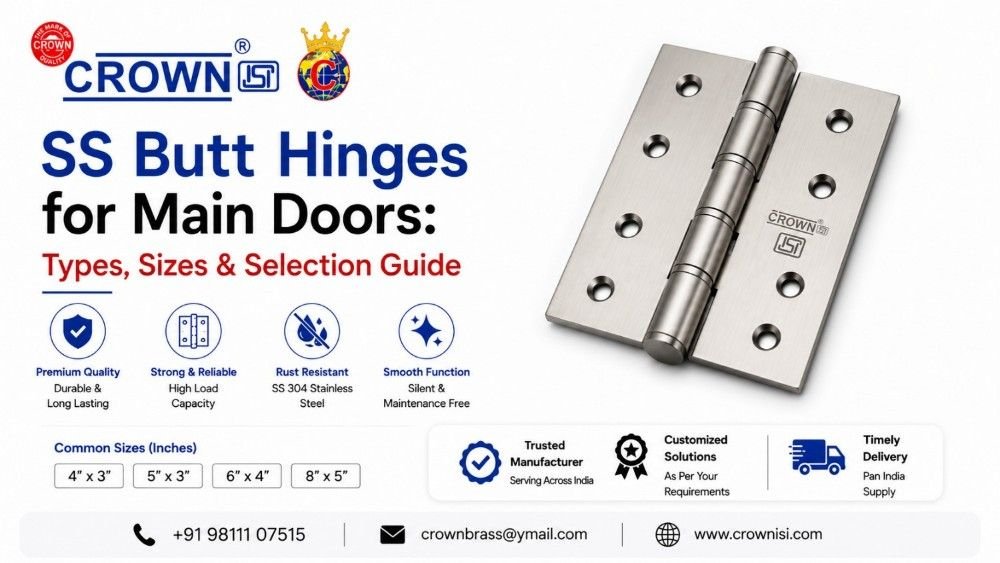
SS Butt Hinges are simply butt hinges made from stainless steel. And not just any stainless steel—SS 304 is the grade that matters for main doors. It contains 18% chromium and 8% nickel, which gives it excellent corrosion resistance. It does not rust, even in humid or coastal areas.
Why Main Doors Need Special Hinges
Main doors are different from bedroom doors or bathroom doors. Here is why:
| Factor | Main Door | Interior Door |
|---|---|---|
| Weight | Heavy (solid wood, metal, or composite) | Light (hollow core or thin panel) |
| Usage | Multiple times daily | Less frequent |
| Exposure | Weather, rain, sun | Indoor only |
| Security | High priority | Low priority |
| Size | Taller and wider | Standard size |
A main door needs SS 304 stainless steel butt hinges that can handle the weight, resist corrosion, and provide long-lasting security. Lower grades like SS 202 may look similar, but they have less nickel and will show signs of rust within a few years in humid conditions.
Types of SS Butt Hinges for Main Doors
When you are shopping for main door hinges, you will come across different types. Here is what you need to know.
1. Standard SS Butt Hinges
These are the most common type. Two leaves joined by a pin. Simple, reliable, and affordable. They work well for medium-weight main doors.
Best for: Standard wooden main doors, moderate weight.
2. Ball Bearing SS Butt Hinges
Ball bearing hinges have small bearings between the knuckles. These reduce friction and allow the door to swing smoothly even under heavy weight. For heavy main doors, ball bearing hinges are recommended for smoother operation and reduced wear over time.
At Crown ISI, we offer both 2 Ball Bearing Hinges and 4 Ball Bearing Hinges. The more ball bearings, the smoother the operation and the better the weight distribution.
Best for: Heavy main doors, high-traffic entrances, doors with closers.
3. Stainless Steel Welded Hinges
Stainless steel welded hinges have the hinge pin welded into one leaf. It cannot be removed from outside, which adds security. They are stronger and do not loosen over time.
Stainless steel welded hinges from Crown ISI have no loose pins and cannot be removed from outside—adding security.
Best for: Main entrance doors, security doors, heavy gates, industrial doors.
4. Severe Duty SS Butt Hinges
For extra-heavy main doors, severe duty hinges with 3.0mm thickness provide maximum strength and load capacity. These are designed for commercial use and very heavy residential doors.
Best for: Very heavy wooden doors, commercial entrances, fire-rated doors.
For a detailed guide on choosing the right hinge based on door weight and material, visit SDH Hardware – How to Choose the Right Stainless Steel Butt Hinge for Your Doors .
SS Butt Hinges Sizes for Main Doors
Choosing the right size is critical. A hinge that is too small will bend and sag. A hinge that is too large may not fit properly.
Standard Sizes
SS Butt Hinges are available in various sizes. The size is typically given as height x width in millimeters or inches.
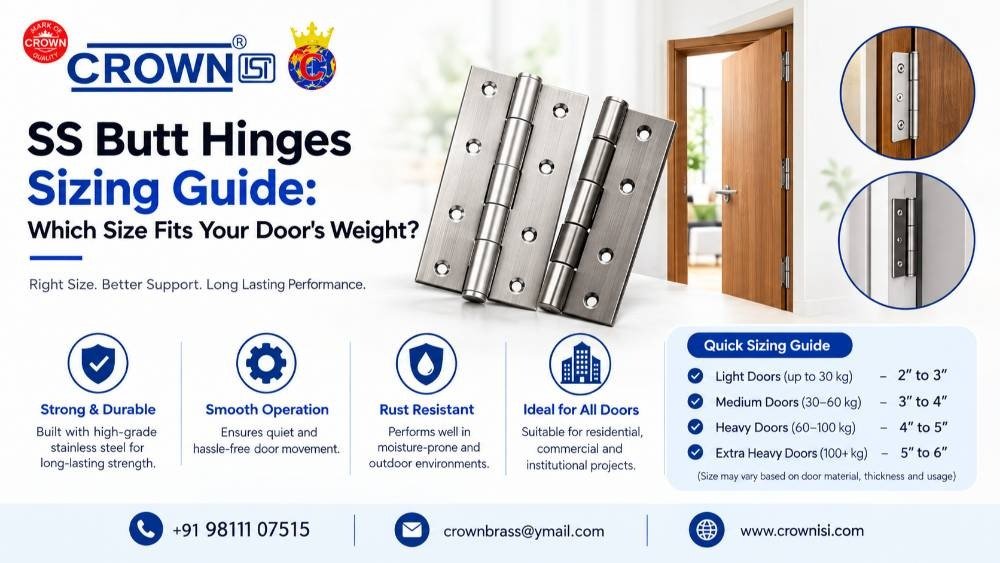
| Size (mm) | Size (Inch) | Common Use |
|---|---|---|
| 75 x 38 | 3 x 1.5 | Wardrobe shutters, lightweight doors |
| 88 x 44 | 3.5 x 1.75 | Bathroom doors, lightweight doors |
| 100 x 75 | 4 x 3 | Standard bedroom doors |
| 125 x 75 | 5 x 3 | Main entrance doors, solid wood doors |
| 150 x 100 | 6 x 4 | Extra heavy doors, commercial use |
For main doors, the general rule is: Choose 5-inch hinges for main entrance doors, solid wood doors, and external doors where the greater door weight requires a larger hinge with higher holding capacity.
Thickness Matters
| Door Type | Recommended Thickness |
|---|---|
| Standard wooden main door | 2.0 mm to 2.5 mm |
| Heavy main door | 3.0 mm or more |
| Fire-rated or security door | 3.0 mm or more |
A 102 x 76 x 2.5 mm hinge with 2 ball bearings can support a door weight of up to 120 kg. For extra-heavy doors, choose 3.0mm thickness.
For detailed hinge sizing based on door thickness (3.5" for 1-3/8" doors, 4" for 1-3/4" doors, 4.5" for taller doors), visit HardwareSource – Butt Hinge Selection Guide .
How Many Hinges Do You Need?
The number of hinges depends on the height and weight of your door.
| Door Height | Recommended Number of Hinges |
|---|---|
| Up to 2040 mm (7 feet) | 2-3 hinges |
| 2040 mm to 2340 mm (7-8 feet) | 3 hinges |
| Over 2340 mm (8+ feet) | 4 hinges |
As a rule, one hinge should be used for every 30 inches (about 76 cm) of a door's height, but the thickness and weight of the door should be taken into account too.
For a standard 7 feet by 3 feet main door, use three 5-inch SS butt hinges. Two hinges will cause sagging after a few months. For doors with closers or automatic operators, use a minimum of 3 hinges, even for shorter doors.
For a comprehensive guide on hinge placement based on door height and weight, visit Access Hardware – Stainless Steel Butt Hinge Sizing Guide .
How to Choose the Right SS Butt Hinges for Your Main Door
Choosing the right hinge involves several factors. Here is a step-by-step guide.
Step 1: Determine the Door Weight
The weight of your door is the most important factor. A good SS butt hinge with 3mm thickness can support doors up to 120kg. For heavier doors, choose welded hinges or severe duty hinges with 3.0mm thickness.
Step 2: Consider the Door Thickness
The thickness of your door determines the width of the hinge you need.
| Door Thickness | Recommended Hinge Width |
|---|---|
| Up to 35 mm | 75 mm (3 inch) |
| 35 mm to 45 mm | 100 mm (4 inch) |
| Over 45 mm | 125 mm (5 inch) or larger |
Step 3: Choose the Right Material Grade
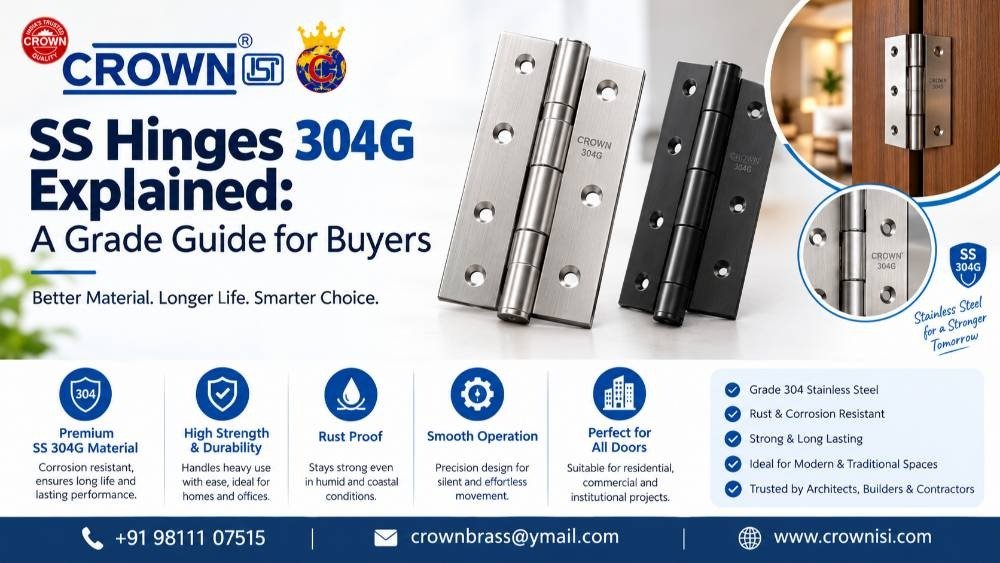
For main doors, always choose SS 304 grade. SS 202 may be cheaper, but it will rust in humid conditions. Look for "SS 304" or "304G" engraved on the hinge.
Crown ISI uses only 304G grade for their SS 304 stainless steel butt hinges.
Step 4: Decide Between Welded and Non-Welded
For main entrance doors and security doors, choose stainless steel welded hinges . They cannot be removed from outside, adding an extra layer of security.
Step 5: Consider Ball Bearings
For heavy main doors, choose ball bearing hinges. They reduce friction and ensure smooth operation even with heavy doors and door closers.
Step 6: Check the Finish
Choose a finish that matches your other Crown stainless steel door fittings . Satin (brushed) is the most popular for main doors because it hides fingerprints and scratches. Mirror finish is sometimes used for luxury homes.
For industry standards on butt hinge sizes and grading, visit ASSA ABLOY – Butt Hinge Standards and Sizing .
Crown ISI SS Butt Hinges for Main Doors
When you choose Crown Stainless Steel Door Fittings , you are choosing quality that lasts.
Over 39 Years of Experience
Crown Industries has been manufacturing high-quality door fittings for over 39 years. Our products are trusted by government departments, semi-government organizations, and public sector undertakings across India.
Genuine SS 304G Material
Crown ISI uses only genuine 304G stainless steel. No mixing. No cheap metal. Every hinge is made from virgin SS 304 raw material—no recycled scrap, no mixing of grades.
Heavy Duty Manufacturing
We make heavy duty SS 304 stainless steel butt hinges in 14 gauge and 12 gauge for main doors and commercial applications. Our hinges have wider leaves and thicker metal to take more weight.
Rigorous Quality Control
Every SS Butt Hinge from Crown ISI passes:
Thickness test – Ensuring consistent thickness
Load test – Verifying strength and load capacity
Salt spray test – 200-hour salt spray test for rust resistance
Screw alignment – Ensuring screw holes align perfectly with Indian door frames
ISI-Certified Products
All Crown ISI products carry the ISI mark, ensuring they meet Indian quality and safety standards.
Complete Range of Products
Crown ISI offers a complete range of Crown Stainless Steel Door Fittings including:
SS Butt Hinges – Available in multiple sizes and thicknesses
Stainless steel welded hinges – For heavy and security doors
4 Ball Bearing Hinges – For smooth, quiet operation
SS door handles
Cylinder door locks
Aldrops (sliding door bolts)
Tower bolts
Installation Guide for SS Butt Hinges on Main Doors
Proper installation is crucial for main doors. Here is what you need to know.
Tools You Will Need
Measuring tape
Pencil or marker
Hammer and chisel (for mortising)
Drill with drill bits
Screwdriver
Level
Screws (provided with the hinge)
Step 1: Determine Hinge Placement
Top hinge: 5-7 inches from the top of the door
Bottom hinge: 10-11 inches from the bottom of the door
Middle hinge: Centered between the top and bottom hinges
Step 2: Mortise the Hinges
For wooden doors, cut a recess (mortise) for the hinge leaf so that it sits flush with the door surface. This ensures a clean look and proper operation.
Step 3: Drill Pilot Holes
Drill pilot holes to prevent wood splitting. Use the appropriate drill bit size for the screws provided with the hinge.
Step 4: Attach the Hinges
Attach the hinges to the door first, then to the frame. Ensure proper alignment.
Step 5: Check the Door Swing
Make sure the door swings freely without binding against the frame. If the door sticks, the hinges may not be aligned properly.
Minimum Door Thickness
For stainless steel butt hinges, minimum door thickness should be 35mm for proper screw holding.
Installation Tips for Main Doors
For Heavy Doors: Use at least 5-inch SS butt hinges with 3mm thickness. Consider ball bearing hinges for smoother operation.
Use the Right Screws: Always use the screws that come with the hinge. For heavy main doors, consider using longer screws that go deeper into the door frame for extra strength.
For Doors with Closers: Use a minimum of 3 hinges, with ball bearings, to handle the additional stress.
For information on weld-on hinges for increased security and tamper resistance, visit Grainger – Stainless Steel Weld-On Hinges .
Frequently Asked Questions (FAQs)
1. What size SS butt hinges do I need for a main door?
For main entrance doors, solid wood doors, and external doors, choose 5-inch or 6-inch SS butt hinges. The greater door weight requires a larger hinge with higher holding capacity.
2. How many hinges does a main door need?
For a standard 7 feet by 3 feet main door, use three 5-inch SS butt hinges. Doors taller than 2100mm should mostly be fitted with four hinges.
3. What is the difference between SS 202 and SS 304 butt hinges?
SS 304 contains 18% chromium and 8% nickel, giving it excellent corrosion resistance. SS 202 has less nickel and chromium, making it cheaper but less durable. SS 304 does not rust, even in humid or coastal areas.
4. What are stainless steel welded hinges?
Stainless steel welded hinges have the hinge pin welded into one leaf. They cannot be removed from outside, adding security. They are more durable and tamper-resistant than standard hinges.
5. Are ball bearing hinges better for main doors?
Yes. Ball bearing hinges reduce friction and allow smoother operation, especially for heavy main doors. They are ideal for high-traffic entrances and doors with closers.
6. How do I know if a hinge is genuine SS 304?
A genuine SS 304 stainless steel butt hinge will have "SS 304" or "304G" engraved on it. If it is not there, assume it is a lower grade.
7. What is the ISI mark, and why is it important?
The ISI mark is a certification from the Bureau of Indian Standards that ensures the product meets Indian quality and safety standards. It guarantees you are getting a reliable, quality product.
8. Can I use stainless steel hinges on a wooden main door?
Yes. Stainless steel hinges work perfectly on wooden main doors. They are strong enough to support heavy wooden doors and will not rust over time.
9. How do I maintain SS butt hinges on my main door?
SS 304 hinges require very little maintenance. A simple wipe with a damp cloth removes surface dirt. For main doors, lubricate the hinge pin with silicone spray or graphite powder every 6-12 months to ensure smooth operation.
10. Why should I choose Crown ISI for my main door hinges?
Crown ISI has been manufacturing high-quality door fittings for over 39 years. Our products are ISI-certified, made from virgin SS 304 raw material, and undergo rigorous quality checks including a 200-hour salt spray test. We are trusted by government departments and public sector organizations across India.
Final Thoughts
Your main door is the first line of defense for your home. It deserves hinges that are strong, secure, and built to last. SS Butt Hinges made from SS 304 stainless steel give you the strength, corrosion resistance, and durability that a main door demands.
If you are looking for the best SS 304 stainless steel butt hinges , stainless steel welded hinges , or Crown Stainless Steel Door Fittings , look no further than Crown ISI .
With over 39 years of experience, ISI-certified products, virgin SS 304 raw material, and rigorous quality control, Crown ISI is the name you can trust for all your door hardware needs.
Visit our products page to explore our full range of SS butt hinges, welded hinges, and door accessories.
Contact us today for more information or to place your order.
Contact Information
Crown Industries
Factory: 39/2/9A, Site IV, Industrial Area, Sahibabad, Distt. Ghaziabad (U.P.)
Office: 500 Kuchha Pati Ram, Bazar Sita Ram, Delhi 110006
Phone: +91 98111 07515