 26 Sep, 2026
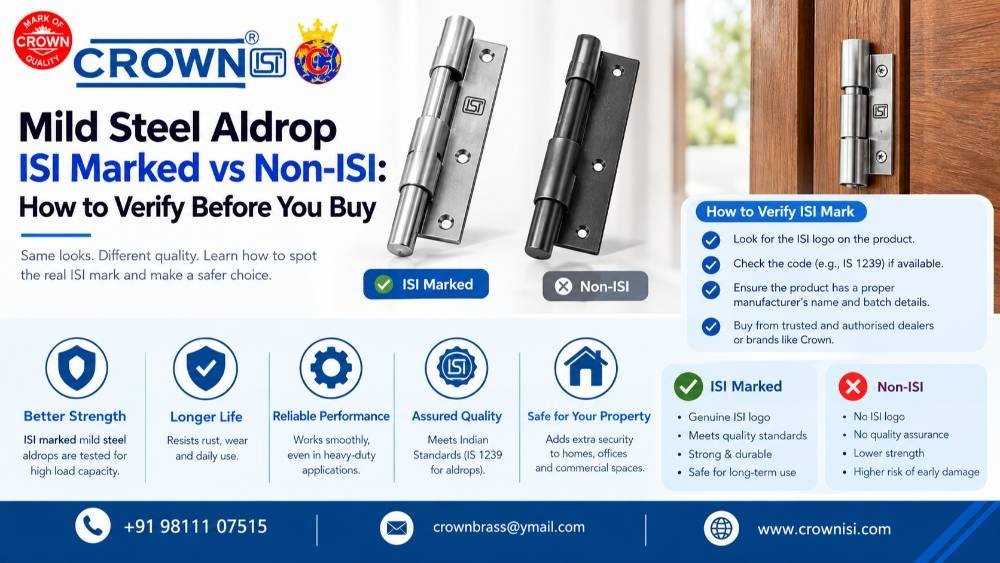
 A mild steel aldrop ISI marked product conforms to the applicable Indian Standard and is manufactured under a valid BIS licence. Under the Bolts, Nuts and Fasteners (Quality Control) Order, 2024, mild steel sliding door bolts (aldrops) for use with padlocks are notified products and must bear the BIS Standard Mark under a valid BIS licence before manufacture, sale or import in India, subject to applicable exemptions. To verify, find the BIS licence number (CM/L number) shown with the Standard Mark on the product or packaging, and check it through the BIS portal or the BIS Care app. The verification will display the manufacturer name, product name, applicable Indian Standard, manufacturing location, and licence validity status. A non-ISI aldrop may look identical on the shelf, but it does not have verified BIS conformity under the applicable certification scheme. For a covered product, buyers should verify the BIS Standard Mark, licence number and licence scope before purchase.
What Is a Mild Steel Aldrop?
A mild steel aldrop is the sliding bolt-and-staple fitting you see on gates, main doors, storerooms and shutters across India. It is made so a padlock can pass through the loop and hold the door shut.
The aldrop is simple in function. But it is produced in enormous volumes by a large and fragmented base of small and mid-sized units across the country. That fragmentation is exactly why the government brought it under compulsory certification. When you are buying an aldrop, you are not just buying a piece of metal. You are buying into a quality assurance system, or you are not.
The three main material types are:
- Mild steel aldrop — the most common and most affordable, with a finish such as electroplating or painting for corrosion resistance
- Stainless steel aldrop — higher corrosion resistance, suitable for humid and coastal environments
- Brass or non-ferrous aldrop — traditional appearance, often used in premium residential settings
These product categories are covered by separate Indian Standards, and BIS certification applies according to the specific product and licence scope.
Why ISI Certification Became Mandatory for Aldrops
The Bolts, Nuts and Fasteners (Quality Control) Order, 2024, which superseded the 2023 order, requires covered products to conform to the applicable Indian Standard and bear the BIS Standard Mark under a valid licence. Mild steel sliding door bolts (aldrops) for use with padlocks are included in the notified products. The order was issued by the Ministry of Commerce and Industry, Department for Promotion of Industry and Internal Trade.
The 2024 QCO provided different implementation dates based on enterprise size:
- Medium and large enterprises: 1 August 2024
- Small enterprises: 1 November 2024
- Micro enterprises: 1 February 2025
The QCO also provides exemptions, including goods manufactured solely for export, goods imported as part of finished products or sub-assemblies, goods imported by domestic manufacturers for manufacturing products exclusively for export, and goods manufactured by Udyam-registered enterprises within specified investment and turnover limits.
For procurement teams and buyers, the practical consequence is straightforward. If you are buying a mild steel aldrop for use in India and it is a covered product, the BIS Standard Mark is a legal requirement, subject to the applicable exemptions.
ISI Marked vs Non-ISI Aldrop: The Real Difference
An ISI marked aldrop and a non-ISI aldrop may look identical in the shop. Same shape. Same finish. Same weight, or so it seems.
The key difference is whether the product has undergone the applicable BIS conformity-assessment process.
An ISI-marked aldrop is covered by a BIS certification process against the applicable Indian Standard, including the specified inspection, testing and conformity requirements. It is manufactured under a BIS licence that involves factory assessment and ongoing surveillance. It is traceable through a licence number that can be verified on the BIS portal.
A product sold without a valid BIS Standard Mark and applicable licence does not have the same BIS certification status as a covered product certified under Scheme-I. It may be made from recycled steel of uncertain composition. Its dimensions may be out of tolerance. Its finish may be cosmetic rather than protective. It may work fine for a year, or it may fail in a few months.
The Standards Behind Aldrop Certification
For buyers in India, the applicable Indian Standard depends on the material of the aldrop.
| Aldrop Type | Applicable Standard | Certification Status |
|---|---|---|
| Mild steel aldrop | IS 281:2009 | Covered under Bolts, Nuts and Fasteners QCO |
| Stainless steel aldrop | IS 15834:2020 | Covered under Bolts, Nuts and Fasteners QCO |
| Non-ferrous metal aldrop | IS 2681:1993 | Covered under Bolts, Nuts and Fasteners QCO |
IS 281:2009 is the Indian Standard for mild steel sliding door bolts for use with padlocks. It covers requirements for material, dimensions, manufacture, finish, and testing.
IS 15834:2020 is the Indian Standard for stainless steel sliding door bolts (aldrops) for use with padlocks. The standard was initially released in 2008 and revised in 2020 to update stainless steel grades, sizes, finishes, and cross-references. It specifies that stainless steel for the sheet shall conform to IS 6911, while stainless steel for the bolt shall conform to IS 6527.
IS 2681:1993 covers non-ferrous metal sliding door bolts (aldrops) for use with padlocks.
You can view the BIS product manual for IS 281:2009 and the BIS standard document for IS 15834:2020 for more details.
ISI Marked vs Non-ISI Aldrop: Comparison
| Factor | ISI Marked Aldrop | Non-ISI Aldrop |
|---|---|---|
| Standard conformity | Covered by BIS certification process against applicable IS standard | No verified conformity |
| BIS licence | Valid licence under Scheme-I | No licence |
| Material traceability | Documented through BIS licence | Unknown |
| Dimensional accuracy | Checked against standard tolerances | May vary |
| Finish | Assessed against applicable certification requirements | May vary; no BIS conformity evidence |
| Corrosion protection | Assessed against applicable standard requirements | Performance and conformity are not established through BIS certification |
| Accountability | Manufacturer traceable through BIS | No BIS certification traceability |
| Legal status | Required for covered products | Non-compliant if product is covered |
How to Verify an ISI Marked Aldrop Before Buying
Verification is not complicated. It takes a few minutes. Here is how to do it.
Step 1: Find the Licence Number on the Product or Packaging
Look for the BIS Standard Mark (ISI Mark) on the aldrop or its packaging. Alongside the ISI Mark, there should be a licence number (CM/L number). Look for the BIS licence number shown with the Standard Mark on the product or packaging, where applicable. Verify that number through BIS before relying on the certification claim.
If there is no licence number on the product or packaging, that is a red flag. An ISI Mark without a verifiable BIS licence number should not be relied upon as proof of certification.
Step 2: Use the BIS Portal or BIS Care App
BIS provides two ways to verify a licence:
- The BIS online portal — navigate to the product certification section and select the licence verification option. Enter the CML/licence number shown on the product or packaging.
- The BIS Care mobile app — available on Android and iOS, this app allows you to enter the licence number and verify the authenticity of the ISI mark. The app also allows you to file complaints regarding non-compliant products. The BIS Care App provides users the provision to verify authenticity of ISI mark on a product using Licence number (CM/L-) available on the product along-with the ISI mark.
Both methods provide a convenient way to verify the licence information before relying on an ISI certification claim.
Step 3: Review the Verification Results
If the licence is valid, the system will display:
- Manufacturer name
- Product name
- Applicable Indian Standard (IS number)
- Manufacturing location
- Licence validity status
- Product certification scope
Check that the product name matches what you are buying and that the applicable standard is correct for the aldrop material (IS 281 for mild steel, IS 15834:2020 for stainless steel, IS 2681 for non-ferrous).
Step 4: Check the Scope of the Licence
A BIS licence applies to the products and scope specified in the licence. The scope can include the product type, sizes and other applicable characteristics. If the aldrop you are buying does not fall within the licence scope, the ISI Mark on that particular product is not valid.
Step 5: Inspect the Product Physically
Verification through BIS confirms the licence is genuine. It does not replace physical inspection. Check for:
- Sharp edges, burrs, and rough finishes
- Smooth sliding operation without excessive play
- Proper alignment of the hasp and staple for easy padlock insertion
- Legible and indelible marking with the manufacturer's name or trademark
IS 281:2009 requires that the aldrop be marked with the manufacturer's name or trademark and other particulars as specified in the standard.
What the BIS Verification Results Tell You
The BIS verification result is not just a yes or no answer. It tells you several things about the product and the manufacturer.
| Verification Result | What It Means |
|---|---|
| Manufacturer name | Identifies the actual producer, not just the seller |
| Product name | Confirms the specific product covered by the licence |
| Applicable IS number | Confirms the standard the product was tested against |
| Manufacturing location | Shows where the product is made |
| Licence validity status | Confirms whether the licence is currently operative |
| Product certification scope | Shows which sizes and variants are covered |
A manufacturer with a valid, operative licence and a scope that covers the aldrop you are buying has an important certification requirement in place. If the licence is expired, suspended, or does not cover the product, the certification claim should not be relied upon for that product.
For procurement teams, this verification should be part of standard vendor due diligence. A claim of ISI certification should be verified through BIS before relying on it for procurement or project approval.
Common Tricks Used on Non-ISI and Fake ISI Aldrops
Not all ISI Marks are genuine. The misuse of ISI marks is a growing concern, and BIS has introduced features to help buyers verify authenticity. Here are the common tricks to watch for:
Fake ISI Mark without licence number. The ISI Mark is printed on the product or packaging, but there is no licence number. Without a licence number, the mark cannot be verified and should be treated as invalid.
Expired or suspended licence number. The licence number is genuine but the licence is no longer operative. The BIS verification result will show the licence status.
Licence scope mismatch. The manufacturer holds a valid licence, but it covers a different product or a different size range. The ISI Mark on the aldrop you are buying is not valid.
Recycled or substituted material. The aldrop is marked as mild steel but uses recycled steel of uncertain composition. The finish may hide the material quality. Material documentation provides stronger evidence of the declared material than appearance or surface finish alone.
Cosmetic finish only. The aldrop has a shiny finish, but it is cosmetic rather than protective. IS 281:2009 specifies the type of finish (galvanizing, plating, painting) but does not have a graded corrosion-resistance requirement. The finish quality is assessed as part of certification.
No manufacturer marking. The aldrop carries no manufacturer name or trademark. IS 281:2009 requires this marking. A product without it should be treated with suspicion.
Mild Steel vs Stainless Steel Aldrops: Which One Do You Need?
This is a common question. The answer depends on where the aldrop will be installed.
Mild steel aldrops are the default choice for most interior and sheltered applications. They are strong, affordable, and widely available. The finish matters, though. Because mild steel rusts in humid and coastal conditions, the finish (electroplating or paint) is as important as the base metal for real-world durability.
Stainless steel aldrops are suitable for humid environments, exterior doors, coastal locations, and any application where corrosion resistance is important. The applicable standard is IS 15834:2020.
For coastal homes and buildings, a Stainless Steel Aldrop 304G offers better corrosion resistance than a mild steel aldrop. Grade 304 stainless steel contains approximately 18% chromium and 8% nickel, which provides good corrosion resistance for many environments. For highly exposed coastal locations, Grade 316 may be considered.
Mild steel may be suitable for some coastal applications when the product has an appropriate protective finish and the exposure and maintenance requirements are properly considered. For highly exposed coastal locations, stainless steel generally offers greater corrosion resistance.
The choice between mild steel and stainless steel is not only about purchase price. Maintenance, corrosion exposure and expected service life can materially affect lifecycle cost.
CROWN Aldrops: Product Range and Quality Information
CROWN Industries has been manufacturing door fittings and hardware for over 39 years. The company produces mild steel aldrops under its mild steel door accessories range, with the following specification from CROWN's published product information:
| Specification | Detail |
|---|---|
| Product | Aldrop (Sliding Door Bolt) |
| Code | CMS 123 |
| Rod Diameter | 16 mm |
| Size Range | 200 mm – 300 mm |
| Standard | IS 281 |
CROWN also manufactures stainless steel and brass aldrops. The company's stainless steel door accessories range includes stainless steel aldrop options for humid and coastal applications.
CROWN states that it holds BIS Licence No. 8700097320 under IS 12817:2020 for stainless steel butt hinges. This licence statement relates to CROWN's stainless steel butt hinges and does not by itself establish BIS certification for every CROWN aldrop product. For aldrops, buyers should verify the applicable Indian Standard and licence scope for the specific aldrop model.
CROWN's published quality control information states that load testing, 200-hour salt-spray testing, and 50,000-cycle testing form part of its manufacturing process for its door hardware range. These are additional product-level quality-control tests; buyers should request the applicable test documentation and compare the test method and acceptance criteria with the relevant standard.
For a broader understanding of mild steel as a material, CROWN's blog includes a guide on what is mild steel: properties, grades, and uses. You can also read more about the full range of mild steel door fittings on the CROWN blog.
For projects that require documented evidence, CROWN can provide product datasheets and test information for the specific aldrop model. You can learn more about the company on the About CROWN page.
Step-by-Step Buying Checklist for Aldrops
Use this checklist every time you buy an aldrop for a project.
Step 1: Determine the Application
Is the aldrop for an interior door, an exterior door, a gate, a storeroom, or a coastal location? The application determines the material grade and finish.
Step 2: Select the Material
Mild steel is suitable for interior and sheltered applications. Stainless steel is suitable for humid, exterior, and coastal applications. Brass is suitable for premium and traditional settings.
Step 3: Check the ISI Mark and Licence Number
Look for the BIS Standard Mark on the product or packaging. Find the licence number. If either is missing, do not proceed.
Step 4: Verify the Licence on BIS
Use the BIS portal or BIS Care app to verify the licence number. Check the manufacturer name, product name, applicable IS number, and licence validity status.
Step 5: Check the Licence Scope
Confirm that the licence scope covers the specific aldrop type and size you are buying. A licence for one product does not cover all products from the same manufacturer.
Step 6: Inspect the Product Physically
Check for sharp edges, burrs, smooth sliding operation, and proper marking with the manufacturer's name or trademark.
Step 7: Request Material and Test Documentation
For project approval, request the material test certificate, load test reports, and any other test documentation available for the specific aldrop model.
Step 8: Check the Finish
For mild steel aldrops, the finish is critical for corrosion resistance. For humid or exterior applications, buyers should confirm that the specified finish is appropriate for the expected exposure and maintenance conditions.
Step 9: Confirm the Manufacturer's Reputation
For larger projects, ask for project references and, if possible, inspect installed aldrops after several years of use.
Frequently Asked Questions
Is ISI certification mandatory for mild steel aldrops in India?
Yes. Mild steel sliding door bolts (aldrops) for use with padlocks are notified products under the Bolts, Nuts and Fasteners (Quality Control) Order, 2024. They must conform to the applicable Indian Standard and bear the ISI Mark under a valid BIS licence before manufacture, sale or import in India, subject to applicable exemptions.
How do I verify an ISI marked aldrop?
Find the BIS licence number (CM/L number) shown with the Standard Mark on the product or packaging. Enter that number on the BIS portal or the BIS Care mobile app. The verification result will display the manufacturer name, product name, applicable Indian Standard, manufacturing location, and licence validity status.
What is a CML number?
CML stands for Conformity Mark Licence. It is the licence number assigned by BIS to product certification licences. Look for the BIS licence number (CML number) shown with the Standard Mark on the product or packaging, where applicable. Verify that number through BIS before relying on the certification claim.
What is the difference between IS 281 and IS 15834?
IS 281:2009 covers mild steel sliding door bolts (aldrops) for use with padlocks. IS 15834:2020 covers stainless steel sliding door bolts (aldrops) for use with padlocks. They are separate standards for separate materials.
Can a manufacturer hold a BIS licence for one product but not another?
A BIS licence applies to the products and scope specified in the licence. The scope can include the product type, sizes and other applicable characteristics. Always verify that the specific aldrop you are buying falls within that scope.
What should I do if a product claims ISI certification but I cannot find the licence on BIS?
If you cannot verify the licence through BIS, request clarification and supporting documentation from the supplier before approval. Do not rely on the ISI Mark alone without a verifiable licence number.
What is the difference between a mild steel aldrop and a stainless steel aldrop?
Mild steel aldrops are strong and affordable, suitable for interior and sheltered applications with a protective finish. Stainless steel aldrops offer better corrosion resistance, suitable for humid, exterior, and coastal applications. They are covered under different Indian Standards and BIS licences.
What finish should I look for on a mild steel aldrop?
IS 281:2009 specifies the type of finish (galvanizing, plating, painting) but does not have a graded corrosion-resistance requirement. For humid or exterior applications, buyers should confirm that the specified finish is appropriate for the expected exposure and maintenance conditions. The finish quality is assessed as part of certification.
Can I use a mild steel aldrop on a coastal home?
Mild steel may be suitable for some coastal applications when the product has an appropriate protective finish and the exposure and maintenance requirements are properly considered. For highly exposed coastal locations, a stainless steel aldrop, such as a Stainless Steel Aldrop 304G, generally offers greater corrosion resistance.
How do I check if an aldrop is genuine Grade 304 stainless steel?
Ask for a mill test certificate or material test report. Compare the reported chemical composition with the specified material grade and applicable material standard. Do not identify the grade from appearance or markings alone.
Final Thoughts
For covered aldrop products, BIS certification requirements now provide buyers with a formal conformity-assessment framework. The Bolts, Nuts and Fasteners Quality Control Order has made BIS certification mandatory for covered products, including mild steel aldrops for use with padlocks.
For project procurement, buyers may also consider documented material controls, quality-control procedures and product-specific test documentation in addition to BIS certification.
When you buy a mild steel aldrop ISI marked product, verify the licence first. Use the BIS portal or the BIS Care app. Check the manufacturer name, product name, applicable standard, and licence validity. Then look beyond the licence. Ask for material certificates. Ask for test reports. Ask for the finish specification.
A genuine BIS Standard Mark with a verifiable licence number provides an important first check when evaluating a covered product. It is not the only check you should perform, but it is the one that confirms the product has been through an independent conformity assessment.
CROWN Industries manufactures mild steel and stainless steel aldrops in India and provides product and quality-control information for project evaluation. For projects that require documented evidence, the company can provide product datasheets and test information for the specific aldrop model.
Need help selecting aldrops for your project?
Share the following details:
- Application (interior, exterior, gate, storeroom, coastal)
- Required material (mild steel, stainless steel, brass)
- Size and rod diameter required
- Finish requirement
- Quantity required
Need help checking the applicable standard or product documentation? Request the applicable BIS documentation, product datasheet, material information and available test reports for the required aldrop model. CROWN can help identify the relevant aldrop specification and available product documentation based on your project requirements. Contact CROWN to discuss your requirements.