 03 Jul, 2026
 When you are building a home, renovating an office, or setting up a commercial space, you focus on the big things. The wood. The design. The layout. The doors you pick. But there is one small thing that holds it all together—literally.
The hinge.
A door hinge is a small component that carries a huge responsibility. It supports the weight of your door, enables smooth opening and closing, and contributes to the security of your space. Choose the wrong hinge, and your door will sag, squeak, or even fall off. Choose the right one, and you will forget it is even there.
If you are looking for the best stainless steel hinges for your residential or commercial doors, this guide is for you. We will cover everything from hinge types to material grades, from residential needs to commercial requirements, and help you make a choice that lasts.
Why Stainless Steel Hinges?
Before we dive into the "how," let us talk about the "why." Why should you choose stainless steel hinges over other materials?
Stainless steel hinges are the most popular choice for both residential and commercial doors—and for good reason.
Corrosion Resistance – Stainless steel contains chromium, which forms a protective layer on the surface. This layer prevents rust and corrosion, making stainless steel hinges ideal for humid environments like bathrooms, kitchens, and coastal areas. SS 304, in particular, is highly resistant to rust even in harsh conditions.
Strength and Durability – Stainless steel is one of the most durable metals for door hinges due to its corrosion resistance and strength. It can support heavy doors without bending or warping over time.
Low Maintenance – Unlike brass hinges that may require regular polishing, stainless steel hinges need very little maintenance. A simple wipe with a damp cloth is usually all they need.
Aesthetic Appeal – Stainless steel has a clean, modern look that works with any door style. Available in satin, mirror, and brushed finishes, it complements both contemporary and traditional interiors.
Abrasion and Wear Resistance – Stainless steel hinges are abrasion and wear resistant, making them ideal for high-traffic areas. If toughness is your priority, choose stainless steel over other materials.
Types of Stainless Steel Hinges
Not all stainless steel hinges are the same. Understanding the different types will help you choose the right one for your application.
1. SS Butt Hinges
A SS butt hinge is the most common type of door hinge. It consists of two rectangular metal plates—called leaves—joined by a central pin. One leaf attaches to the door, and the other attaches to the door frame. When the door swings, the leaves rotate around the pin.
Best for: Wooden doors, metal cabinets, bathroom shutters, and general residential use.
Key Features:
- Simple, reliable design
- Available in multiple sizes (3 inch, 4 inch, 5 inch, etc.)
- Removable pin for easy door installation and removal
2. Ball Bearing Hinges
Ball bearing hinges have small ball bearings between the leaves, which reduce friction and allow the door to swing more smoothly. They are ideal for heavy doors or doors that are used frequently.
Best for: Heavy doors, high-traffic areas, commercial applications.
Key Features:
- Smoother operation
- Reduced friction
- Longer lifespan
- Quieter movement
Heavy-duty stainless steel ball bearing hinges are recommended for commercial applications, particularly on 'high traffic' doors. They should be used on heavy doors such as steel glazed doors, solid core timber doors, and fire doors.
At Crown ISI, we offer both 2 Ball Bearing Hinges (CSH 001) and 4 Ball Bearing Hinges (CSH 003). The more ball bearings, the smoother the operation and the better the weight distribution.
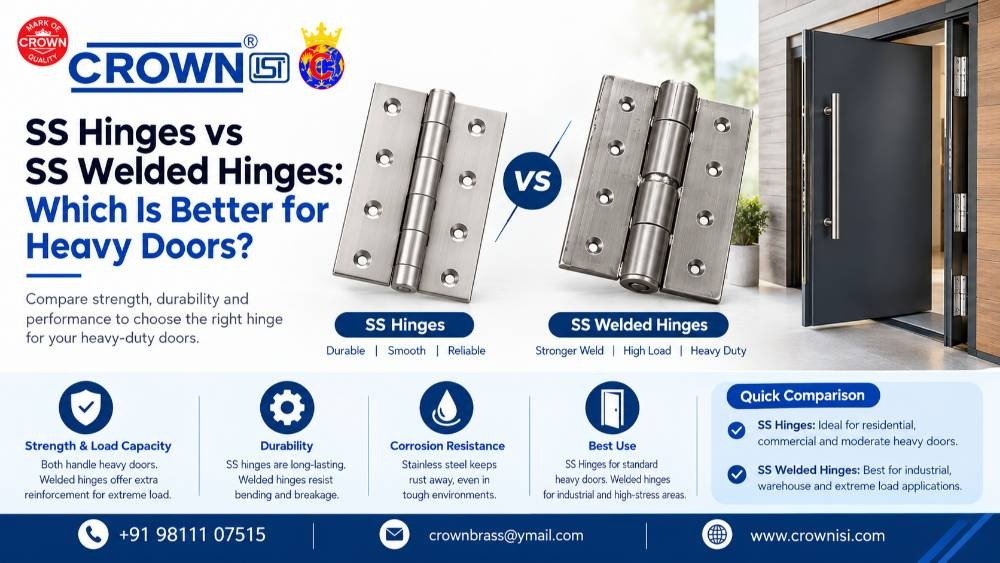
3. Stainless Steel Welded Hinges
Stainless steel welded hinges have the hinge pin welded into one leaf. It cannot be removed. This makes them more durable and tamper-resistant than standard hinges.
Best for: Heavy gates, main doors, security doors, industrial use.
Key Features:
- Cannot be forced open by removing the pin
- Stays tight for many years
- Supports heavier doors
- No gaps, no loosening
Expert Tip: For main doors, always choose welded hinges.
4. Standard Weight vs Heavy-Duty Hinges
Standard weight 5-knuckle hinges are one of the most popular types of hinges and can be used for commercial or residential applications. They are recommended for low-frequency doors.
For high-traffic areas and heavy doors, choose heavy-duty hinges. These are designed to support heavier doors and withstand frequent use. They require less maintenance due to reduced friction and increased durability.
Residential vs Commercial: What's the Difference?
The hinge needs of a residential door are very different from those of a commercial door. Here is what you need to know.
Residential Doors
Residential doors are typically lighter and used less frequently than commercial doors. However, they still require quality hinges that will last for years.
Common Residential Applications:
- Bedroom doors
- Bathroom doors
- Kitchen cabinets
- Main entrance doors
- Interior wooden doors
Recommended Hinges for Residential:
- SS Butt Hinges – For most interior wooden doors, 3x3 inch or 4x4 inch SS butt hinges are sufficient.
- Ball Bearing Hinges – For heavy main doors or doors that are used frequently.
- SS 304 Stainless Steel Butt Hinges – For humid areas like bathrooms and kitchens.
Typical Specifications:
- Thickness: 2.0mm to 2.5mm for main wooden doors
- Size: 4 inch or 5 inch for standard residential doors
- Material: SS 304 for corrosion resistance
Commercial Doors
Commercial doors face heavier use and more frequent opening and closing. They need hinges that can withstand constant wear and tear.
Common Commercial Applications:
- Office doors
- Shopfitting
- Hotel doors
- Factory and warehouse doors
- High-traffic entry doors
Recommended Hinges for Commercial:
- Ball Bearing Hinges – Ideal for high-traffic areas and heavy doors
- Heavy-Duty Hinges – Designed to support heavier doors and withstand frequent use
- Stainless Steel Welded Hinges – For security doors and industrial applications
- 4.5 inch or larger hinges – For taller or heavier doors (e.g., 90+ inches)
Typical Specifications:
- Thickness: 3mm or more for heavy commercial doors
- Size: 4.5 inch, 5 inch, or 6 inch for commercial doors
- Material: SS 304 or SS 316 for superior corrosion resistance
- Finish: Satin or polished for professional appearance
Expert Tip: Heavy-duty stainless steel hinges with built-in ball bearings are ideal for any commercial or intensive use door.
Stainless Steel Grades: 304 vs 202 vs 316
Not all stainless steel is the same. Understanding the grades will help you choose the right hinge for your environment.
SS 202
This is the entry-level grade. It contains less nickel and chromium than higher grades. It is cheaper, but it is also less corrosion-resistant. Over time, especially in humid conditions, SS 202 hinges may start to show signs of rust.
Best for: Dry, indoor applications where corrosion is not a concern.
SS 304 (The Gold Standard)
SS 304 is the most trusted grade for door fittings. It contains 18% chromium and 8% nickel.
Advantages:
- Excellent corrosion resistance
- High load-bearing capacity
- Does not rust even in humid or coastal areas
- Handles heavy door weight without bending
- Keeps its polish for years
Best for: Residential and commercial doors, humid environments, coastal areas, and general use.
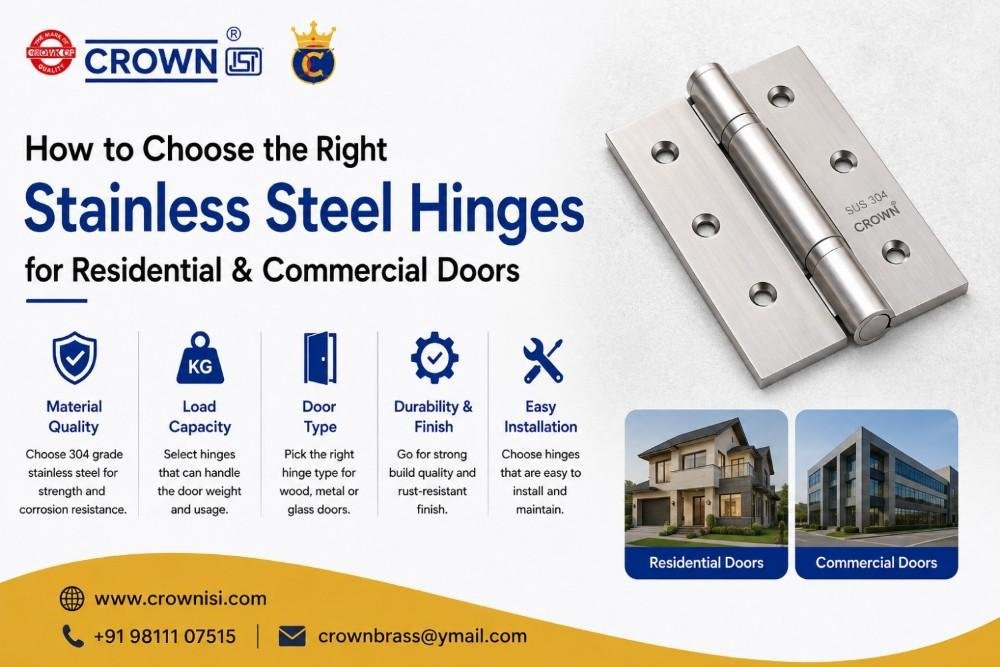
How to Identify: A genuine SS 304 stainless steel butt hinge will have "SS 304" or "AISI 304" stamped on it. If it is not there, assume it is a lower grade.
SS 316 (Marine Grade)
SS 316 contains molybdenum, which makes it highly resistant to saltwater and ideal for medical, marine, and food processing applications. It offers superior corrosion resistance compared to SS 304.
Best for: Coastal areas, marine environments, and harsh conditions.
Trade-off: SS 316 is more expensive than SS 304 due to the molybdenum content. For most residential and commercial applications in India, SS 304 is more than sufficient.
Expert Recommendation: At Crown ISI , we recommend SS 304 for the best balance of quality and value. Our SS 304 stainless steel butt hinges are made from virgin SS 304 raw material—no recycled scrap, no mixing of grades.
For a detailed comparison of stainless steel grades, read our guide: SS 304 vs Stainless Steel Hinges – Crown ISI Guide .
How to Choose the Right Stainless Steel Hinge
Choosing the right hinge involves several factors. Here is a step-by-step guide.
Step 1: Determine the Door Weight
The weight of your door is the most important factor in choosing a hinge.
| Door Type | Approximate Weight | Recommended Hinge |
|---|---|---|
| Light Interior Door | Up to 30 kg | 3-inch SS Butt Hinge |
| Standard Wooden Door | 30–60 kg | 4-inch SS Butt Hinge (2.0–2.5 mm Thickness) |
| Heavy Wooden Door | 60–120 kg | 5-inch or 6-inch SS Butt Hinge (3 mm Thickness) |
| Main Gate / Industrial Door | 120+ kg | Stainless Steel Welded Hinge |
A good SS butt hinge with 3mm thickness can support doors up to 120kg.
Step 2: Consider the Environment
Where is your door located?
| Environment | Recommended Grade |
|---|---|
| Dry, Indoor | SS 202 (Budget) or SS 304 (Preferred) |
| Humid (Bathroom, Kitchen) | SS 304 |
| Coastal Area | SS 304 or SS 316 |
| Outdoor / Exterior | SS 304 |
| Marine / Saltwater | SS 316 |
Step 3: Choose the Right Size
Hinge size is measured in inches or millimeters. The size you need depends on the weight and thickness of your door.
| Door Thickness | Recommended Hinge Size |
|---|---|
| Up to 1-3/8 inch | 3.5-inch Hinges |
| Up to 1-3/4 inch | 4-inch Hinges |
| Heavier or Taller Doors (90+ inches) | 4.5-inch Hinges |
For a detailed guide on choosing the right hinge size, visit HardwareSource – Butt Hinge Sizing Guide .
Step 4: Determine the Number of Hinges
How many hinges do you need? This depends on the height and weight of your door.
| Door Height | Recommended Number of Hinges |
|---|---|
| Up to 7 feet | 2–3 Hinges |
| 7 to 8 feet | 3 Hinges |
| Over 8 feet | 4 Hinges |
For a standard 7 feet by 3 feet bedroom door, use three 4-inch SS butt hinges. Two hinges will cause sagging after a few months.
Step 5: Decide Between Welded and Non-Welded
| Door Type | Recommended Hinge Type |
|---|---|
| Standard Interior Door | Non-Welded SS Butt Hinge |
| Main Entrance Door | Welded SS Butt Hinge |
| Security Door | Welded SS Butt Hinge |
| Heavy Gate | Stainless Steel Welded Hinge |
Step 6: Check the Finish
Stainless steel hinges come in different finishes.
| Finish | Appearance | Best For |
|---|---|---|
| Satin | Brushed, Non-Reflective, Hides Fingerprints | Most Residential and Commercial Applications |
| Mirror | Highly Polished, Reflective | Luxury Homes and Commercial Spaces |
| Matt | Flat, Non-Reflective | Modern, Minimalist Interiors |
Choose a finish that matches your other door hardware like handles, locks, and tower bolts.
Step 7: Look for Quality Indicators
Before buying, check these quality indicators:
- Grade Mark – Look for "SS 304" or "304G" engraved on the hinge.
- Thickness – Measure the thickness. Thicker = stronger.
- Pin Material – The pin should be of the same SS 304 material. Cheap hinges use iron pins that rust.
- Welding Finish – Good welded hinges have smooth, continuous weld lines. No gaps. No black spots.
- Movement – Open and close the hinge. A quality hinge moves silently and smoothly.
- Weight – Hold two hinges of the same size. The heavier one usually has more metal and more strength.
For more information on hinge types and applications, visit Grainger – Butt Hinge Types and Applications .
Quality Control at Crown ISI
At Crown ISI , quality is not just a word—it is a process.
Every SS 304 stainless steel butt hinge from Crown ISI passes rigorous quality checks:
- Raw Material Inspection – Procuring raw material directly from manufacturers
- Assembly Inspection – Checking all components
- Visual Inspection – Ensuring perfect finish
- Coating Inspection – Verifying surface quality
- Final Inspection – Complete product testing
Our stainless steel welded hinges are 100% machine welded for consistency. Every hinge is polished by hand and pin-tested.
We use only virgin SS 304 raw material—no recycled scrap, no mixing of grades. Every hinge is made from genuine 304G grade stainless steel.
Learn more about our Quality Control process.
Common Mistakes to Avoid
When buying stainless steel hinges, avoid these common mistakes:
1. Buying by look only – A shiny hinge can still be low quality. Always check the grade mark and quality indicators.
2. Choosing the cheapest option – A cheap hinge might save you ₹50 today, but it will cost you a door replacement tomorrow.
3. Ignoring the pin material – Cheap hinges use iron pins with a steel coating. Those will rust within months.
4. Using the wrong size – Too small, and the hinge will bend. Too large, and it will not fit properly.
5. Not using enough hinges – Two hinges on a heavy door will cause sagging. Use three or four hinges for heavy doors.
6. Forgetting about the environment – Using SS 202 in a coastal area will lead to rust. Always match the grade to the environment.
Other Door Fittings You May Need
A door is not complete with just hinges. You also need locks, bolts, and other fittings to ensure security and smooth operation.
At Crown ISI , we offer a complete range of stainless steel door accessories including:
- SS door handles
- Cylinder door locks
- Aldrops (sliding door bolts)
- Tower bolts
We also manufacture Crown ISI brass fittings . Brass does not rust, and ISI mark means quality.
Frequently Asked Questions (FAQs)
1. What is the difference between SS 202 and SS 304 stainless steel hinges?
SS 304 contains 18% chromium and 8% nickel, giving it excellent corrosion resistance. SS 202 has less nickel and chromium, making it cheaper but less durable. For long-lasting performance, always choose SS 304.
2. How do I know if a hinge is real SS 304?
A genuine SS 304 stainless steel butt hinge will have "SS 304" or "AISI 304" stamped on it. If it is not there, assume it is a lower grade.
3. What size of SS butt hinges should I buy?
For normal doors, use 4 inch or 5 inch hinges. For heavy doors, use 6 inch with 3mm thickness.
4. How many hinges do I need for a wooden door?
For a standard 7 feet by 3 feet bedroom door, use three 4-inch SS butt hinges. For heavier or taller doors (90+ inches), use four hinges or larger sizes.
5. What is the difference between butt hinges and welded hinges?
Butt hinges have two leaves joined by a pin. Welded hinges have the pin welded into one leaf, making them more durable and tamper-resistant.
6. Are ball bearing hinges better than standard hinges?
Ball bearing hinges reduce friction and allow smoother operation, especially for heavy doors. They are ideal for high-traffic areas and heavy doors.
7. Can I use stainless steel hinges on a wooden door?
Yes. Stainless steel hinges work perfectly on wooden doors. They are strong enough to support heavy wooden doors and will not rust over time.
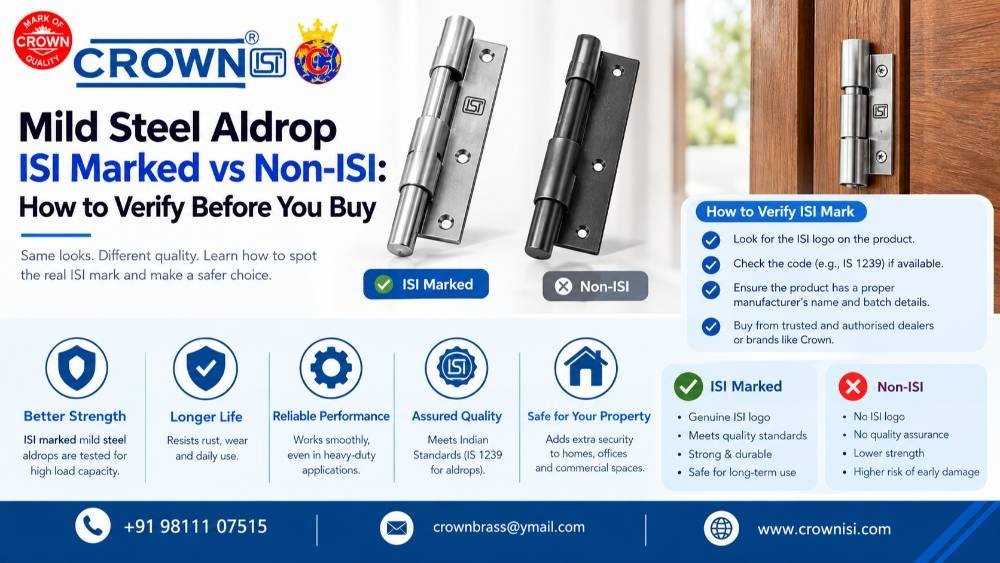
8. What is the ISI mark, and why is it important?
The ISI mark is a certification from the Bureau of Indian Standards that ensures the product meets Indian quality and safety standards. ISI mark guarantees you are getting a quality product.
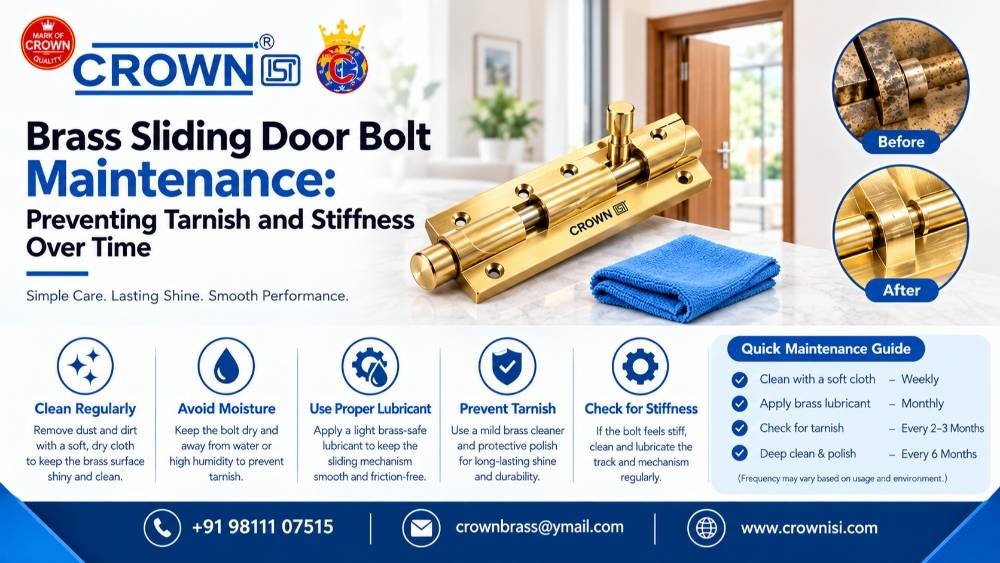
9. How do I maintain stainless steel hinges?
Wipe them with a damp cloth regularly. For deeper cleaning, use a mixture of vinegar and water. Lubricate the hinge pin with silicone spray or graphite powder every few months.
10. Why should I choose Crown ISI stainless steel hinges?
Crown ISI has been manufacturing high-quality door fittings for years. Our hinges are made from virgin SS 304 raw material, pass rigorous quality checks, and are trusted by homeowners and businesses across India.
Final Thoughts
Choosing the right stainless steel hinges for your residential or commercial doors is not complicated, but it does require some thought. Pay attention to:
- The grade – SS 304 is your best bet for most applications
- The thickness – 3mm for heavy doors, 2.0-2.5mm for standard doors
- The size – 4 inch or 5 inch for most doors
- The type – Welded for security doors, ball bearing for high-traffic areas
- The environment – Match the grade to your location
Remember, a good hinge is an investment. It will keep your door swinging smoothly for decades. A poor hinge will sag, squeak, and eventually fail—forcing you to replace it and potentially damaging your door in the process.
If you are looking for SS butt hinges , Crown ISI stainless steel butt hinges , or stainless steel welded hinges , look no further than Crown ISI. With years of experience, a commitment to quality, and a nationwide presence, Crown ISI is the name you can trust.
Visit our products page to explore our full range of stainless steel butt hinges, welded hinges, and door accessories. For our complete range of door fittings, check out our stainless steel door accessories page.
Contact us today for more information or to place your order.
Contact Information
Crown Industries
Factory: 39/2/9A, Site IV, Industrial Area, Sahibabad, Distt. Ghaziabad (U.P.)
Office: 500
Kuchha Pati Ram, Bazar Sita Ram, Delhi 110006
Phone: +91 98111 07515