 06 Nov, 2025
 Every door, cabinet or lid relies on hinges to swing smoothly and safely. A hinge is a mechanical bearing that connects two solid objects, typically allowing only a limited angle of rotation between them. In other words, hinges are the hidden hardware that let doors open and close. At Crownisi, we know that choosing the right hinge can make a big difference in function and style. Factors like where the hinge will be used, how heavy or frequently the door swings, and the hinges finish all matter. For example, exterior entry doors need durable hinges that resist weather, while a kitchen cabinet door might use a discrete hidden hinge.
Consider these key factors when selecting a hinge:
- Application: What will the hinge support? (e.g. a heavy entry door, a cabinet door, a storage box lid, etc.)
- Weight & Size: Larger, heavier doors need stronger hinges (often with ball bearings) to prevent sagging.
- Usage: How often and how hard will the door swing? High-traffic doors (like front doors or garage doors) need heavy-duty hinges.
- Mounting Style: Will the hinge be mortised (set into a cutout) or surface-mounted? Also consider if the door is inset or overlays the frame.
- Material & Finish: Outdoor gates may require stainless-steel or galvanized hinges for rust resistance, while interior furniture might use brass or bronze for aesthetics.
Experts recommend weighing all these factors to pick the right hinge for your project. With that in mind, here are 11 hinge types to know, how they work, and where they shine:
1. Butt (Mortise) Hinges
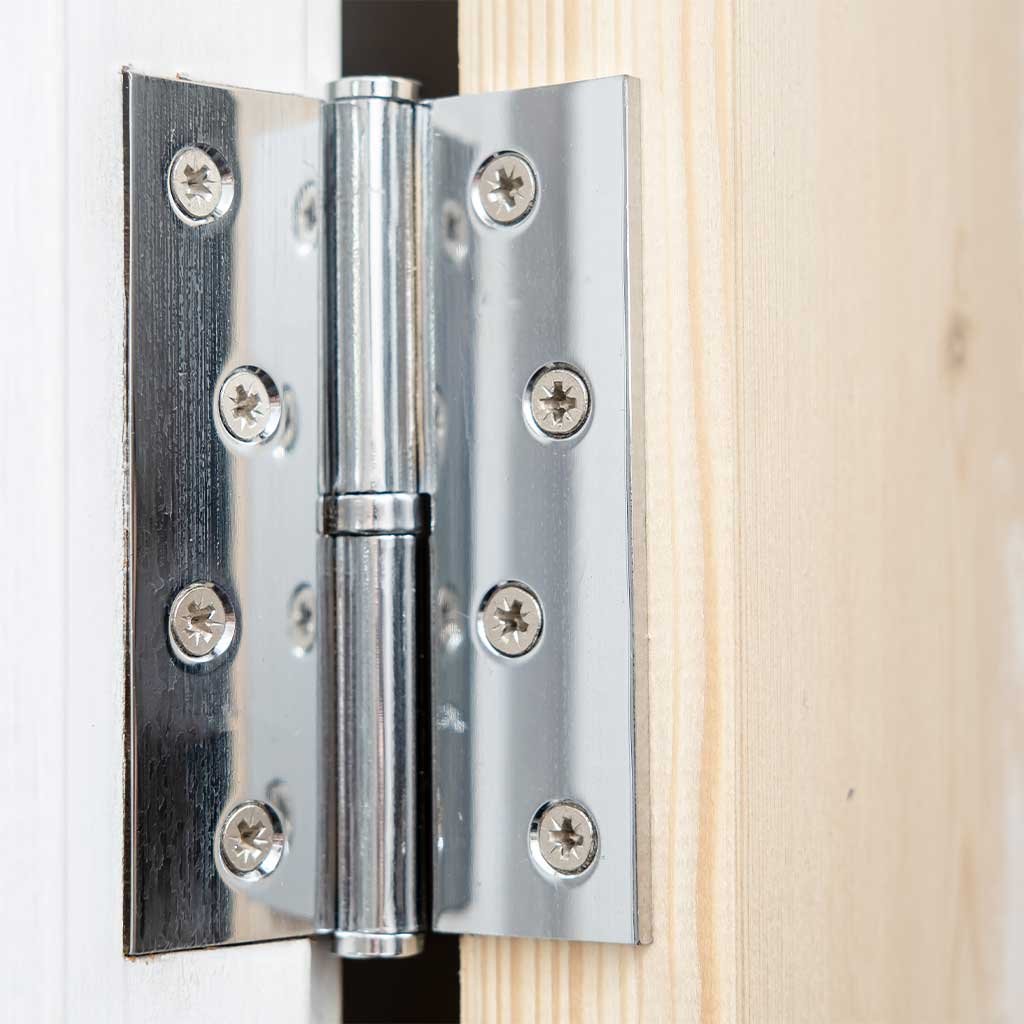
The classic butt hinge (also called a mortise hinge) is the most common door hinge. It has two flat leaves that are mortised into the door and frame so they sit flush. A pin runs through their knuckles (the barrel), allowing the door to pivot. Plain butt hinges are simple and inexpensive, making them ideal for lightweight interior doors. Crownisi’s range of butt hinges includes plain and reinforced models. Mortise hinges are ubiquitous – you’ll find them on entrance doors, bedroom doors, cabinet doors, and many utility flaps throughout a home. Because they sit in recesses, they offer a neat look and sturdy support. (Crownisi stocks durable steel butt hinges for both indoor and outdoor use.)
2. Ball-Bearing Hinges
Ball-bearing butt hinges are a beefed-up version of the standard butt hinge. Tiny ball bearings sit between the hinge’s knuckles to reduce metal-on-metal friction. This makes them ideal for heavy or high-traffic doors, such as front entryways or commercial doors. The bearings help the hinge swing smoothly and last longer under frequent use. For example, a solid-core front door will swing more quietly and endure years of use if supported by ball-bearing hinges. Crownisi carries heavy-duty ball-bearing hinges made of stainless steel, so your doors operate smoothly and resist sagging even in busy households.
3. Spring-Loaded (Self-Closing) Hinges
Spring-loaded hinges, often called self-closing hinges, contain an internal spring that automatically pulls a door closed. This is handy for screen doors, gates, or rooms you want to keep closed behind you. For instance, a screen door can latch itself shut by using a spring hinge. The spring can usually be adjusted so the door closes gently or quickly as needed. (On Crownisi’s site you’ll find spring hinges for screen and storm doors, which save you the extra step of pulling the door shut every time.) In practice, a spring hinge works like this: you open the door, and when you let go, the spring in the hinge forces it back to closed. This feature is also useful in commercial settings (think kitchen service doors that swing shut on their own). As one guide explains, these “self-closing” hinges have a spring inside that automatically shuts the door, keeping spaces secure and hands-free.
4. Rising Butt Hinges
Rising butt hinges are a specialized type that lifts the door slightly as it opens. You’ll often use these when there’s thick carpet or a high threshold that a normal door would scrape. When closed, a rising hinge looks like a standard butt hinge. But as you open the door, the hinge’s mechanism raises the door by about ½ inch. This ensures the bottom of the door clears the floor covering. For example, if you installed new thick carpet in a room, a rising hinge would let the door swing smoothly instead of catching on the pile. Crownisi offers rising hinges in brass and steel finishes for precisely this scenario: doors in bedrooms or offices with heavy rugs. In short, use a rising butt hinge whenever your door needs just a bit of lift to avoid dragging.
5. Barrel Hinges
A barrel hinge (sometimes called a concealed barrel hinge) is a small cylindrical hinge ideal for light, hidden projects. It consists of a hollow barrel (knuckle) and a pivot pin. To install, you drill matching holes into the two mating surfaces and insert each half of the barrel, joining them with the pin. Barrel hinges are often made of brass and are flush with the surface, making them virtually invisible when installed. They’re perfect for jewelry boxes, keepsake chests, or small cabinets where you want an invisible hinge. Because barrel hinges are tiny, they are not meant for heavy doors; they’re best for lids or panels on lightweight enclosures. For example, a Cedar box or secret compartment might use a pair of brass barrel hinges so that nothing shows on the outside. Crownisi offers brass and stainless barrel hinges precisely for these finishing touches, so that the hinge itself stays hidden from view.
6. Concealed (Cup) Hinges
Concealed hinges, also called cup hinges or Euro hinges, are common on modern kitchen cabinets and furniture. When the door is closed, you see nothing of the hinge – it’s completely hidden inside the cabinet. A concealed hinge has two parts: a “cup” that sits in a round recess in the door, and an arm that attaches to the cabinet frame. These hinges are often adjustable (you can fine-tune the door’s position with screws) and many feature self-closing or soft-close mechanisms. Because they are invisible when shut, concealed hinges give a clean, uninterrupted look to the cabinet’s exterior. Crownisi offers a line of high-quality cup hinges that are easy to install on frameless or inset cabinets. In practical use, concealed hinges won’t show on the outside of the cabinet at all, yet they reliably swing and hold doors tight (many models even allow you to adjust the gap or soft-close the door).
7. Knife (Pivot) Hinges
Knife hinges (a type of pivot hinge) look like flat blades and are attached on the edge of a door. One leaf is mortised into the end of the door and the other into the frame, with a pin at the pivot. When the door is closed, only the slim pivot pin is visible, giving a streamlined profile. Knife hinges are common in cabinets, doors that pivot in place, or applications where only the pivot point should be exposed.
Another related hinge is the double-acting pivot hinge (often used on swing doors in restaurants). These pivot hinges are mounted at the top and bottom of a door so it can swing open in both directions (in and out). For example, a kitchen saloon door uses a pivot hinge to swing freely both ways. Such double-swing hinges are larger and sturdier. In contrast, the standard knife hinge on a cabinet only swings one way and is much smaller. Crownisi supplies both types: knife hinges for furniture and more heavy-duty pivots for swinging doors.
8. Overlay Hinges
Overlay hinges are used on cabinets where the door “overlays” the cabinet frame. For instance, many frameless kitchen cabinets have doors that cover the edges of the cabinet box. An overlay hinge allows the door to lay over the frame (partially or fully). There are partial-overlay and full-overlay styles depending on how much of the door covers the cabinet. Some specialized overlay hinges are designed to fold back on themselves: this way the door sits flush against the cabinet face without adding thickness. This is commonly done with European cup hinges that have a long, folded mounting arm. In practical terms, if your cabinet doors sit on top of the cabinet box (rather than inside it), you’d use overlay hinges.
Overlay hinges come in many versions. For example, full-overlay hinges allow a door to almost entirely cover the cabinet frame, useful when the cabinet has no face frame. Crownisi’s selection includes high-quality Blum-style overlay hinges in various opening angles. These hinges hide most of their hardware under the cabinet door, yet provide a firm swing. In all cases, overlay hinges make the door look flush and even with the cabinet surface when closed.
9. Offset (Swing-Clear) Hinges
Offset hinges (also known as swing-clear hinges) are specialty hinges that let a door swing completely free of the opening. Unlike a standard hinge which swings within the door frame, an offset hinge pushes the door away from the frame as it opens. This can give you up to 2 extra inches of clear passage when the door is open. For example, if you’re trying to move furniture through a doorway that’s just a bit too narrow, an offset hinge can help the door swing wide out of the way.
These hinges are also often used for accessibility. Because they let a door swing entirely clear of the doorway, they provide more room for wheelchairs or walkers. In fact, swing-clear hinges are recommended in many ADA-compliant installations. Crownisi offers offset hinges that are ideal for widening openings and improving access. In short, if you need a door to swing farther out of the frame, an offset (swing-clear) hinge is the solution.
10. Piano (Continuous) Hinges
A piano hinge (or continuous hinge) runs the full length of the door, panel, or lid. It’s essentially a long metal strip with knuckles and a pin all the way along its length. The name comes from the fact that this type of hinge was originally used on piano lids. Because the hinge is continuous, it distributes weight and stress evenly, making it very strong and perfect for heavy or long doors.
Use piano hinges on things like long storage chest lids, drop-leaf tables, or any span where a row of smaller hinges wouldn’t be ideal. For example, a toy box or a bench might use a 30-inch piano hinge so that the lid is supported along its entire edge. Crownisi supplies continuous hinges in steel or brass, with or without pre-drilled holes. These hinges ensure stable, smooth motion along the entire door length – much more even than with several discrete hinges.
11. Strap Hinges
Strap hinges are recognized by their long, tapered leaves (or “straps”). Think of the old-fashioned gate or barn door hinge – it has a broad leaf that extends far onto the door. The extra length provides more support for heavy, wide doors. You’ll often see heavy-duty strap hinges on exterior gates, garage doors, or barn doors.
Inside the home, designers sometimes use smaller strap hinges on cabinets or furniture to achieve a rustic or decorative look. These hinges can have ornate shapes (like fleur-de-lis or heart designs) and are usually made of wrought iron or stamped steel. The long straps make the door look supported over a greater area. Crownisi offers strap hinges in forged iron and other finishes for both functional gates and style accents. Wherever you need extra strength and a classic look, strap hinges deliver longevity and charm.
People Also Like: The 7 Types of Exterior Door Hinges
Why Choose Crownisi for Hinges?
At Crownisi, we believe the right hardware transforms how your space looks and feels. Our hinges aren’t just metal parts — they’re the foundation of smooth movement, strength, and design harmony.
Here’s why customers trust Crownisi:
- Wide Range of Options: From modern concealed hinges to heavy-duty outdoor models, we offer a complete range to suit every application.
- Built for Durability: Every Crownisi hinge is crafted from premium materials like stainless steel, brass, or iron — engineered to perform and last for years.
- Stylish Finishes: Choose from elegant finishes such as chrome, antique brass, or matte black to complement your interiors perfectly.
- Expert Guidance: Unsure which hinge fits your project best? Our experienced team helps you select the right option for your specific needs.
- Fast & Reliable Delivery: We ensure quick and secure delivery of all hardware products across India, so your project stays on schedule.
At Crownisi, we’re not just selling hinges — we’re helping you build with confidence and elegance.
Conclusion
Choosing the right hinge is key to a professional and lasting installation. Hinges come in many styles and materials – stainless steel, brass, bronze, pewter, and more – with finishes like chrome, brushed nickel, or antique patinas to match your decor. At Crownisi, we carry all these hinge types so you can find the perfect fit for your project, from heavy-duty steel hinges for exterior gates to invisible cup hinges for sleek cabinetry.
Frequently Asked Questions
1. What is the best hinge for heavy doors?
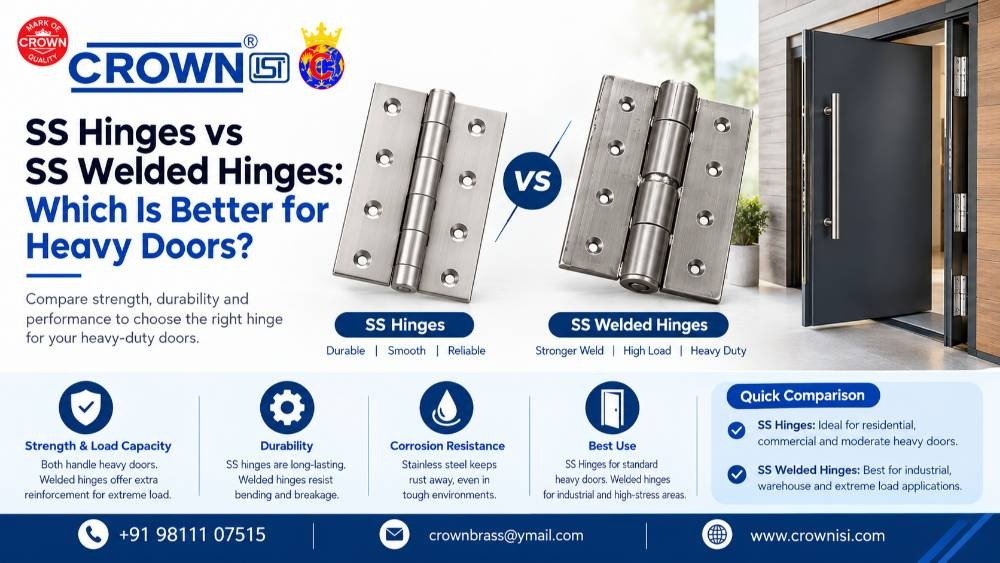
For heavy or frequently-used doors, ball-bearing butt hinges are generally the best choice. These hinges have steel ball bearings between their knuckles, which reduce friction and prevent squeaking. This makes them ideal for supporting the extra weight and frequent motion of heavy doors. In fact, ball-bearing hinges “provide the best support, smoothest action, [and] long-lasting performance” for medium and heavy doors. Using heavy-duty stainless-steel ball-bearing hinges can also help resist rust for exterior use.
2. How do I choose the right hinge?
Start by assessing your door’s dimensions and use. Measure the door’s thickness, height, and weight – thicker or heavier doors need sturdier hinges. Consider how often the door is used and in what environment. For example, a front entry door or commercial door needs robust, high-grade hinges (like Grade 1 ball-bearing hinges) to handle frequent use. Check each hinge’s weight rating: heavier doors typically require hinges with higher load ratings. Also consider materials: use stainless steel or brass hinges for outdoor or humid locations to prevent rust. Finally, match the hinge style to the door type (e.g. concealed hinges for a flush look vs. standard butt hinges for simplicity) and make sure the hinge size is proportional to the door (often hinge height ≈ 1/3 of door height is recommended).
3. What is the difference between concealed and overlay hinges?
Concealed hinges (also known as European hinges) are designed to be hidden when the door is closed. They are mounted inside the cabinet or door frame and do not show on the exterior, giving a clean, modern appearance. In contrast, overlay hinges refer to how much the door covers the cabinet frame. An overlay hinge allows the door to lay flat against the face of the cabinet, covering the edge of the cabinet opening. So a hinge can be both concealed and overlay if it sits inside the cabinet and the door covers the frame completely. In summary: concealed = hidden hardware; overlay = door covers (overlays) the cabinet/frame edge.
4. Are all hinges rust-resistant?
No, not all hinges resist rust. Stainless steel hinges are exceptionally corrosion-resistant and are often used outdoors or in moist environments. Brass hinges also offer natural corrosion resistance and an attractive finish. However, plain steel or carbon steel hinges can rust over time if not protected by a finish. If rust resistance is important (for exterior doors, bathroom cabinets, etc.), choose hinges made of stainless steel or brass, or make sure they have a durable anti-corrosion coating.
5. How many hinges does a door need?
It depends on the door’s height and weight. Typical interior doors (up to about 7 feet tall and moderate weight) usually use two or three hinges. Two hinges are sufficient for most lightweight interior doors, especially under 40–50 kg. For heavier or taller doors, add a third hinge. As a rule of thumb, a heavy or large door often needs three hinges, and very heavy or over-sized doors may require four or more. Using more hinges helps distribute the weight and prevents sagging. Always refer to door manufacturer or building codes for specific guidelines, but 3 hinges is common for solid exterior or heavier doors.
6. What hinge is best for cabinets?
For cabinets, the choice depends on the style and type of cabinet. Butt hinges (exposed on the outside of the cabinet) are simple and cost-effective, and they are often used on face-framed cabinets. These are visible when the door is closed. If you want a more seamless look, concealed (European) hinges are a great option – they mount inside the cabinet and are hidden when the door is closed. A common approach is: use traditional butt hinges if you don’t mind them showing and want a classic look; use concealed overlay hinges for frameless or modern cabinets to achieve a flush exterior. In either case, ensure the hinge size and weight rating match the cabinet door.