 01 Dec, 2025
 A professional installing a door hinge on a wooden frame. Door hinges are the unsung heroes of every entrance: they carry the weight of a door and enable smooth, squeak-free operation. In India’s diverse climate – from humid coasts to dry interiors – choosing the right type of door hinge is crucial. A poor choice can lead to squeaky, loose or corroded doors. In this guide, we’ll explore the top 10 door hinge types used in Indian homes and offices. We draw on expert insights and manufacturer guidelines to explain each hinge’s design and ideal use. By the end, you’ll understand which hinge fits your project and why.
For instance, hinges like the common butt hinge come mortised into the frame and are typically made of steel or brass. Indoor butt hinges are often simple steel, but outdoor doors (especially in monsoon-prone areas) should use stainless steel to resist corrosion. Smaller urban doors and cabinets might use concealed or pivot hinges for a clean look, while heavy gates rely on strap or ball-bearing hinges. Indian hardware makers such as Crownisi supply all these hinge types across the country.
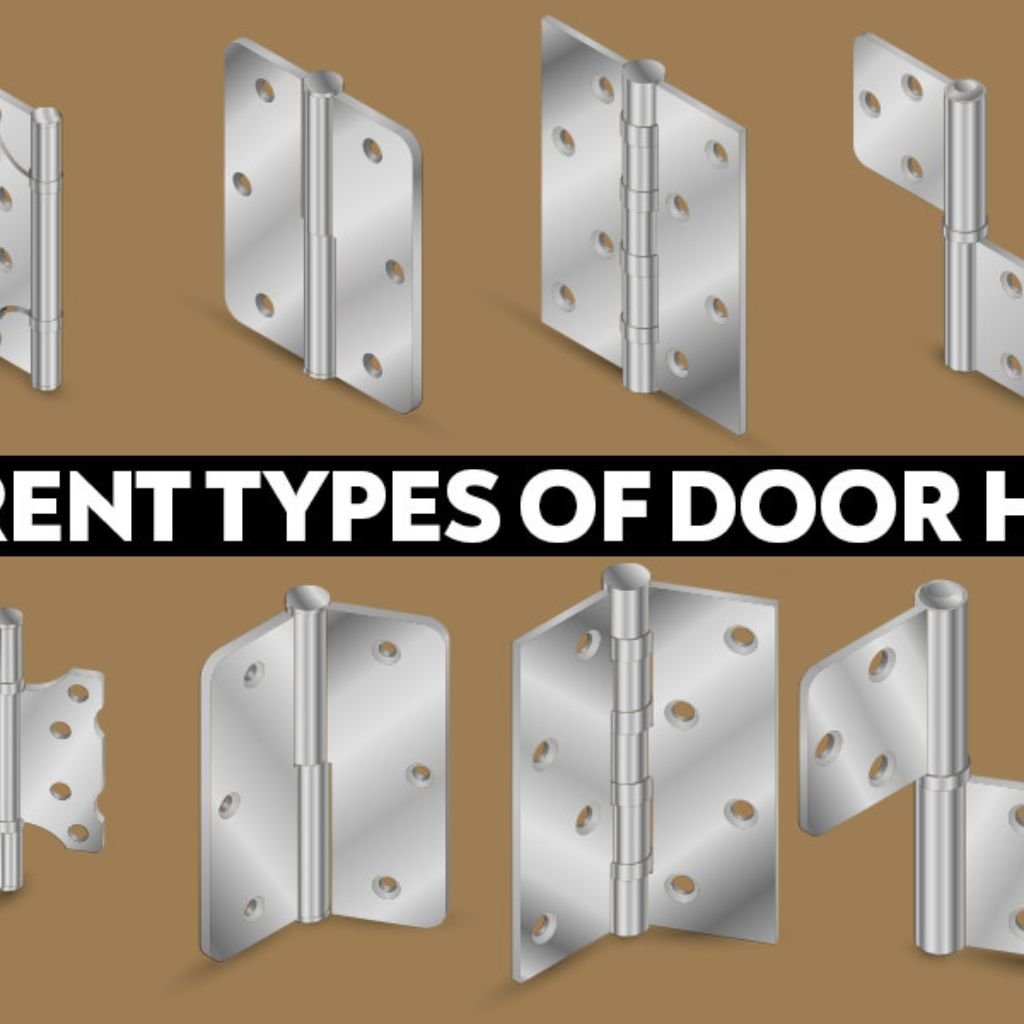
Here’s are top 10 types of door hinges and their uses:
1. Butt Hinges (Mortise Hinges)
Standard butt hinges are the most common door hinge type, mortised into the door and frame. Butt hinges, also called mortise hinges, are the most common hinges for doors and windows. They consist of two rectangular metal plates (the “leaves”) joined by a central pin. One leaf is screwed to the door, the other to the frame, with both leaves recessed into matching mortises. As McCoy Mart notes, butt hinges are usually 6 inches or less and can hold most commercial or residential doors. They distribute door weight evenly and work for inward- or outward-swinging doors. In India, butt hinges often come in brass or steel; builders use plain steel butt hinges indoors, and stainless-steel versions outdoors to avoid rust. Butt hinges can also accommodate ball bearings (see next section) for heavier doors.
Pros: Simple and strong, supports heavy doors, easy to install.
Uses: Interior doors, gates, cabinets (larger sizes), shutter windows
Considerations: Requires mortising; align carefully during installation. For very heavy doors, use butt hinges with ball-bearings for durability.

2. Ball-Bearing Hinges
A ball-bearing hinge is essentially a heavy-duty butt hinge with small steel balls placed between its knuckles. These internal bearings reduce friction and wear when a heavy door swings. In practice, ball-bearing hinges are ideal for large, high-traffic doors – for example, the main entry of an office building or a heavy front gate. The hidden balls between the hinge’s barrels carry much of the door weight, so the hinge turns smoothly and quietly even under load. As experts explain, this design “has lubricated bearings… to reduce friction” and “extends the life” of the hinge by preventing metal-on-metal wear. In India’s busy environments (shopping malls, schools, hospitals), ball-bearing hinges keep doors functioning quietly over years of use.
Pros: Supports heavy, wide doors; operates silently; lasts longer under frequent use.
Uses: High-traffic entry doors, heavy wooden or metal gates, security doors.
Key fact: The ball-bearing elements make these hinges among the most durable availabl. Look for stainless steel ball-bearing hinges (Crownisi and others sell these) to resist rust in humid regions.

3. Spring (Self-Closing) Hinges
Spring hinges contain one or more coil springs that automatically close (or hold open) a door. In other words, they are self-closing hinges. When the door is opened, the spring is tensioned and then returns the door to closed position when released. In India, spring hinges are common on toilet cubicles, apartment building service doors, and restaurant entrances – anywhere you want the door to shut itself. McCoyMart notes that spring hinges are strong and durable, used in everything from box lids to handheld gear. On doors, a calibrated spring hinge can pull shut a door reliably.
There are varieties like rising butt hinges (a type of spring hinge where the door lifts slightly on opening) that help ensure a tight closure in restroom doors. Spring hinges come in single-spring (pull the door closed once) or double-spring (hold the door open at a certain angle) versions.
Pros: Automatically closes doors, improving security and saving effort (no prop needed).
Uses: Restroom cubicles, kitchen doors, gates, garage doors.
Tip: Adjust spring tension correctly (too strong and the door slams; too weak and it won’t close fully). Crownisi and other manufacturers provide spring hinges rated for different door weights.

4. Concealed (Invisible/European) Hinges
Concealed hinges (also called invisible or European hinges) are hidden from view when the door is closed. They consist of two parts: one fixed into the door frame and one into the door edge, with an internal pivot or arm that allows the door to swing out of sight. These are especially popular in modern interiors, as they give a clean, uninterrupted look – all you see is the door surface, with no visible hardware. Concealed hinges can allow doors to swing a full 90 degrees (or more) and are often used on flush doors or glass doors.
An important security benefit: because the hinge mechanism is inside the door, it cannot be tampered with from the outside, which is an advantage for entry doors. (By contrast, exposed hinges can be removed by removing pins.) However, installing concealed hinges requires precise routing of the door and frame.
Pros: Sleek appearance; hidden mechanism; adds security.
Uses: Frameless glass doors, flush wooden doors, high-end cabinetry, entry doors where aesthetics matter.
Caution: Requires exact installation. Typically used in pairs and often paired with a door closer to control closing.
5. Security Hinges (Non-Removable Pin Hinges)
Security hinges are a special class designed to prevent forced entry. They look like standard butt hinges but have one-way (non-removable) pins or interlocking “security tabs” that prevent the hinge pin from being taken out if the door swings outward. In practice, on an outward-swinging door, even if an intruder removes the visible hinge pins, the door still cannot be lifted off the frame. In India, security hinges are often used on main entrance doors, safes, or exterior gates.
As noted by hardware experts, these hinges “make doors open outwards while preventing someone from taking down the hinges and breaking in”. The design may include riveted pins or built-in stops.
Pros: Enhances security for external doors; prevents door removal.
Uses: Outward-opening external doors, bank/vault doors, security gates.
Material: Typically heavy-duty steel or stainless steel. Even on interior doors, a security hinge adds tamper-resistance for valuables (e.g. a cash room).
6. Pivot Hinges
Pivot hinges are mounted at the top and bottom of a door, rather than on the side of the frame. One part of the hinge is fixed into the floor (or threshold) and another into the header above the door. This allows the door to pivot smoothly on a vertical axis. Pivot hinges are ideal when you don’t want visible hinge hardware – common for heavy or tall doors. Since the weight is transferred through the floor, pivot hinges can support very heavy doors (like large glass or metal doors in lobbies).
An interesting feature: many pivot hinges allow the door to swing both ways (in and out), similar to a saloon door. In India, pivot hinges are used on glass entrances, temple doors, or designer interiors. Because the hinge is out of view (top and bottom), it provides a clean look and a durable bearing.
Pros: Excellent for heavy, large doors; invisible from the edge; can allow double-swing.
Uses: Floor-mounted office doors, large glass doors, caravan doors, revolving slab doors.
Note: Pivot hinges require precise installation on floor and header, and the door may need a groove or pivot point cut.

7. Offset Hinges
Offset hinges are a special variety used when a standard butt hinge won’t do due to space constraints or code requirements. They hold the hinge pin several inches offset from the door jamb. In practice, this means when the door swings open 90°, the pivot point is set back a bit from the jamb. This effectively widens the opening by a couple of inches without changing the frame. For example, in narrow hallways or ADA-compliant entrances, offset hinges can make a tight door swing clear obstacles.
In India, offset hinges are often used in retrofits: if a frame is too narrow for new hardware or to improve clearance in old buildings. They come in various offsets (1/2″, 3/4″, etc). With an offset hinge, the door “swings away” from the frame, allowing easier passage through the opening.
Pros: Increases effective doorway width; useful for retrofits and wide-clearance needs.
Uses: Accessibility doorways, existing frame renovations, heavy exterior doors needing extra clearance.
Installation: Uses same screw holes as standard butt hinges, so it’s relatively easy to swap in an offset hinge without refitting the frame.

8. Continuous (Piano) Hinges
Continuous hinges, commonly called piano hinges, run the full length of a door (or lid) with a continuous pin. They look like a long strip of butt hinges side-by-side. This even support is what inspired their name (originally used on piano lids). Because a continuous hinge spans the entire door edge, it distributes weight uniformly and adds strength.
Continuous hinges are great for heavy wooden lids, attic doors, or long cabinet doors. In an Indian context, they’re used on heavy room partitions, stage doors, or any long panel that needs full-edge support. As one source notes, piano hinges have many leaves and a rod running through their length, making them very sturdy.
Pros: Very strong; supports the entire length of the door; reduces stress on any one point.
Uses: Long cabinet doors, large lids, secret panels, folding furniture.
Tip: Requires continuous mortise along the door and frame; make sure to lubricate long hinges occasionally to prevent binding.
9. Strap (Gate) Hinges
Strap hinges are heavy-duty hinges with long, narrow leaves (or “straps”) that extend across the door surface. You’ve probably seen them on garden gates, barn doors or antique furniture. The long leaf gives extra leverage and support, which is perfect for wide or heavy gates. In India, exterior gates (wooden or metal) often use strap hinges. They’re also found on large temple doors or big double-leaf doors where extra support is needed.
Strap hinges come in two flavors: half-straps (one leaf long, the other short) and full-straps (both leaves long). Material is usually wrought iron, mild steel, or stainless steel. As one guide explains, “the only distinguishing feature is its long and narrow shape”, which provides greater rigidity. Some strap hinges are decorative (for a rustic look), while others are plain and purely functional.
Pros: Excellent support for large gates/doors; attractive rustic appearance on wooden gates. Uses: Exterior gates, large wooden doors, shed, or even shutter windows.
Hint: Many strap hinges can be fitted with a pintle or pivot for wide-opening gates. Crownisi and other brands supply stainless strap hinges in lengths up to 12″ or more.

10. Double-Action (Saloon) Hinges
Double-action hinges allow a door to swing both ways (inward and outward) and automatically return to the closed position in both directions. You might call these “saloon door hinges,” since they were famously used on swinging café doors. They contain springs on both sides of the hinge pin. For example, restaurants and kitchens often use them on pass-through doors: staff can push the door open with either side of the body, and it swings back.
Double-action hinges add a classic, old-world character to doors. In modern India, they appear in homes or cafes designed with a colonial or vintage theme. Functionally, they are useful whenever a door needs to move freely both ways (e.g. between connected rooms). When released, the spring mechanism pulls the door to center.
Pros: Allows two-way swing; convenient in traffic areas; decorative.
Uses: Restaurants (kitchen pass-through), cafes, bar doors, rooms needing easy double-sided access.
Caution: Not suitable if you need the door to stay open or closed firmly (since they will always center). Install with proper adjustment so that the door stops centered without slamming.
People aslo like: Top 10 Door Hinges Brands in India 2025
Choosing the Right Hinge Type
The types of door hinges above cover virtually all common applications in India. When choosing, consider:
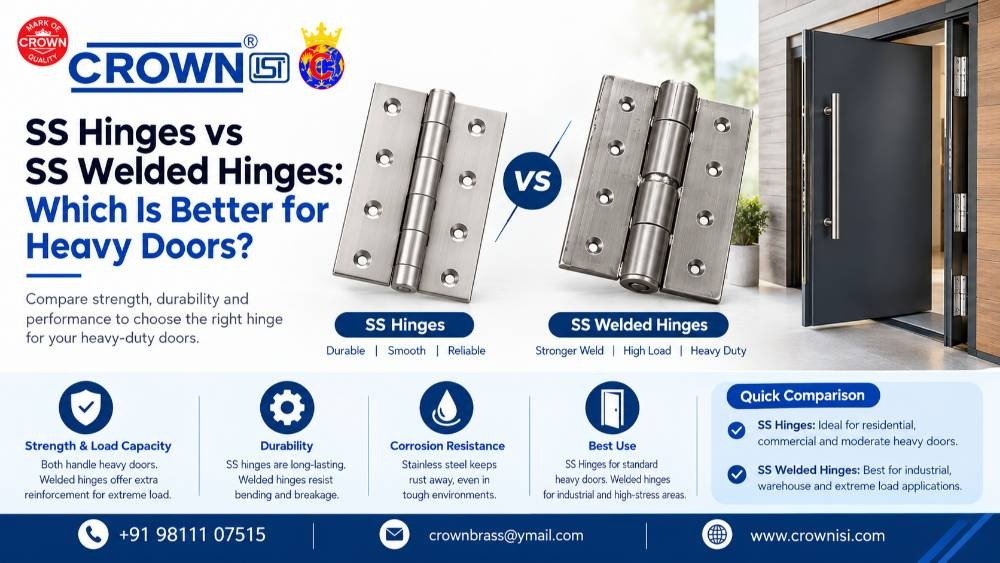
- Weight Usage: Heavy doors need ball-bearing or pivot hinges. Light interior doors can use simple butt or concealed hinges.
- Swing Direction: Outward-swinging doors often require security hinges. Doors needing a wide swing clearance may use offset hinges. Double action hinges are unique for two-way swing.
- Appearance: For hidden hardware, pick concealed or pivot hinges. For decorative appeal on wooden doors or gates, strap hinges add character.
- Material Durability: In humid or coastal regions, stainless-steel or brass hinges resist rust better. Most Indian manufacturers (including Crownisi) offer corrosion-resistant finishes. Always verify that hinges meet BIS standards (e.g. IS 12817 for stainless butt hinges) for quality and safety.
- Installation: Some hinges (butt, ball-bearing) are mortised and easy to fit, while others (pivot, continuous) require more carpentry work. Plan accordingly.
Example: A Pune apartment might use concealed hinges on bedroom doors for a sleek look, while a Mumbai shopfront would use heavy stainless ball-bearing hinges on its entrance for security and durability. Crownisi’s catalogs show all these types available pan-India, so contractors and homeowners nationwide can find the right hinge.
In summary, doors come in many styles and sizes, and there’s a matching hinge for each need. Selecting the correct door hinge type not only prevents issues like sagging or squeaking, it ensures safety and longevity. We hope this comprehensive overview – grounded in industry expertise and local practice – helps you pick the best hinge for any door in India.
Key Takeaways:
- Choose hinges based on door weight, usage frequency, and appearance.
- Heavy external doors often need ball-bearing or pivot hinges; lightweight interior doors can use butt or concealed hinges.
- For outswing doors in India, use security hinges to prevent easy removal.
- Strap hinges support large gates and add a rustic look, while continuous (piano) hinges support the full length of long doors.
- Brands like Crownisi offer all hinge types (stainless steel, brass, etc.) across India; look for quality certifications and corrosion-resistant materials in your choice.
By matching door and hinge appropriately – for example, heavy front door with ball-bearing hinges, or glass door with pivot hinges – you’ll ensure smooth operation and enhanced security. The types of hinges above cover every typical scenario, whether you’re renovating a Delhi bungalow, a Chennai office, or a rural farm gate. With the right hinge, your door will open quietly and last for years.
Why Choose Crownisi for Door Hinges?
When it comes to door hardware, quality and durability matter. Crownisi is one of India’s trusted hinge manufacturers, known for precision engineering, premium materials, and products designed specifically for Indian conditions. Whether it’s a home renovation, commercial space, or industrial project, Crownisi ensures smoother operation, better stability, and long-lasting reliability for every door.
The Crownisi Advantage: Quality Hinges Built for India
- Premium-Grade Materials: Crownisi uses high-quality 304/316 stainless steel, solid brass, and heavy-duty steel to ensure long life and resistance to rust, corrosion, and daily wear.
- Weather-Resistant Finishes: Each hinge is built to perform in India’s diverse climate—humid coasts, dry interiors, or monsoon-prone regions—without losing strength or finish.
- Wide Range for All Door Types: From butt hinges and ball-bearing hinges to pivot, concealed, security, and strap hinges, Crownisi offers the full spectrum for residential, commercial, and industrial applications.
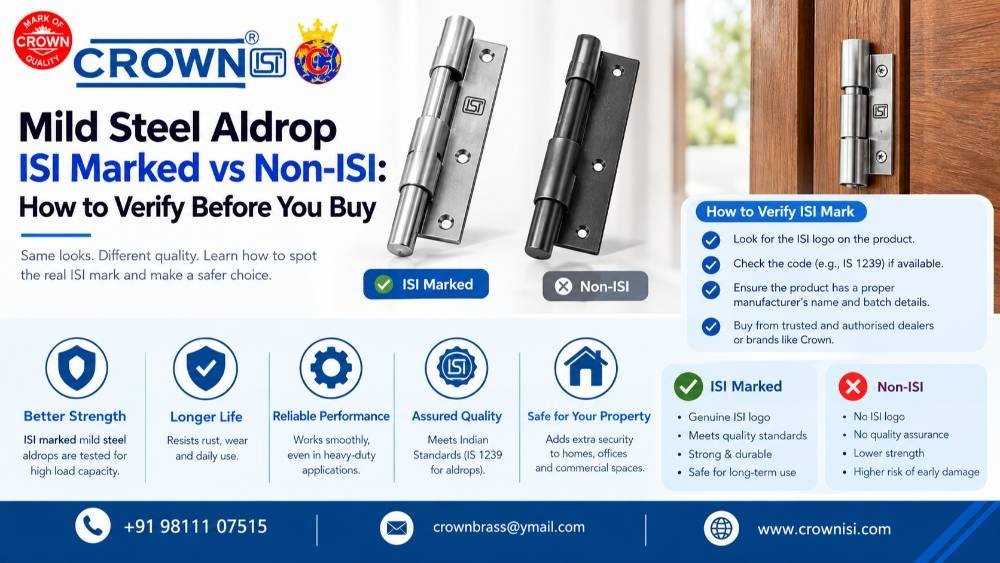
- BIS/ISI-Certified Quality: Crownisi follows BIS standards to ensure the hinges meet strict parameters for load-bearing, durability, and safety.
- Smooth, Noise-Free Movement: Every hinge is designed for friction-free, silent door movement, ensuring comfort and convenience in daily use.
- Custom Sizes with Pan-India Delivery: Multiple sizes, thicknesses, and finishes are available with fast delivery across India, making Crownisi accessible to homeowners, contractors, and retailers nationwide.
- Preferred by Industry Professionals: Architects, interior designers, and builders trust Crownisi for consistent quality, long-term performance, and reliable hardware solutions.
Conclusion
Choosing the right hinge type depends on the door’s weight, material, usage frequency, and aesthetic needs. For example, heavy stainless-steel butt hinges (with or without ball bearings) are ideal for main doors that see constant use, while decorative strap or T‑hinges suit rustic or lightweight gates. In India, it’s common to select BIS/ISI-certified hinges in durable materials (like 304/316 stainless steel) to withstand the tropical climate and ensure long life. Leading manufacturers like Crownisi offer a full range of these hinge types, supplying high-quality stainless and brass hinges tailored for Indian buildings. By understanding these 10 hinge types and their uses, you can ensure every door in your home or project swings smoothly, lasts longer, and suits its purpose perfectly.
FAQs: Top 10 Types of Door Hinges and Their Uses
1. Which hinge is best for main doors in India?
For heavy or frequently used main doors, ball-bearing hinges or stainless-steel butt hinges are recommended due to their strength and smooth operation.
2. What hinge should I use for bathroom or kitchen doors?
Spring hinges or stainless-steel butt hinges are ideal since they resist moisture and prevent rust in humid areas.
3. Which hinge is best for glass or modern designer doors?
Pivot hinges or concealed hinges work best for glass, flush, or premium designer doors because of their minimal and clean appearance.
4. How many hinges should a standard door have?
Most wooden doors require 2–3 hinges. Heavy, tall, or wide doors may need 3–4 hinges for proper support.
5. Are concealed hinges stronger than butt hinges?
Both offer strength, but concealed hinges add a clean appearance and extra tamper-resistance, while butt hinges are easier to install and cost-effective.
6. Which hinge prevents forced entry on outward-opening doors?
Security hinges with non-removable pins or interlocking tabs help prevent intruders from lifting the door off its hinges.
7. What hinge allows a door to swing both ways?
Double-action hinges, also known as saloon hinges, allow the door to swing inward and outward easily.
8. Are stainless-steel hinges necessary in coastal areas?
Yes. Coastal humidity accelerates rusting, so 304/316 stainless-steel hinges are essential for long-term durability.
9. Which hinge is best for heavy gates?
Strap hinges or heavy-duty ball-bearing hinges provide superior support for large wooden or metal gates.
10. Why should I choose Crownisi hinges?
Crownisi offers high-quality materials, corrosion-resistant finishes, BIS-certified construction, a wide product range, and pan-India availability—making it a dependable choice for any project.