 13 Mar, 2026
 Let me ask you something.
When was the last time you thought about your door hinges?
Probably never. And that is exactly the problem.
Hinges are the most ignored part of any home. They sit there, holding up heavy doors, swinging open and closed thousands of times, dealing with humidity, dust, and sometimes even rust. And what thanks do they get? None. Until they start squeaking. Or worse, until the door starts sagging and scraping the floor.
Then suddenly, you notice them.
I have been in the hardware business long enough to tell you this: a good hinge is worth its weight in gold. A bad one will ruin your door, your floor, and your peace of mind.
That is why, if you are building or renovating in 2026, you need to understand Stainless Steel Hinges. Not the cheap ones. The right ones.
At Crown ISI, we make hinges that actually last in Indian homes. Hot summers, wet monsoons, salty coastal air—our hardware handles it all. Let me walk you through everything you need to know, without the technical headache.
Why Stainless Steel?
First things first. Why stainless steel? Why not brass, or mild steel, or those cheap imported ones?
Simple answer: Rust.
Mild steel hinges look fine in the shop. They are painted or coated. But the moment that coating scratches—and it will scratch—moisture gets in. Rust starts. It spreads under the paint, bubbles form, and within a year, the hinge is weak.
Brass is better than mild steel, but it is soft. It bends. It also tarnishes and needs polishing.
Stainless steel? It does not rust. It does not need paint. It is strong. The chromium in the steel forms a protective layer that heals itself if scratched. That is why Stainless Steel Hinges are the standard for anyone who wants to build once and build right.
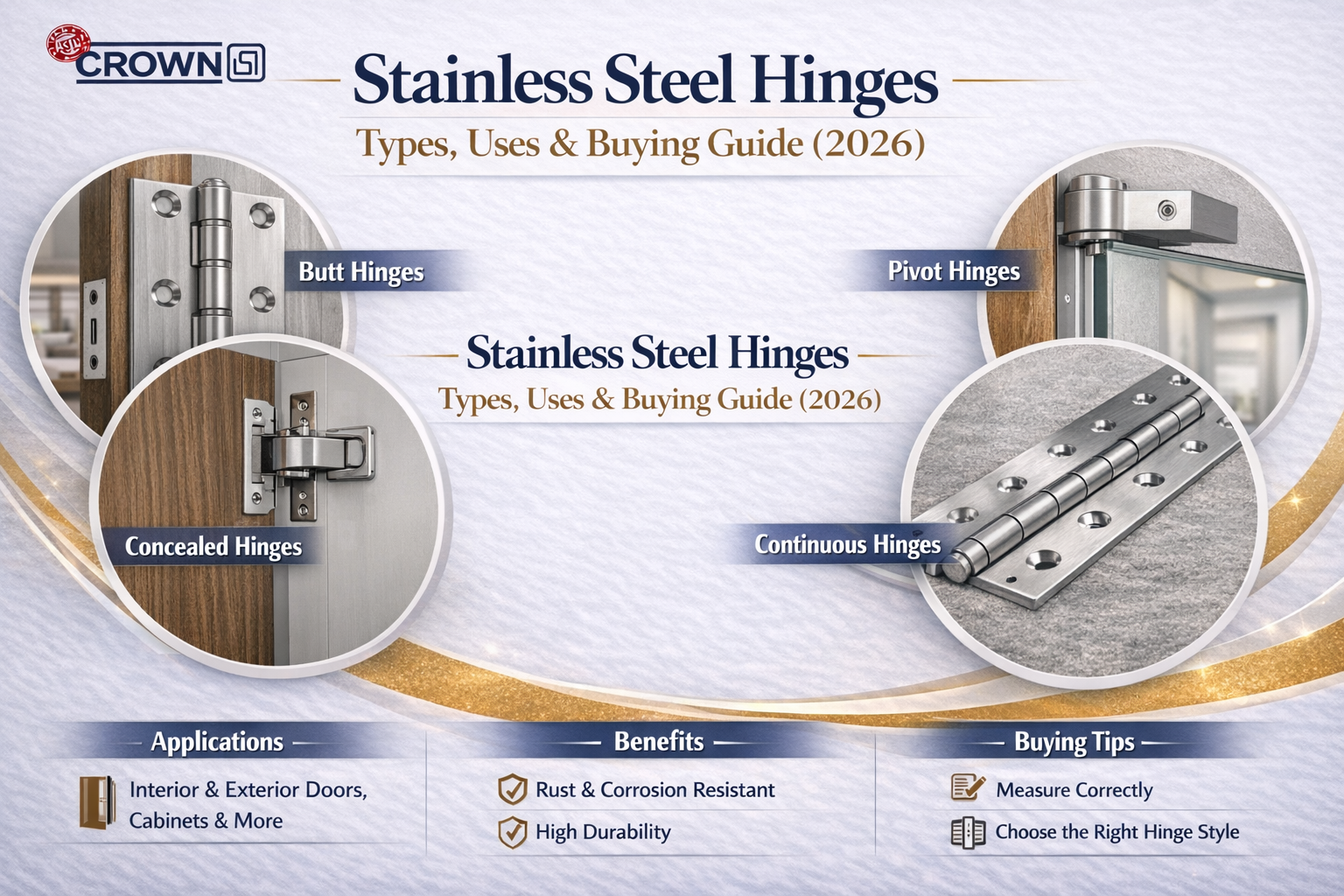
The Different Types of Stainless Steel Hinges
Not all hinges are the same. You cannot use a cabinet hinge on a main door. You cannot use a butt hinge on a gate. You need the right tool for the job.
Here is a breakdown of the common types you will come across.
|
Hinge Type |
Best For |
Why Choose It |
|
Butt Hinge |
Internal wooden doors, cupboards |
Classic design. Two leaves that screw into the door and frame. Simple and strong. |
|
Heavy Duty Butt Hinge |
Main doors, heavy wooden doors |
Thicker material, more knuckles. Handles extra weight without sagging. |
|
Stainless Steel Welded Hinges |
Metal gates, compound walls |
No screws. Welded directly to the gate and pillar. Impossible to break or remove. |
|
Piano Hinge (Continuous) |
Long lids, workbenches, foldable tables |
Runs the full length of the door. Distributes weight evenly. Very strong. |
|
Rising Butt Hinge |
Doors with carpets or rugs |
Lifts the door slightly as it opens. Clears thick carpets without scraping. |
|
Spring Hinge |
Self-closing doors, screen doors |
Has a spring inside that pulls the door shut automatically. |
Deep Dive: Butt Hinges vs. Welded Hinges
Since your keywords focus on these two, let me explain them properly.
Stainless Steel Butt Hinges
These are the ones you see on every wooden door in every house. Two flat plates (leaves) with a pin in the middle. One leaf screws into the door, the other into the frame.
They come in different sizes—3 inch, 4 inch, 5 inch, 6 inch. The size you need depends on the door weight. A light bathroom door is fine with 4 inch. A heavy teak main door needs 6 inch, and you use three of them, not two.
The good ones have removable pins. That means you can take the door off easily if you need to move furniture in or out. Cheap hinges have fixed pins. If you need to remove the door, you have to unscrew everything.
When you buy Stainless Steel Butt Hinges from Crown ISI, check the thickness. Literally pick them up. Feel the weight. A heavy hinge means thick steel. Thick steel means no sagging.
Stainless Steel Welded Hinges
Now, these are different beasts.
If you have a metal gate—the big one at your compound entrance, or a garden gate—screws are not enough. People try to screw hinges onto metal pipes, but it never holds well. The screws strip, the gate wobbles, and eventually, it falls.
Stainless Steel Welded Hinges solve that. They are designed to be welded directly onto the metal frame and the gate. No screws. No bolts. Just solid metal fused together.
Once welded, that hinge is not going anywhere. It cannot be unscrewed. It cannot be pried off. It is permanent.
These hinges have a heavy-duty pin and thick leaves. They take the weight of big gates easily. They also resist rust, which is crucial for outdoor use. Rain, sun, dust—they handle it all.
If you are putting up a boundary wall or a farmhouse gate, do not use regular hinges. Get Stainless Steel Welded Hinges. Fit them once. Forget them forever.
How to Choose the Right Hinge: A Simple Guide
Buying hinges can be overwhelming. Here is a step-by-step way to make it simple.
Step 1: Identify the Door Type
- Wooden door? Go with Butt Hinges.
- Metal gate? Go with Welded Hinges.
- Cabinet with a long flap? Go with Piano Hinge.
- Door that needs to close automatically? Go with Spring Hinge.
Step 2: Measure the Door Weight
Heavier doors need bigger hinges. As a rule:
- Light doors (less than 15 kg): 3 inch hinges.
- Standard internal doors (15-25 kg): 4 or 5 inch hinges.
- Heavy main doors (25-40 kg): 6 inch heavy duty hinges.
Step 3: Count the Hinges
Always use three hinges for a standard door. Two hinges might hold it at first, but over time, the weight distribution is uneven. Three hinges share the load. The door stays straight.
Step 4: Check the Material
Make sure it says 304 grade stainless steel. That is the good stuff. 202 grade or 201 grade is cheaper but less rust-resistant. For coastal areas, 304 is a must.
Step 5: Look at the Pin
A removable pin is better. It lets you take the door off easily for maintenance or moving furniture. Non-removable pins are cheaper but less convenient.
Why Crown ISI?
Look, I know there are cheaper options in the market. Imported hinges from China. Local ones made from recycled steel. They look similar in the store. The difference shows up after six months.
Crown ISI has been making hardware for Indian homes for a long time. We know our weather. We know our dust. We know our humidity. Our Stainless Steel Hinges are made from genuine 304 grade steel. The thickness is consistent. The pins are strong. The welding is clean.
When you buy from Crown ISI, you are not just buying a hinge. You are buying the guarantee that your doors will work smoothly for years. No rust. No sag. No squeak.
Installation Tips That Matter
Even the best hinge fails if installed badly.
For Butt Hinges:
- Mortise them: Cut a shallow recess so the hinge sits flush with the wood. Do not just screw it on the surface.
- Use the right screws: The screws that come with the hinge are the correct length. Do not substitute.
- Check alignment: Close the door slowly. The gap around the door should be even. Adjust by bending the hinge slightly or adding thin packing behind it.
For Welded Hinges:
- Hire a good welder: Welding stainless steel needs skill. A bad weld can weaken the hinge.
- Weld in multiple spots: Do not run a continuous weld along the whole leaf unless necessary. Tack weld in several places to distribute heat and prevent warping.
- Grind smooth: Grind the welds neatly and paint over them if needed. A clean weld looks professional and lasts longer.
Maintenance: Keep Them Moving
Stainless steel hinges are low maintenance, but they like a little attention.
- Wipe them clean: Dust and grime build up over time. A damp cloth every few months keeps them looking new.
- Tighten screws: Check once a year. A loose screw makes the door wobble and wears out the hinge.
- Lubricate the pin: If you hear a squeak, rub a pencil lead on the pin. Graphite is a dry lubricant. Do not use oil—it collects dust.
Final Thoughts
Hinges are small. Easy to overlook. But they carry the weight of every door in your house. If the hinges fail, the door fails. The lock misaligns. The handle scrapes. Everything goes wrong.
Do not gamble on cheap hardware. Spend a little extra. Buy good Stainless Steel Hinges from Crown ISI. Install them properly. And then forget about them for the next twenty years.
That is what quality feels like. You do not notice it. It just works.
Frequently Asked Questions
1. What are the different types of Stainless Steel Hinges?
The main types are Butt Hinges (for wooden doors), Welded Hinges (for metal gates), Piano Hinges (for long lids), Rising Butt Hinges (for carpets), and Spring Hinges (for self-closing doors). Each is designed for a specific job.
2. What is the difference between butt hinges and welded hinges?
Butt hinges have leaves that screw into wood. Welded hinges are designed to be welded onto metal surfaces. Butt hinges are for doors. Welded hinges are for gates.
3. Are Stainless Steel Welded Hinges strong enough for heavy gates?
Yes. They are specifically made for heavy gates. When welded properly, they are stronger than any screwed hinge. They cannot be pried off or loosened over time.
4. What size hinge do I need for my main door?
For a standard main door, use 5-inch or 6-inch heavy duty butt hinges. Use three hinges to distribute the weight evenly. If the door is very heavy, go for the thickest gauge you can find.
5. Will these hinges rust in coastal areas?
If you buy genuine 304 grade stainless steel, they will not rust. That is the whole point. Lower grades (201 or 202) might show rust spots in salty air. Always ask for 304.
6. Can I use butt hinges on a metal door?
You can, but it is not ideal. For metal doors, welded hinges are better. If you must use butt hinges on metal, you need to drill and tap holes for machine screws. Welding is simpler and stronger.
7. How many hinges should I use on a door?
For a standard door, use three hinges. Two hinges might hold a lightweight door, but three is safer. It prevents sagging and keeps the door aligned.
8. Why is my door sagging even with new hinges?
Either the hinges are too small for the door weight, or the screws are loose, or the hinges were installed without mortising. Check all three. If the hinges are undersized, replace them with heavier ones.
9. How do I stop a hinge from squeaking?
Rub a pencil lead on the hinge pin. The graphite acts as a dry lubricant. If that does not work, remove the pin, clean it, and apply a little graphite powder. Do not use oil.
10. Do Crown ISI hinges come with a warranty?
Yes. Crown ISI provides a warranty against manufacturing defects. Keep your bill safe. If a hinge fails due to a material flaw, we replace it. Normal wear and tear over many years is not covered, but our hinges are built to last.