 03 Sep, 2026
 Technical sources reviewed: BIS, NFPA, BSI, UL Solutions, BWF Fire Door Alliance and Warringtonfire
Quick Answer
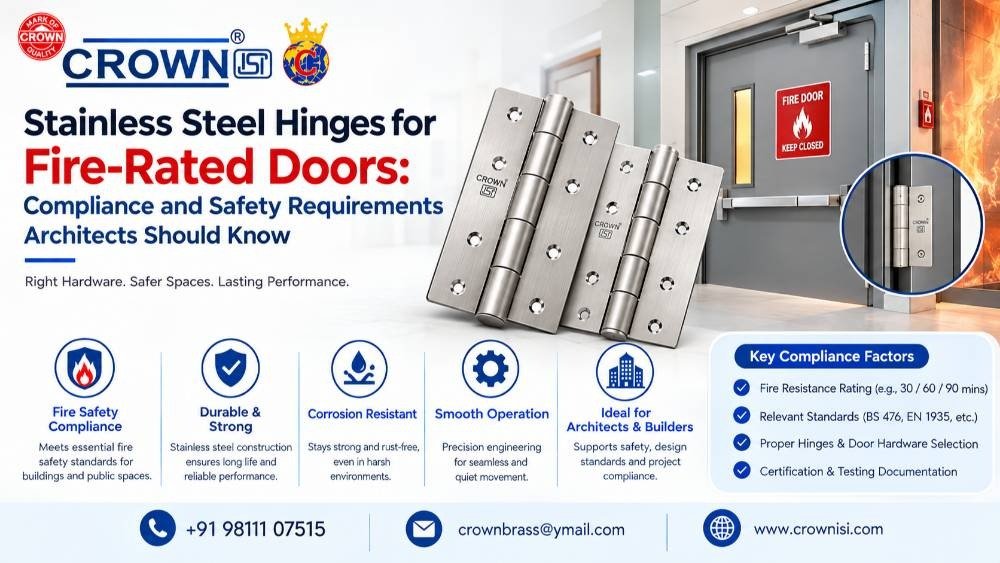
- Stainless steel hinges are not automatically fire-rated simply because they are made from stainless steel. For a fire-rated door, the hinge must be suitable for the tested or certified doorset, meet the applicable hinge standard, and be installed according to the approved hardware and fire-test documentation.
- BS EN 1935 covers single-axis hinge requirements and classification. Hinges must also be assessed as part of the fire door assembly.
- NFPA 80 sets requirements for fire door assemblies and their hardware; hardware must comply with the applicable listing and installation requirements.
- IS 12817:2020 is the Indian Standard for stainless steel butt hinges. BIS currently lists the applicable Hinges Quality Control Order and subsequent exemption/transition orders.
- Grade 304 stainless steel is widely used in architectural hardware. Grade 316 offers higher corrosion resistance for coastal or highly corrosive conditions.
- Always follow the fire door certificate and the hardware manufacturer's published installation instructions.
This guide is intended for architects, specification writers, contractors, fire-door manufacturers, hardware consultants and project procurement teams evaluating stainless steel hinges for fire-rated doors.
Important: This guide provides general specification information. It does not replace the fire-door manufacturer's certificate, tested doorset documentation, applicable building and fire regulations, or installation instructions.
At a Glance: Fire-Door Hinge Compliance Checklist
| Requirement | What Architects Should Verify |
|---|---|
| Hinge standard | BS EN 1935 / IS 12817:2020 / applicable local standard |
| Fire suitability | Hinge assessed or tested for the specified doorset |
| Fire test | Relevant doorset test evidence applicable to the project jurisdiction, such as BS EN 1634-1, UL 10C or NFPA 252 |
| Hinge quantity | Standard provisions + door listing + manufacturer instructions |
| Material | Grade 304 or 316 according to project environment |
| Corrosion resistance | Applicable BS EN 1670 classification, confirmed from test documentation |
| Intumescent protection | As specified by the tested doorset certificate |
| Certification | BIS / UL / applicable conformity documentation for the project jurisdiction |
| Installation | Manufacturer and doorset instructions |
What Makes a Hinge Suitable for a Fire-Rated Door?
A fire door is a complete assembly. It brings together the door leaf, frame, seals, closer, latch and hinges. The BWF Fire Door Alliance describes hinges as essential hardware, meaning they are indispensable to the correct performance of the fire door. Fire-door performance is established for a defined doorset configuration, including the hardware and components permitted by the applicable test or certification scope.
Core rule: a fire-door hinge should always be evaluated as part of the tested or certified doorset, not as an isolated stainless-steel component.
This means the hinge cannot be treated as an independent purchase. It must be suitable for the specific tested doorset and installed according to the applicable certification and manufacturer instructions. The hinge must support the door leaf, withstand the thermal and mechanical stresses encountered during the applicable fire test, and maintain the required door alignment and operation within the tested assembly.
When you specify Stainless Steel Hinges, you are selecting a corrosion-resistant metal hardware material commonly used in architectural applications. However, the stainless-steel grade alone does not establish fire-door compliance. The hinge must be compatible with and permitted by the tested doorset.
Fire-Door Hinge Standards
Several standards and certification frameworks are relevant to fire-door hinge specification. BS EN 1935 is important for single-axis hinges in the UK and European context, while NFPA 80 and UL 10C are commonly relevant to US projects. IS 12817:2020 applies to stainless steel butt hinges in India.
BS EN 1935
BS EN 1935 specifies requirements for single-axis hinges used on doors and access windows. It uses an eight-digit coding system. The relevant digits for fire door specification are:
- Digit 1 – Category of use: Grade 1 (light duty), Grade 2 (medium duty), Grade 3 (heavy duty), Grade 4 (severe duty).
- Digit 2 – Durability: Grade 3 (10,000 cycles, windows only), Grade 4 (25,000 cycles, windows and doors), Grade 7 (200,000 cycles, doors only).
- Digit 3 – Test door mass: Eight door mass grades.
- Digit 4 – Suitability for fire/smoke door use: Grade 0 (not suitable for fire/smoke resistant door assemblies) or Grade 1 (suitable for fire/smoke resistant door assemblies subject to satisfactory assessment of the hinge's contribution to the fire resistance of the specified assembly).
- Digit 5 – Safety: Grade 1 only.
- Digit 6 – Corrosion resistance: Grades 0–4 in accordance with BS EN 1670:2007.
- Digit 7 – Security: Grade 0 or Grade 1.
- Digit 8 – Hinge grade: Fourteen grades identified in the standard.
The EN 1935 performance classification includes a final hinge-grade classification running through fourteen grades, while the fire/smoke suitability classification is separate and uses Grade 0 or Grade 1. These are two different classification systems within the same standard.
EN 1935 compliance alone should not be presented as proof that a hinge is suitable for every fire-door assembly. The hinge's fire/smoke suitability and the evidence for the specific doorset must also be checked. The standard itself notes that the suitability of single-axis hinges for use on fire/smoke compartmentation door assemblies is determined by performance tests conducted in addition to the performance tests required by the standard. Annex B indicates additional requirements for these products.
The BWF Fire Door Alliance states that hinges or butts must comply with Annex B of BS EN 1935, and rising butt or spring hinges are not permitted in the specifications covered by its guidance. Requirements can vary by jurisdiction and tested doorset, so always verify against the applicable certification.
NFPA 80
In the United States, NFPA 80 governs fire door assemblies. It requires hardware to be installed according to the door assembly's listing and the manufacturer's instructions.
NFPA 80 includes specific requirements for hinges and pivots used on fire-rated swinging doors. These provisions address bearing types, spring hinges and alternative antifriction bearing surfaces meeting applicable ANSI/BHMA requirements. The applicable NFPA 80 edition and the listing for the specific doorset should always be checked before specifying a hinge.
UL 10C
UL 10C is a fire-test standard for door assemblies, not a standalone stainless-steel hinge standard. It evaluates swinging door assemblies under positive-pressure fire-test conditions. In jurisdictions adopting the applicable U.S. building-code provisions, side-hinged and pivoted swinging fire doors may be tested in accordance with UL 10C or NFPA 252, depending on the applicable code and certification pathway. For NFPA 252 testing, the IBC specifies that after five minutes the neutral pressure level is established at 40 inches (1,016 mm) or less above the sill.
The applicable listing, test method and hardware configuration should always be verified for the specified doorset. A stainless-steel finish or a product-level fire claim does not by itself establish that a hinge is permitted for a particular UL-listed doorset.
IS 12817:2020 in India
For projects in India, IS 12817:2020 is the Indian Standard for stainless steel butt hinges. The Bureau of Indian Standards (BIS) lists IS 12817:2020 under its certification framework.
The 2025 Hinges Quality Control Order lists 1 July 2025 as the implementation date for stainless steel butt hinges. BIS also lists subsequent 2026 exemption and transition-facilitation orders. For Indian projects, verify the current BIS/QCO requirements, applicable licence scope and any subsequent exemption or transition provisions before approval.
For products covered by the applicable BIS certification requirements, the ISI Standard Mark indicates conformity with the relevant Indian Standard under the applicable BIS certification scheme. It is a mark of conformity, not a universal fire-door certification. Fire-door suitability depends on the tested doorset and the applicable building regulations.
CROWN states that its stainless steel butt hinges are covered by BIS certification under IS 12817:2020. For project approval, verify the current licence status, scope and applicable product documentation through the BIS portal.
Key Standards Comparison Table
| Standard | Region | What It Covers | Relevance to Hinge Selection | Verification Source |
|---|---|---|---|---|
| BS EN 1935 | UK / European standards context | Single-axis hinges for doors and windows | Classifies hinge performance and fire/smoke suitability; applicable doorset evidence must also be checked | BSI |
| BS EN 1634-1 | UK / European standards context | Fire-resistance testing of door, shutter and window assemblies | Provides the fire-resistance test framework for door assemblies | BSI |
| NFPA 80 | USA | Fire doors and other opening protectives | Includes requirements for fire-door hardware, installation and hinges | NFPA |
| UL 10C | USA / projects using UL certification | Positive-pressure fire testing of door assemblies | Provides the fire-test method used for qualifying swinging fire-door assemblies | UL Solutions |
| BS EN 1670 | UK / European standards context | Corrosion resistance of building hardware | Provides corrosion-resistance classifications for hardware | BSI |
| IS 12817:2020 | India | Stainless steel butt hinges | Specifies requirements for stainless steel butt hinges | BIS |
| NFPA 252 | USA | Fire testing of door assemblies | Alternative fire-test method for swinging door assemblies | NFPA |
Which Fire-Door Hinge Standard Applies?
| Project | Standards / Documentation to Check |
|---|---|
| India | IS 12817:2020, applicable BIS/QCO requirements and fire-door test/certification |
| UK / Europe | BS EN 1935 and applicable fire-door test/certification such as BS EN 1634-1 |
| United States | NFPA 80, applicable listing and UL 10C/NFPA 252 where relevant |
| Other jurisdictions | Local building/fire regulations and approved doorset certification |
The applicable standard depends on the project jurisdiction, door type, fire rating and certification pathway. The doorset's approved test or certification documentation should take precedence when specifying hardware.
Does Stainless Steel Grade 304 Make a Hinge Fire-Rated?
No. Grade 304 stainless steel is widely used in architectural hardware because of its corrosion resistance and durability. However, its material properties alone do not establish fire-door compliance.
A Grade 304 stainless steel hinge should not be assumed to be compliant with a specific fire-door assembly unless its suitability is supported by the applicable test, certification, listing or doorset documentation.
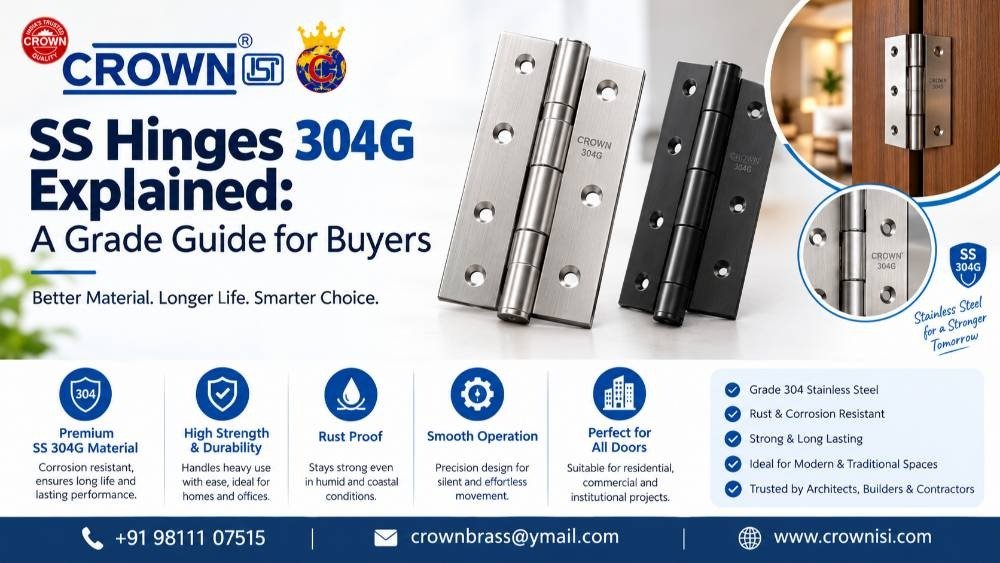
CROWN uses "304G" as its product designation for its Grade 304 stainless steel hinge range. The exact material specification and applicable certification should be confirmed from the product datasheet or certificate for the specific model.
304 vs 316 Stainless Steel Hinges
Grade 304 is an austenitic stainless-steel grade commonly used for architectural hardware. Grade 316 contains molybdenum and generally provides better resistance to chloride-rich environments, making it suitable for coastal projects or areas with high humidity and salt exposure.
Grade 304 and Grade 316 are both widely used stainless-steel grades for architectural hardware. However, the stainless-steel grade itself does not establish fire-door suitability; the hinge must be permitted by the applicable tested or certified doorset.
The relevant corrosion resistance classification for building hardware is BS EN 1670. BS EN 1670 provides corrosion-resistance classifications for building hardware based on standardized corrosion testing. The applicable corrosion class should be confirmed from the product's test documentation rather than inferred from the stainless-steel grade alone.
How Many Hinges Does a Fire Door Need?
US / NFPA 80
NFPA 80 includes hinge-count provisions based on door height. For example, NFPA 80 committee material for the 2020 edition specifies at least two hinges for doors up to 60 inches high, with an additional hinge for each additional 30 inches or fraction thereof. The applicable NFPA 80 edition and the doorset listing should be checked for the project.
| Door Height | Basic NFPA 80 Hinge Provision |
|---|---|
| Up to 60 in. | At least 2 hinges |
| Over 60 in. | Additional hinge per additional 30 in. or fraction |
| Listed assembly | Follow the applicable listing/manufacturer requirements |
This should not be treated as a universal hinge-selection formula. Door weight, traffic frequency, environmental conditions, and the applicable listing or manufacturer instructions also affect hinge selection.
UK / European Practice
For many UK timber fire-door specifications, three hinges are commonly used. Warringtonfire certification guidance for one hinge range specifies a minimum of 3 hinges for 60-minute timber fire door assemblies, with top hinge max 250 mm from the top of the door, second hinge max 450 mm from the top, and bottom hinge max 250 mm from the bottom.
Why Door Weight Matters
The hinge size, measured by height, width and thickness, must also be appropriate for the door leaf size and weight. The manufacturer's instructions will state the maximum door weight for each hinge model. Hinge dimensions and construction should be matched to the door leaf size, weight and usage. The manufacturer's published load limits and applicable hinge classification should be used rather than relying on leaf thickness alone.
Intumescent Protection and Hinge Installation
In many fire door assemblies, intumescent protection is required under the hinge blades. Intumescent materials expand when exposed to heat, sealing the gap between the door and the frame. This stops hot gases and smoke from passing through.
The specific requirements are set by the door manufacturer and the fire test certificate. For a specific hinge range, Warringtonfire certification guidance may prescribe a particular intumescent material, thickness and seal arrangement.
Example from one tested 60-minute timber doorset — not a universal requirement: guidance for one 60-minute timber fire door assembly specifies a minimum of 2 mm thick intumescent sheet material (ISL Therm-A-Strip or Interdens) under all hinge blades, and a perimeter intumescent fire seal that bypasses the hinges by a minimum of 4 mm.
For 30-minute applications, the required intumescent specification may differ. Always use the thickness and configuration stated in the tested doorset documentation. For 90 and 120-minute applications, the required protection must be as tested by the chosen door manufacturer.
If the intumescent protection is not fitted according to the tested specification, the door's fire performance can be compromised.
How Architects Should Specify Fire-Door Hinges
The specification should identify the tested doorset, approved hinge type, quantity, dimensions and installation requirements.
Step 1: Identify the fire rating of the door. Is it FD30, FD60, FD90, or FD120? The rating determines the protection level and the testing regime the assembly must meet.
Step 2: Check the door certificate. Check the doorset certificate, test evidence and associated hardware documentation to confirm the approved or permitted hardware configuration. Do not specify a hinge that is not on the list. If you need an alternative, make sure it has been assessed or tested as part of a comparable assembly.
Step 3: Choose the correct grade of stainless steel. Grade 304 is widely used for architectural hardware in many environments. Grade 316 may be selected for coastal, marine, or highly corrosive environments. The required stainless-steel grade should be selected according to the project environment and the applicable hardware specification.
Step 4: Select the hinge type. Ball-bearing butt hinges are commonly specified for fire-rated openings, particularly in the US where NFPA 80 addresses bearing requirements. They reduce friction and wear, especially for heavier or high-traffic doors. Welded hinges, where the pin is welded into one leaf, offer additional security because the pin cannot be removed. CROWN manufactures both Stainless Steel Butt Hinges and welded hinges in Grade 304. You can see the full range on the Stainless Steel Butt and Welded Hinges page.
Step 5: Verify the certification. Verify the conformity marking, certification or listing required for the project and jurisdiction. For Indian projects, check the applicable BIS/ISI requirements; for US projects, verify the applicable listing; and for UK/European projects, follow the certification and conformity requirements applicable to the specified doorset and hardware.
Step 6: Specify the correct quantity and size. Use the applicable standard's provisions as a starting point, but always check the manufacturer's recommendations for the specific door weight and size.
Step 7: Include intumescent requirements. If the door certificate requires intumescent protection under the hinge blades, state this clearly in the specification. Specify the type and thickness according to the door manufacturer's instructions.
Step 8: Confirm compatibility with other hardware. The hinge must work with the door, frame, closer, latch and seals. A complete fire door hardware package may include mortise locks and mortise handles. CROWN manufactures a range of stainless steel door accessories for architectural door-hardware applications.
Fire-Door Hinge Requirements in India
For Indian projects, the regulatory context includes both the Indian Standard for hinges and the broader fire safety requirements applicable to the building.
IS 12817:2020 is the Indian Standard for stainless steel butt hinges. The 2025 Hinges Quality Control Order lists 1 July 2025 as the implementation date for stainless steel butt hinges. BIS also lists subsequent 2026 exemption and transition-facilitation orders, so manufacturers and purchasers should verify the current applicable requirements, applicable licence scope and any subsequent exemption or transition provisions before approval.
For fire door applications in India, the hinge must also be suitable for the tested doorset. The National Building Code of India and applicable fire safety regulations set out the requirements for fire door assemblies. Project specifications should reference the relevant fire test evidence and the door manufacturer's instructions.
Indian environmental conditions vary widely, from humid coastal regions to dry inland areas. Grade 304 stainless steel is widely used for architectural hardware in many inland environments, while Grade 316 may be considered where chloride exposure or other corrosive conditions are significant. The BS EN 1670 corrosion resistance classification can be a useful reference when comparing hinge specifications.
For projects sourcing architectural hardware from India, local supplier verification can also be part of procurement due diligence. CROWN's published company information identifies its manufacturing location in Sahibabad, Ghaziabad, Uttar Pradesh. Project teams should still verify the specific product, certification scope and documentation before approval.
CROWN manufactures SS Hinges 304G in India and serves architects, builders and project managers across the country. CROWN's published product information states that its hinges undergo load and corrosion-related testing. You can learn more about our quality control processes on our website.
India Fire-Door Hinge Compliance Checklist
- IS 12817:2020 for stainless steel butt hinges
- Applicable BIS certification/licence
- ISI/BIS marking where required
- Current QCO requirements (verify current applicable orders)
- Fire-door test evidence for the specified doorset
- Approved doorset hardware schedule
- Installation instructions from the door manufacturer
How CROWN Tests Its Stainless Steel Hinges
CROWN has been manufacturing door fittings and hardware for over 39 years. Our Stainless Steel Hinges 304G are manufactured using Grade 304 stainless steel, according to the applicable product specification.
| Test | Purpose | CROWN's Published Quality-Control Information |
|---|---|---|
| Load testing | Verify load performance | Load testing is conducted as part of CROWN's quality-control process |
| Salt-spray testing | Evaluate corrosion resistance | 200-hour salt-spray test |
| Cycle testing | Evaluate repeated operation | 50,000 open-and-close cycles |
CROWN's published information states that these tests form part of its quality-control process for evaluating hinge performance, corrosion resistance and repeated operation. For project approval, request the applicable test report or product-specific documentation confirming the test method, duration, sample and acceptance criteria.
These product-level tests should not be interpreted as fire-resistance certification for a complete doorset.
CROWN states that its stainless steel butt hinges are covered by BIS certification under IS 12817:2020. For project approval, verify the current licence status, scope and applicable product documentation through the BIS portal.
For projects that require documented evidence, we can provide product datasheets and test information for the specific hinge model.
CROWN's stainless-steel hinge range is designed for architectural door-hardware applications, with product specifications and quality-control information available for project review. If you have a project that requires fire door hardware, please contact us to discuss your specification.
Common Specification Mistakes
Mistake 1: Assuming a hinge is fire-rated because it is made of stainless steel. Stainless steel itself does not establish a fire-resistance rating. A stainless-steel hinge still needs to be suitable for the applicable tested or certified doorset.
Mistake 2: Substituting a hinge without checking the listing. In the US, replacing a specified hinge can take the hardware configuration outside the scope of the applicable listing or certification. In Europe, a hinge not listed on the door certificate may not be compliant. Always check the documentation.
Mistake 3: Using too few hinges. Hinge-count provisions in standards and UK guidance should be treated as part of the specification process, not as a substitute for the tested doorset requirements. Heavy doors may need more hinges or heavier hinges.
Mistake 4: Ignoring intumescent requirements. Intumescent hinge pads are not optional in many assemblies. If the door certificate requires them, they must be fitted according to the tested specification.
Mistake 5: Specifying spring hinges on fire doors where they are not permitted. In the specifications covered by BWF guidance, rising butt or spring hinges are not permitted. NFPA 80 also contains specific requirements for spring hinges and their use on fire-rated swinging doors. Always verify the applicable NFPA 80 edition, doorset listing and manufacturer instructions.
Mistake 6: Overlooking corrosion resistance. A hinge that corrodes will fail over time. In humid or coastal environments, Grade 304 may not be sufficient. Consider Grade 316 for extreme conditions.
Mistake 7: Not checking the door certificate. The doorset's certification, test evidence and associated hardware documentation should be checked to confirm the approved hardware configuration.
Technical Documents to Request Before Approval
Before approving a fire-door hinge, request and review the following documents:
- Fire-door test certificate
- Doorset certification or listing documentation
- Hinge product datasheet
- Applicable BIS/ISI documentation (for Indian projects)
- Applicable UL listing or certification (for US projects)
- Material specification
- Corrosion-test documentation, where relevant
- Installation instructions
- Manufacturer compatibility statement
- Declaration of performance or conformity, where applicable
- Approved hardware schedule / doorset hardware schedule
This documentation provides the evidence needed to confirm that the hinge is suitable for the specific tested doorset and applicable regulatory framework.
Frequently Asked Questions
Are stainless steel hinges required for fire-rated doors?
Stainless steel is not the only material used for fire-door hinges. It is widely specified for architectural hardware because of its corrosion resistance, durability and suitability for many project environments. The key requirement is that the hinge is suitable for the specific fire-door assembly and supported by the applicable certification or listing. Stainless Steel Hinges 304G are specified for architectural hardware applications; the applicable fire-door certification and doorset documentation should be checked for each project.
What is the difference between SS 304 and SS 316 hinges?
SS 304 is an austenitic stainless-steel grade commonly used for architectural hardware. SS 316 contains molybdenum and generally provides better resistance to chloride-rich environments, making it more suitable for many coastal or marine applications. SS 304 is widely used for architectural hardware in many environments. SS 316 may be selected where chloride exposure, coastal conditions or other corrosive conditions are significant. The required stainless-steel grade should be selected according to the project environment and the applicable hardware specification.
How many hinges does a fire door need?
A fire door does not have one universal hinge count. NFPA 80 committee material for the 2020 edition specifies at least two hinges for doors up to 60 inches high, with an additional hinge for each additional 30 inches or fraction thereof. The applicable NFPA 80 edition, doorset listing and manufacturer requirements should be checked for the project. UK guidance commonly uses three hinges for many timber fire-door applications, but the certified doorset requirements take precedence.
Can I use any stainless steel hinge on a fire door?
No. The hinge must be suitable for the fire door assembly and listed on the door certificate or applicable listing. A hinge that has passed a standalone test but has not been assessed with the specific door leaf, frame and intumescent protection may not be compliant. Always refer to the fire door certificate.
What is BS EN 1935 and why does it matter?
BS EN 1935 is the European Standard for single-axis hinges used on doors and windows. It classifies hinge performance across eight characteristics, including category of use, durability, door mass, fire/smoke suitability and corrosion resistance. The performance classification includes a final hinge grade running through fourteen grades. The fire/smoke suitability classification is separate and uses Grade 0 (not suitable) or Grade 1 (suitable, subject to satisfactory assessment of the hinge's contribution to the fire resistance of the specified assembly).
Do fire door hinges need intumescent pads?
Sometimes, but only where required by the tested doorset. Intumescent pads expand when exposed to heat and seal the gap between the door and the frame. For a specific hinge range, Warringtonfire certification guidance may prescribe a particular intumescent material, thickness and seal arrangement. For example, guidance for one 60-minute timber fire door assembly specifies a minimum of 2 mm thick intumescent sheet material beneath each hinge blade, and a perimeter intumescent fire seal that bypasses the hinges by at least 4 mm. The specific requirements are set by the door manufacturer and the fire test certificate.
What is the difference between ball-bearing and plain-bearing hinges?
Ball-bearing hinges contain a race of hardened steel or stainless steel balls that reduce friction between the knuckles. This makes them smoother and more durable, especially for heavy doors and high-traffic applications. NFPA 80 contains specific requirements concerning bearing types and spring hinges for fire-rated swinging doors. The applicable edition and listing should be checked for the specific doorset. Plain-bearing hinges use a bearing or bushing arrangement rather than ball bearings. Their suitability depends on the hinge design, load, duty cycle and applicable standard or listing.
Can spring hinges be used on fire doors?
In the specifications covered by BWF guidance, rising butt or spring hinges are not permitted. NFPA 80 contains specific requirements for spring hinges used on fire-rated swinging doors. Because requirements can depend on the applicable edition, door assembly and listing, always follow the applicable NFPA 80 provisions and the tested doorset documentation.
What is the ISI mark and why does it matter for hinges?
The ISI mark is the BIS Standard Mark. For products covered by the applicable BIS certification requirements, it indicates conformity with the relevant Indian Standard under the applicable BIS certification scheme. For stainless steel butt hinges, the relevant standard is IS 12817:2020. CROWN states that its stainless steel butt hinges are covered by BIS certification under IS 12817:2020. For procurement or project approval, verify the current BIS licence status, scope and applicable product documentation.
How do I verify that a hinge is compliant for a fire door?
Ask for the test certificates and the declaration of performance or conformity. Check that the hinge is listed on the fire door certificate. Verify the conformity marking, certification or listing required for the project and jurisdiction. For example, Indian projects may require applicable BIS/ISI requirements, while UK/European and US projects may follow different conformity, certification and listing frameworks. Always check the applicable doorset documentation and hardware certification.
Final Thoughts
Fire-door hinges should be specified as part of the tested doorset rather than as an isolated hardware component. The applicable standard, hinge classification, door weight, quantity, installation method and supporting documentation should all be checked before approval.
For Indian projects, also verify the applicable BIS requirements for stainless steel butt hinges under IS 12817:2020 and the current Hinges Quality Control framework.
CROWN provides stainless steel architectural hinges with product and quality-control information for project evaluation. Where fire-door applications are involved, the relevant doorset certification and hardware documentation should always take precedence.
Need help specifying fire-door hinges?
Share the following details:
- Door height
- Door width
- Approximate door weight
- Fire rating
- Door/frame material
- Project location
- Required standard/certification
- Quantity required
Need documentation for project approval? Request the relevant product datasheet, test information or certification documents for the required hinge model. The CROWN technical team can help identify relevant hinge specifications and product documentation. Final fire-door compliance should be confirmed by the responsible doorset manufacturer, test/certification documentation and applicable authority requirements. Contact CROWN to discuss your project requirements.