 25 Sep, 2026
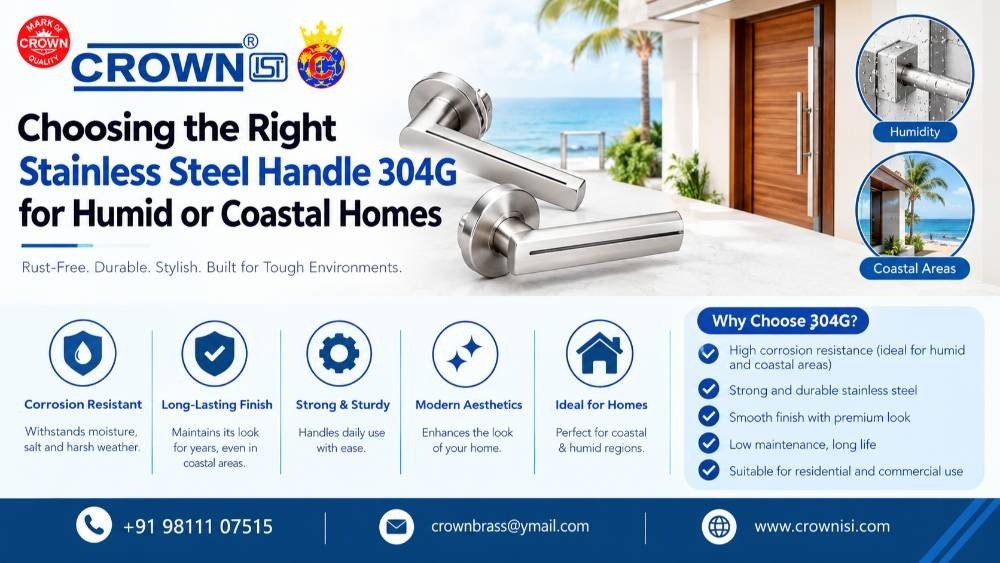
 A Stainless Steel Handle 304G is made from Grade 304 stainless steel and offers good corrosion resistance for many humid environments. For homes located directly on the coastline, where salt-laden air is constant, Grade 316 stainless steel is generally the preferred choice because it contains molybdenum, which provides better resistance to chloride-induced corrosion. The right choice depends on your distance from the sea, the level of salt exposure, the surface finish, and how regularly you maintain the hardware. For door handles in India, BIS currently lists IS 208:2020 for Door Handles – Specification and IS 4992:2024 for Door Handles for Mortice Locks. Buyers should verify the exact Indian Standard and certification scope applicable to the handle model they are purchasing.
Why Coastal and Humid Environments Are Hard on Door Hardware
Living near the sea changes the rules for every piece of metal in your home.
The air carries salt. Not just a little salt, but a constant, invisible mist of chloride particles that settles on every surface. When that salt combines with moisture, it creates a highly corrosive environment for metals.
This is why door handles that look fine after ten years in an inland city may begin to show rust, pitting, or discolouration within two or three years in a coastal home.
The challenge is not just salt. Humidity plays a role too. Coastal homes experience higher average humidity levels, and in India, the monsoon season adds months of persistent moisture. Together, salt and humidity create the perfect conditions for corrosion.
The good news is that stainless steel is well-suited to this environment, provided you choose the right grade and maintain it properly.
What Is a Stainless Steel Handle 304G?
A Stainless Steel Handle 304G is a door or cabinet handle made from Grade 304 stainless steel. The "304" refers to the specific grade of stainless steel. The "G" is a product designation used by CROWN Industries to identify its Grade 304 handle range.
It is not a separate grade of steel. It is not an international standard. It is a naming convention used within CROWN's product line.
When you see SS Handle 304G, you are looking at a handle made from Grade 304 stainless steel, marketed under a specific product range. The important thing is the underlying material: Grade 304 stainless steel.
The "304G" designation by itself should not be treated as proof of BIS certification. Buyers should verify the actual BIS Standard Mark and the licence scope applicable to the specific product.
Grade 304 is one of the most widely used stainless steel grades for architectural hardware. It offers good corrosion resistance for many environments, including humid bathrooms, kitchens, and inland homes. Whether it is suitable for your specific coastal location depends on several factors that we will cover in this guide.
The Composition of Grade 304 Stainless Steel
Grade 304 stainless steel is an austenitic stainless steel. Its nominal composition typically includes:
| Element | Approximate Content |
|---|---|
| Chromium | 18–20% |
| Nickel | 8–10.5% |
| Carbon | 0.08% max |
| Manganese | 2% max |
| Silicon | 0.75% max |
| Phosphorus | 0.045% max |
| Sulfur | 0.03% max |
| Iron | Balance |
Chromium is the key alloying element responsible for the passive oxide layer that gives stainless steel its corrosion resistance. This layer forms naturally on the surface and reforms if the surface is scratched, provided there is sufficient oxygen available.
Nickel stabilizes the austenitic structure and contributes to properties such as toughness and formability.
Together, chromium and nickel create a material that is strong, durable, and resistant to rust in many environments. But "many environments" does not mean "all environments." Coastal and marine environments present a more severe challenge because chlorides can break down the passive oxide layer, leading to pitting corrosion.
Exact composition limits should be checked against the applicable material specification. The nominal 18/8 figures are a useful shorthand, but they are not a substitute for proper material certification.
Grade 304 vs Grade 316: Which Is Right for Your Home?
This is the most important decision when choosing handles for a coastal or humid home.
Grade 316 stainless steel contains molybdenum in addition to chromium and nickel. This addition provides significantly better resistance to chlorides, making Grade 316 the preferred choice for coastal environments.
The table below compares the two grades:
| Feature | Grade 304 | Grade 316 |
|---|---|---|
| Chromium | 18–20% | 16–18% |
| Nickel | 8–10.5% | 10–14% |
| Molybdenum | No | Yes (2–3%) |
| Corrosion Resistance | Good for many environments | Excellent, particularly for chloride exposure |
| Best For | Inland, humid, and sheltered environments | Coastal, marine, and highly corrosive environments |
| Cost | Moderate | Higher |
Guidance from the British Stainless Steel Association and worldstainless indicates that chloride exposure is the key risk in coastal environments, and 316-grade stainless steel performs better than 304 because it offers stronger resistance to pitting and crevice corrosion.
For buildings located directly on the coastline, or within a few kilometres of the sea, Grade 316 is generally the recommended choice for exterior door hardware. For inland homes with high humidity (such as bathrooms or kitchens), Grade 304 is often suitable.
How Exposure Conditions Affect Grade Selection
The table below provides a general guide based on exposure conditions:
| Exposure Condition | Typical Starting Point | What to Check |
|---|---|---|
| Direct marine / highly exposed coastal | Grade 316 or higher corrosion resistance | Salt spray, wind exposure, surface finish and maintenance |
| Within several kilometres of surf | Grade 316 generally preferred | Local exposure and shelter |
| Inland but humid | Grade 304 may be suitable | Humidity, pollutants and maintenance |
| Dry inland | Grade 304 is commonly suitable | Actual environmental conditions |
Distance is only a starting indicator. Wind direction, salt deposition, building orientation, shelter, pollution, surface finish and cleaning frequency can change the actual corrosion exposure.
The Role of Surface Finish in Coastal Environments
The grade of stainless steel is important, but it is not the only factor. Surface finish plays a significant role in corrosion resistance.
In marine environments, the British Stainless Steel Association recommends 316 stainless steel with a mirror-polished finish. It specifically warns against using a standard 240 alumina brushed finish in marine locations. The reason is simple: smoother surfaces retain fewer contaminants and are easier to clean, which improves corrosion resistance in real-world exposure.
Common surface finishes for stainless steel handles include:
- Polished (mirror finish): Smooth, reflective, easiest to clean. Best for coastal environments where contamination needs to be removed easily.
- Satin (brushed finish): Matte appearance, may retain more contaminants on the surface. Suitable for inland environments and lower-exposure coastal locations with regular cleaning.
- PVD coated: A hard coating applied over stainless steel. Provides additional protection and comes in various colours. May be suitable for coastal environments depending on the coating quality.
For exposed coastal applications, a smooth, well-finished Grade 316 surface is generally easier to keep clean and can reduce contamination traps. A polished finish can therefore be advantageous, but grade, surface quality, installation and maintenance all affect corrosion performance.
BIS Certification and the ISI Mark for Stainless Steel Handles
For buyers in India, product certification is an important indicator of quality and conformity.
The Bureau of Indian Standards (BIS) operates a product certification scheme under which manufacturers can obtain a licence to use the BIS Standard Mark (ISI Mark) on products that conform to the relevant Indian Standard.
For door handles in India, the applicable BIS standard depends on the handle type. BIS currently lists IS 208:2020 for Door Handles – Specification, while IS 4992:2024 covers Door Handles for Mortice Locks. Stainless steel butt hinges are covered separately by IS 12817:2020. Buyers should verify the exact Indian Standard and certification scope applicable to the handle model they are purchasing.
The Hinges (Quality Control) Order, 2025, issued by the Ministry of Commerce and Industry, makes BIS certification mandatory for covered hinge products in India. Under this order, Stainless Steel Butt Hinges must conform to IS 12817:2020 and bear the BIS Standard Mark under a valid licence from BIS.
For handles and other hardware, buyers should check whether the product falls under a mandatory certification order. If it does, the ISI Mark is a legal requirement. If it does not, the ISI Mark still indicates that the manufacturer has voluntarily submitted to BIS certification, which is a positive quality signal.
You can verify a manufacturer's BIS licence through the BIS Scheme-I certification information.
When evaluating SS Handle ISI products, remember that the ISI Mark confirms conformity with the applicable standard. It does not guarantee that the manufacturer goes beyond the minimum. Buyers may still request additional material, testing and quality-control documentation when project specifications require evidence beyond basic conformity.
CROWN Stainless Steel Handles: Products and Quality Information
CROWN Industries has been manufacturing door fittings and hardware for over 39 years. The company produces Stainless Steel Handle 304G in a range of designs and sizes for different door types and applications.
CROWN's product range includes stainless steel door accessories and stainless steel butt and welded hinges. For mortise applications, the company offers a mortise handle designed for use with mortise locks.
CROWN states that it holds BIS Licence No. 8700097320 under IS 12817:2020 for stainless steel butt hinges. This licence statement relates to CROWN's stainless steel butt hinges and does not by itself establish BIS certification for every CROWN handle product. For handles, buyers should verify the applicable Indian Standard and licence scope for the specific handle model. Buyers should verify the licence's current status and scope directly through the BIS portal before relying on the claim for procurement or project approval.
CROWN's published quality control information states that load testing, 200-hour salt-spray testing, and 50,000-cycle testing form part of its manufacturing process for its stainless steel product range. These are additional product-level quality-control tests; buyers should request the applicable test documentation and compare the test method and acceptance criteria with the relevant standard.
For projects that require documented evidence, CROWN can provide product datasheets and test information for the specific handle model. You can learn more about the company on the About CROWN page.
How to Choose the Right Handle for Your Coastal Home: A Framework
Here is a practical framework for selecting the right Stainless Steel Handle 304G for your coastal or humid home.
Step 1: Determine Your Exposure Conditions
Assess the level of salt exposure your home experiences. Consider wind patterns and building orientation. A home directly facing the sea will experience more salt exposure than one sheltered by other buildings or vegetation.
Step 2: Choose the Correct Grade
For coastal and marine environments, Grade 316 stainless steel offers better corrosion resistance than Grade 304. For inland humid environments, Grade 304 is often suitable.
Step 3: Select the Surface Finish
For coastal environments, a polished (mirror) finish is preferred because it retains fewer contaminants and is easier to clean. For inland environments, satin or brushed finishes are suitable.
Step 4: Check Certification and Documentation
For covered products in India, verify the BIS Standard Mark and licence status. Request the product datasheet, material certificate, and test reports for the specific handle model.
Step 5: Plan for Maintenance
Even Grade 316 handles require regular cleaning in coastal environments. Plan to inspect and clean your exterior handles regularly, more frequently if salt deposits are visible.
Caring for Stainless Steel Handles in Humid or Coastal Homes
Stainless steel is not maintenance-free, especially in coastal environments. Regular cleaning is essential to remove salt and other contaminants before they can cause corrosion.
Cleaning Frequency
In coastal environments, inspect handles regularly and clean them whenever salt deposits or visible contamination accumulate. Highly exposed locations may require cleaning every one to three months, while sheltered locations may need less frequent cleaning.
How to Clean Stainless Steel Handles
- Rinse with warm water to remove loose salt and dirt.
- Wash with a mild detergent using a soft, non-abrasive cloth.
- Rinse thoroughly to remove all detergent residue.
- Dry with a soft cloth to prevent water marks.
Avoid using cleaning products that contain solvents, acids, or abrasive substances, as they can impair the finish and the protective oxide layer.
What Is Tea Staining?
Tea staining is a surface discolouration that can appear on stainless steel hardware, particularly in coastal or polluted environments. It appears as a brownish discolouration and is a common issue in seaside locations. It does not indicate structural failure, but it is a sign that the hardware needs cleaning.
According to the Australian Stainless Steel Development Association (ASSDA), tea staining occurs most commonly within about five kilometres of the surf and becomes progressively worse closer to the marine source. However, wind exposure, pollution levels, local sheltering and higher temperatures can create environments where tea staining might occur 20 kilometres or more from the surf.
Regular cleaning helps reduce the risk of tea staining by removing salt and other contaminants before they accumulate. If tea staining has already occurred, a specialised stainless steel cleaner can remove it without damaging the metal.
Common Mistakes When Buying Handles for Coastal Homes
Mistake 1: Assuming all stainless steel is the same. Grade 202 and Grade 304 can look very similar during a basic visual inspection, but their composition and corrosion performance differ. Always verify the specified grade through appropriate documentation.
Mistake 2: Choosing Grade 304 for a highly exposed coastal location. Grade 304 offers good corrosion resistance for many environments, but for homes directly on the coast, Grade 316 is generally the safer choice.
Mistake 3: Ignoring the surface finish. A brushed finish may retain more contaminants than a polished finish, increasing the risk of corrosion in coastal environments.
Mistake 4: Skipping material documentation. Without appropriate material documentation, buyers may not have sufficient evidence to verify the specified steel grade.
Mistake 5: Not verifying the manufacturer's BIS licence. A claim of ISI certification should be verified through BIS before relying on it for procurement or project approval.
Mistake 6: Neglecting maintenance. Even Grade 316 handles require regular cleaning in coastal environments. Skipping maintenance allows salt deposits to accumulate, increasing the risk of corrosion.
Mistake 7: Using interior-grade handles on exterior doors. Handles designed for interior use may not have the corrosion resistance required for exterior coastal applications. Always check the manufacturer's recommendations for exterior use.
Frequently Asked Questions
What does "304G" mean in Stainless Steel Handle 304G?
The "304" refers to Grade 304 stainless steel. The "G" is a product designation used by CROWN Industries to identify its Grade 304 handle range. It is not a separate grade of steel or an international standard. The important thing is the underlying material: Grade 304 stainless steel.
Is Grade 304 stainless steel suitable for coastal homes?
Grade 304 offers good corrosion resistance for many humid environments, but for homes directly on the coastline, Grade 316 is generally the preferred choice because it contains molybdenum, which provides better resistance to chloride-induced corrosion. The appropriate grade depends on your level of salt exposure and maintenance routine.
What is the difference between Grade 304 and Grade 316 stainless steel?
Grade 304 contains approximately 18% chromium and 8% nickel. Grade 316 contains molybdenum in addition to chromium and nickel. The molybdenum provides additional resistance to chlorides, making Grade 316 more suitable for coastal or marine environments. Grade 304 is widely used for many inland and humid applications.
How often should I clean stainless steel handles in a coastal home?
In coastal environments, inspect handles regularly and clean them whenever salt deposits or visible contamination accumulate. Highly exposed locations may require cleaning every one to three months, while sheltered locations may need less frequent cleaning.
What is tea staining on stainless steel?
Tea staining is a surface discolouration that can appear on stainless steel hardware, particularly in coastal or polluted environments. It appears as a brownish discolouration and is a sign that the hardware needs cleaning. It does not indicate structural failure.
Is BIS certification mandatory for stainless steel handles in India?
BIS certification requirements depend on the type of door handle and the applicable Indian Standard. BIS currently lists IS 208:2020, Door Handles – Specification, as a mandatory-certification standard, while IS 4992:2024 covers door handles for mortice locks. Buyers should verify the exact standard, licence status and product scope applicable to the handle they are purchasing.
How can I verify a manufacturer's BIS licence?
BIS provides online certification and product-certification information that buyers can use to verify applicable licence details and scope. Verify that the licence is operative and covers the relevant product.
What surface finish is best for coastal environments?
For exposed coastal applications, a smooth, well-finished Grade 316 surface is generally easier to keep clean and can reduce contamination traps. A polished finish can therefore be advantageous, but grade, surface quality, installation and maintenance all affect corrosion performance.
Can I use Stainless Steel Handle 304G on exterior doors in a coastal home?
It depends on your level of salt exposure. For exposed coastal locations, Grade 316 is generally preferred. Grade 304 may be suitable for humid inland environments or sheltered locations, depending on actual salt exposure, finish and maintenance. Always check the manufacturer's exterior-use recommendation.
How do I check if a handle is genuine Grade 304 or Grade 316?
Ask for a mill test certificate or material test report. Compare the reported chemical composition with the specified material grade and applicable material standard. Do not identify the grade from appearance or markings alone.
Final Thoughts
Choosing the right Stainless Steel Handle 304G for a humid or coastal home is a balance of several factors: exposure conditions, level of salt exposure, surface finish, certification, and maintenance routine.
For homes directly on the coastline, Grade 316 stainless steel is generally the preferred choice for exterior handles. For inland homes with high humidity, Grade 304 is often suitable. The surface finish matters too: a smooth, polished finish retains fewer contaminants and is easier to clean than a brushed finish.
For covered products in India, verify the BIS Standard Mark and licence status first. Then look beyond it. Ask for material certificates. Ask for test reports. Ask about the manufacturer's recommendations for coastal use.
Regular maintenance is essential. Even the best stainless steel handle will corrode if salt deposits are allowed to accumulate. Regular inspection and cleaning is a simple routine that will extend the life of your hardware significantly.
CROWN Industries manufactures Stainless Steel Handle 304G in India and states that it holds BIS Licence No. 8700097320 under IS 12817:2020. Buyers requiring certification evidence should verify the current licence status and scope directly through BIS and request the applicable product documentation from the manufacturer.
Need help choosing handles for your coastal or humid home?
Share the following details:
- Door type and location (interior or exterior)
- Distance from the coastline
- Level of salt exposure
- Required finish
- Handle type (lever / pull / mortise / cabinet / D-handle)
- Quantity required
Need documents for vendor approval? Request the applicable BIS documentation, product datasheet, material information and available test reports for the required handle model. CROWN can help identify the relevant handle specification and available product documentation based on your project requirements. Contact CROWN to discuss your requirements.