 10 Sep, 2026
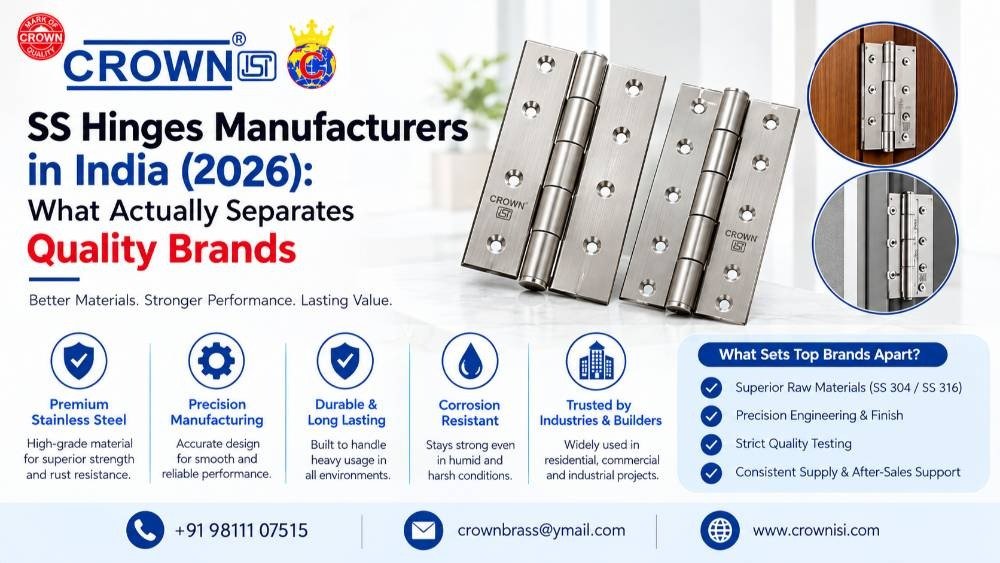
 A quality SS hinges manufacturer in India should demonstrate applicable BIS/QCO compliance, the specified stainless-steel grade, documented testing, manufacturing traceability, accurate dimensions and supporting technical documentation. The BIS Standard Mark establishes conformity with the applicable standard, but buyers should also review test reports, material documentation and project-specific requirements before approving a supplier.
This guide is intended for architects, procurement teams, contractors, hardware consultants and project managers evaluating SS hinges manufacturers in India.
Why 2026 Changed the Game for SS Hinges in India
Before the current QCO framework took effect, buyers had fewer compulsory BIS-based checks to rely on for covered hinge products and often had to assess suppliers through documentation, reputation, specifications and product inspection.
That changed with the Hinges (Quality Control) Order, 2025, issued by the Ministry of Commerce and Industry on 21 March 2025. Under this order, Stainless Steel Butt Hinges must conform to Indian Standard IS 12817:2020 and bear the BIS Standard Mark (ISI Mark) under a valid licence from the Bureau of Indian Standards (BIS). The implementation date was 1 July 2025.
BIS has since issued subsequent exemption and transition-facilitation orders, including the Transition Facilitation (Quality Control) Order, 2026, issued in June 2026. This means manufacturers and buyers must verify the current applicable requirements, not assume that a single order settles the matter permanently.
For procurement teams and architects, this regulatory shift has one practical consequence: for covered products, BIS conformity is a regulatory requirement rather than a voluntary differentiator, subject to applicable exemptions and transition provisions.
But the BIS Standard Mark alone does not tell the full story. Two manufacturers can both hold valid BIS licences and still produce hinges of noticeably different quality. The licence confirms conformity with the standard. It does not guarantee that the manufacturer goes beyond the minimum. That is where the real differentiators lie.
2026 BIS/QCO Compliance Snapshot
| 2026 Procurement Check | What to Verify |
|---|---|
| BIS Licence | Current status and scope |
| IS 12817:2020 | Applicable standard for stainless steel butt hinges |
| QCO | Current applicable provisions under the Hinges (Quality Control) Order framework |
| Exemptions | Whether any exemption applies (e.g., pre-shipment imports) |
| Transition Provisions | Whether the product or order falls under a transition arrangement |
| Product Marking | Applicable Standard Mark requirements |
What IS 12817:2020 Actually Requires
To understand what separates quality manufacturers, you first need to understand what the standard demands. IS 12817:2020 is the third revision of the Indian Standard for Stainless Steel Butt Hinges. It specifies requirements for materials, dimensions, manufacture, finish, and performance.
Material Requirements
The standard specifies stainless steel for the hinge flap conforming to IS 6911 and stainless steel for the pin conforming to IS 6528. The standard specifies the applicable stainless-steel material requirements for the hinge flap and pin. Buyers should compare the supplier's material certificate with the grade and material specification required by IS 12817:2020.
This matters because Grade 304 contains approximately 18% chromium and 8% nickel. Exact composition limits should be checked against the applicable material specification rather than relying on nominal 18/8 figures. Lower grades, such as Grade 202, may look similar on the shelf but may offer different corrosion performance, especially in humid or coastal environments.
For applications specified for Grade 304, the supplier should provide material documentation demonstrating conformity with the specified grade. The difference may not be visible during a basic visual inspection. Corrosion performance can become more apparent over time, particularly in humid, coastal or chloride-rich environments.
Performance Requirements
IS 12817:2020 mandates two critical performance tests:
Endurance testing: The standard specifies endurance requirements for operating cycles. The endurance test is intended to evaluate performance under repeated operation and identify failures or unacceptable wear under the specified test conditions.
Corrosion resistance testing: The standard includes corrosion-resistance testing requirements under specified test conditions. Buyers should verify the current IS 12817:2020 test method and acceptance criteria when reviewing supplier reports.
Dimensional and Finish Requirements
The standard specifies dimensional requirements for hinge length, breadth, flap thickness, pin diameter, knuckle configuration and screw-hole arrangement. Buyers should compare supplier samples and technical drawings with the applicable requirements.
The standard also requires that hinges be free from sharp edges and burrs, which can be a safety hazard and indicate poor manufacturing quality. Using a hinge below the specified dimensions can affect load performance, fit and durability, so buyers should verify dimensions against the applicable standard and project requirements.
IS 12817:2020 Key Requirements at a Glance
| Requirement | Specification | Why It Matters |
|---|---|---|
| Material Grade (Flap) | Stainless steel per IS 6911 | Corrosion resistance and structural integrity |
| Material Grade (Pin) | Stainless steel per IS 6528 | Pin strength and wear resistance |
| Endurance Test | Specified operating cycles per the standard | Verifies durability under repeated use |
| Corrosion Test | Corrosion-resistance testing as specified by IS 12817:2020 | Evaluates resistance under standardized test conditions |
| Finish | Free from sharp edges and burrs | Safety and manufacturing quality indicator |
| Marking | Manufacturer identification and applicable BIS Standard Mark requirements | Traceability and conformity verification |
| Dimensions | Length, breadth, thickness, pin diameter, knuckle count | Load capacity and fit with door and frame |
Source: IS 12817:2020.
The Real Differentiators: What Quality Manufacturers Do Differently
IS 12817:2020 sets the floor. Quality manufacturers go beyond it. Here is what separates them.
1. They Use Genuine Grade 304 Steel, Not Substitutes
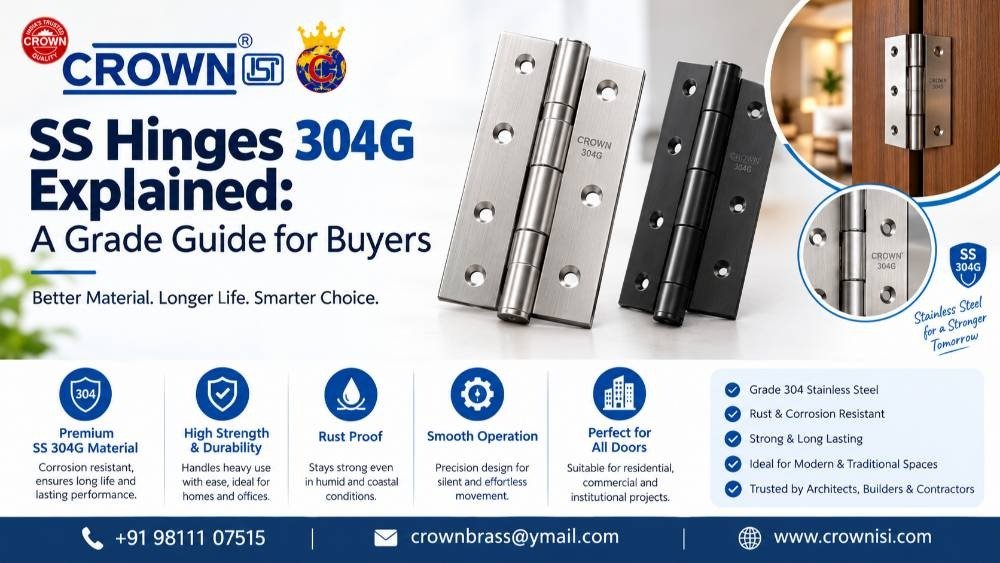
For procurement, the useful question is not simply whether a supplier claims Grade 304, but whether the material can be documented. Grade 304 Stainless Steel Hinges contain chromium and nickel in proportions that create a passive oxide layer, protecting the metal from corrosion. Grade 202 hinges contain manganese instead of some nickel. They look similar and cost less. They may also offer different corrosion performance.
A quality manufacturer will provide mill test certificates or material test reports confirming the steel grade. If a supplier cannot or will not provide this documentation, that is a red flag.
CROWN Industries manufactures SS Hinges 304G using genuine Grade 304 stainless steel, according to the applicable product specification. The company's product information is available for project review.
2. They Have a Documented Quality-Control and Testing Regime
Quality manufacturers should be able to explain how they control dimensions, material, load performance, corrosion resistance and repeated operation. Buyers should ask whether testing is performed on every batch, at defined intervals, or according to the manufacturer's documented quality-control plan.
Testing frequency, sampling procedures and acceptance criteria should be documented and appropriate to the product and applicable quality-control requirements. Testing frequency, method and acceptance criteria matter more than a generic statement that a product has been "tested."
CROWN's quality-control information states that load testing, 200-hour salt-spray testing, and 50,000-cycle testing form part of its manufacturing process. CROWN's published quality-control information states that its hinges undergo a 200-hour salt-spray test and 50,000-cycle test. These are additional product-level quality-control tests; buyers should request the applicable test documentation and compare the test method and acceptance criteria with the relevant standard.
Note on cycles: CROWN's published quality-control information refers to a 50,000-cycle product test. This should not be presented as a substitute for any endurance test required for BIS conformity under IS 12817:2020. For project approval, buyers should request the applicable BIS/test documentation and confirm the exact test method and acceptance criteria.
3. They Maintain Valid BIS Certification Under IS 12817:2020
The ISI Mark is not optional for covered SS Hinges. BIS licensing involves conformity-assessment requirements that may include product testing, factory assessment and surveillance under the applicable certification scheme.
CROWN states that it holds BIS Licence No. 8700097320 under IS 12817:2020 for stainless steel butt hinges. Buyers should verify the licence's current status and scope directly through the BIS portal before relying on the claim for procurement or project approval.
4. They Control the Manufacturing Process, Not Just Assembly
Not every company selling hinges operates the same type of manufacturing setup. Some businesses manufacture components in-house, while others may source or assemble products through third parties. For procurement, the important questions are traceability, quality control, documented responsibility and the scope of the manufacturer's certification.
CROWN's published company information identifies its manufacturing location in Sahibabad, Ghaziabad, Uttar Pradesh. The company describes its production process, including material inspection, forming, assembly, polishing, and quality checks. You can read more about the SS hinges manufacturing process on the CROWN blog.
5. They Provide Documentation, Not Just Assurances
A quality manufacturer can provide product datasheets, test reports, material certificates, and BIS licence details. If a supplier cannot provide relevant technical or compliance documentation, buyers should seek clarification before approving the supplier.
For project approval, request the fire-door test certificate (if applicable), doorset certification or listing documentation, hinge product datasheet, applicable BIS/ISI documentation, material specification, corrosion-test documentation, installation instructions, and the manufacturer compatibility statement.
6. They Understand the Difference Between Product Quality and Fire-Door Certification
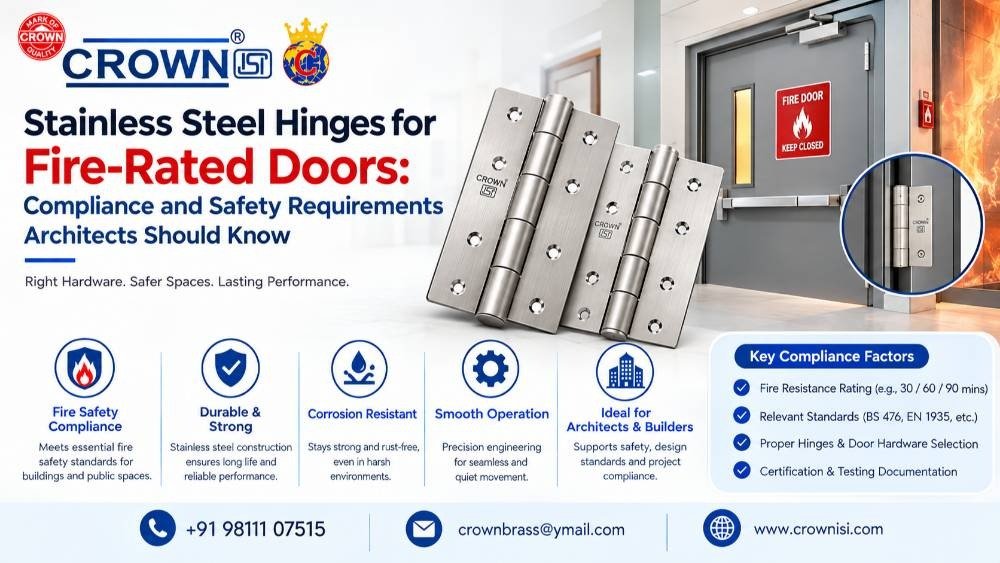
The important distinction is between hinge-level testing and complete doorset certification. A high-quality Stainless Steel Hinge is not automatically suitable for a fire-rated door. Fire-door suitability depends on the tested doorset and the applicable certification.
A responsible manufacturer will not claim that its hinges are "fire-rated" simply because they are made of Grade 304 steel. It will state that the hinge must be evaluated as part of the tested or certified doorset.
CROWN's product information includes this disclaimer: "These product-level tests should not be interpreted as fire-resistance certification for a complete doorset."
Quality Differentiators Checklist for SS Hinge Manufacturers
| Factor | What to Verify | Why It Matters |
|---|---|---|
| Steel Grade | Grade 304 confirmed by MTC or test report | Prevents premature corrosion and failure |
| BIS Licence | Valid licence under IS 12817:2020, verifiable on BIS portal | Regulatory conformity and certification verification |
| Testing Regime | Documented load, salt spray, and cycle testing | Consistent quality, not just sample-based claims |
| Manufacturing Control | Own manufacturing facility, not just assembly or trading | Traceability and process control |
| Documentation | Datasheets, test reports, material certificates available | Evidence for project approval |
| Fire-Door Awareness | Clear distinction between product QA and doorset certification | Prevents compliance errors |
| Traceability | Marked with manufacturer name or trademark | Accountability and recall capability |
How to Verify a Manufacturer's Claims
Step 1: Check the BIS Licence
BIS Scheme-I certification information provides online certification and product-certification information that buyers can use to verify applicable licence details and scope. If a manufacturer claims ISI certification but you cannot verify the relevant licence or scope through BIS, request clarification and supporting documentation before approval.
Step 2: Request the Material Test Certificate
A genuine Grade 304 SS Hinge will have a mill test certificate or material test report confirming the chemical composition. Compare the reported chemical composition with the specified material grade and applicable material standard. Do not identify the grade from manganese content alone.
Step 3: Ask for Test Reports
Request load test reports, salt spray test reports, and cycle test reports for the specific hinge model. A credible supplier should be able to provide relevant test documentation or explain what testing and certification records are available for the specific hinge model.
Step 4: Inspect the Hinge Physically
Check for sharp edges, burrs, and uneven finishes. Inspect the knuckle for smooth operation. Look for the manufacturer's name or trademark stamped on the hinge. IS 12817:2020 requires that hinges be legibly and indelibly marked with the manufacturer's name or trademark.
Step 5: Ask About the Fire-Door Application
If the hinge is intended for a fire-rated door, ask for the doorset test evidence. Do not accept a statement that "the hinge is fire-rated" without documentation linking that specific hinge model to a tested doorset.
The Role of BIS and the Hinges Quality Control Order
The Hinges (Quality Control) Order, 2025 establishes compulsory Standard Mark requirements for the covered hinge products listed in the order, including stainless steel butt hinges under IS 12817:2020, subject to applicable exemptions and transition provisions.
The Bureau of Indian Standards acts as the certification and enforcement authority. Violations of the order are subject to action under the Bureau of Indian Standards Act, 2016.
For procurement teams, this means the applicable BIS Standard Mark and licence requirements are now an important baseline for covered SS Hinges. Manufacturers supplying covered products for the Indian market should be checked against the applicable BIS licensing and Standard Mark requirements. The differentiator is what they do beyond it: the grade of steel they use, the rigorousness of their testing, the traceability of their materials, and the documentation they provide.
Grade 304 vs Grade 202: The Corrosion Difference That Matters
Grade 304 stainless steel contains chromium and nickel in proportions that create a stable passive oxide layer. This layer protects the steel from corrosion. Grade 202 contains manganese instead of some nickel. It may offer different corrosion performance.
Grade 304 generally provides better corrosion resistance than Grade 202 in many environments, but actual performance depends on exposure conditions, surface finish, fabrication, installation and maintenance.
Grade 304 is widely used for many inland architectural-hardware applications; the appropriate grade should still be selected according to the project's environmental and performance requirements. Grade 316 may be preferred where chloride exposure or severe corrosive conditions are significant. Grade 316 contains molybdenum, which provides additional resistance to chlorides.
Grade 202 should not be substituted for a specified Grade 304 hinge where the project specification requires Grade 304. Material grade should be verified against the applicable standard and project requirements.
CROWN's SS Hinge Manufacturing and Quality Information
CROWN Industries has been manufacturing door fittings and hardware for over 39 years. The company produces Stainless Steel Hinges 304G using Grade 304 stainless steel, according to the applicable product specification.
CROWN states that it holds BIS Licence No. 8700097320 under IS 12817:2020 for stainless steel butt hinges. Buyers requiring certification evidence should verify the current licence status and scope directly through BIS and request the applicable product documentation from the manufacturer.
CROWN's published quality-control information states that load testing, 200-hour salt-spray testing, and 50,000-cycle testing form part of its manufacturing process. For projects that require documented evidence, CROWN can provide product datasheets and test information for the specific hinge model.
The company's product range includes Stainless Steel Butt and Welded Hinges and a broader range of stainless steel door accessories.
CROWN's manufacturing location is in Sahibabad, Ghaziabad, Uttar Pradesh. The company serves architects, builders, and project managers across India. You can learn more about the company on the About CROWN page.
CROWN Quality Control Information
| Test | Purpose | CROWN's Published Information |
|---|---|---|
| Load testing | Verify load performance | Part of CROWN's quality-control process |
| Salt-spray testing | Evaluate corrosion resistance | 200-hour salt-spray test |
| Cycle testing | Evaluate repeated operation | 50,000 open-and-close cycles |
Note: These product-level tests should not be interpreted as fire-resistance certification for a complete doorset. Fire-door suitability depends on the tested doorset and the applicable certification. CROWN's published quality-control information refers to a 50,000-cycle product test. This should not be presented as a substitute for any endurance test required for BIS conformity under IS 12817:2020.
How to Choose an SS Hinges Manufacturer: A Procurement Framework
Step 1: Verify BIS Certification
Check the manufacturer's BIS licence under IS 12817:2020 through the BIS portal. Confirm the licence is operative and covers the specific hinge types and sizes you need.
Step 2: Request Material Documentation
Ask for mill test certificates or material test reports confirming Grade 304 steel. Verify chromium and nickel content against the applicable material specification.
Step 3: Request Performance Test Reports
Ask for load test reports, salt spray test reports, and cycle test reports. Compare the reported results against IS 12817:2020 requirements and the applicable test method.
Step 4: Inspect Product Samples
Order samples and inspect them physically. Check for burrs, sharp edges, smooth operation, and proper marking.
Step 5: Confirm Manufacturing Location
Verify that the manufacturer has its own production facility, not just a trading operation. This affects traceability and quality control.
Step 6: Request Project Documentation
For fire-rated doors, request the doorset test evidence. Do not accept product-level claims as substitutes for doorset certification.
Step 7: Check References
Ask for project references where the manufacturer's SS Hinges have been installed. If possible, visit a site and inspect the hinges after several years of use.
Common Mistakes When Buying SS Hinges in India
Mistake 1: Assuming all stainless steel is the same. Grade 202 and Grade 304 look identical but perform differently. Always verify the grade.
Mistake 2: Treating the ISI Mark as a quality guarantee. The ISI Mark confirms conformity with the standard. It does not mean the manufacturer goes beyond the minimum.
Mistake 3: Skipping material documentation. Without a mill test certificate, you cannot be certain of the steel grade.
Mistake 4: Accepting product-level claims for fire doors. A hinge that passes load and corrosion tests is not automatically suitable for a fire-rated doorset. The tested doorset certification takes precedence.
Mistake 5: Choosing on price alone. The lowest purchase price does not necessarily represent the lowest lifecycle cost. Material grade, hinge construction, installation, usage and maintenance all influence long-term performance.
Mistake 6: Not verifying the manufacturer's BIS licence. A claim of ISI certification is meaningless if the licence cannot be verified through BIS.
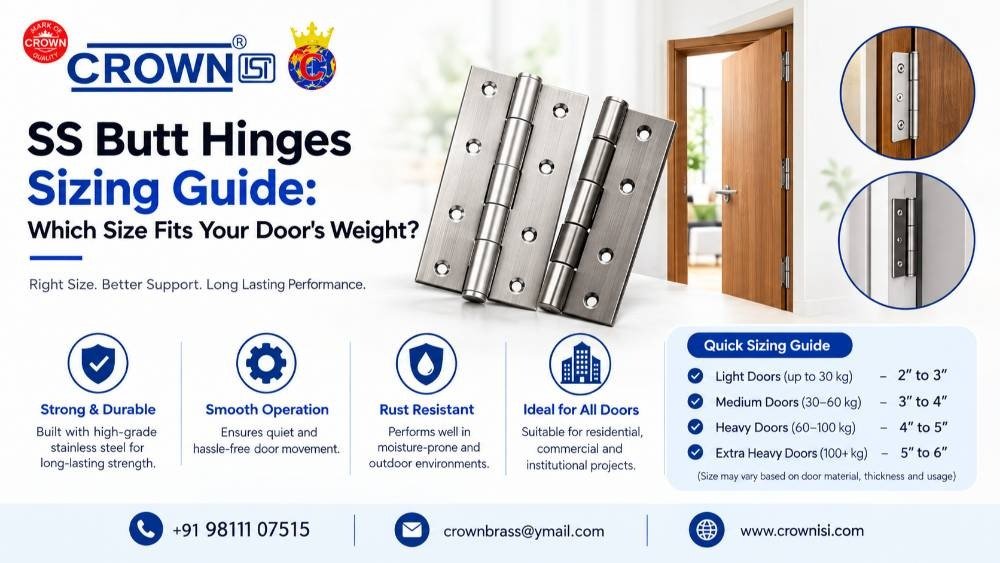
Mistake 7: Ignoring the installation requirements. Even a high-quality hinge will fail if installed incorrectly or if the door weight exceeds the hinge's rated capacity.
Frequently Asked Questions
Which stainless steel grade should I choose for hinges in India?
Grade 304 is widely used for architectural hardware in India and is suitable for many general-purpose and inland applications. Grade 316 may be preferred where chloride exposure or severe corrosive conditions are significant. Grade 304 is widely used for many inland architectural-hardware applications, but the appropriate grade should be selected according to the project's environmental and performance requirements. Grade 202 should not be substituted where the project specification requires Grade 304.
Is BIS certification mandatory for SS hinges in India?
Under the Hinges (Quality Control) Order framework, Stainless Steel Butt Hinges must conform to IS 12817:2020 and bear the BIS Standard Mark under a valid licence, subject to applicable exemptions and transition provisions. Businesses dealing with covered hinge products should verify the applicable BIS Standard Mark, licensing, exemption and transition requirements before placing products on the Indian market.
How can I verify a manufacturer's BIS licence?
BIS provides online certification and product-certification information that buyers can use to verify applicable licence details and scope. Verify that the licence is operative and covers the relevant product.
What is the difference between IS 12817:2013 and IS 12817:2020?
IS 12817:2020 is the third revision of the standard. It updates requirements for materials, dimensions, manufacture, and performance. The 2020 revision is the current applicable standard under the Hinges Quality Control Order framework.
How many cycles should a quality SS hinge withstand?
IS 12817:2020 specifies endurance requirements for operating cycles. CROWN's published quality-control information refers to a 50,000-cycle product test as an internal quality check. For project approval, request the applicable BIS/test documentation and confirm the exact test method and acceptance criteria.
What does salt spray testing mean for hinges?
Salt spray testing exposes the hinge to a concentrated salt solution under controlled conditions. It is an accelerated corrosion test used to evaluate resistance to rust in humid or coastal conditions. Buyers should verify the current IS 12817:2020 test method and acceptance criteria when reviewing supplier reports.
Can I use SS hinges on fire-rated doors?
Stainless steel hinges can be suitable for fire-rated doors, but only if they are part of the tested or certified doorset. The hinge itself does not carry a fire rating. The fire-door assembly is tested as a complete unit, including the hinges. Always refer to the doorset certification and manufacturer instructions.
What is the difference between Grade 304 and Grade 316 hinges?
Grade 304 contains approximately 18% chromium and 8% nickel. Grade 316 contains molybdenum in addition to chromium and nickel. The molybdenum provides additional resistance to chlorides, making Grade 316 more suitable for coastal or marine environments. Grade 304 is widely used for many inland architectural-hardware applications, but the appropriate grade should be selected according to the project's environmental and performance requirements.
How do I check if a hinge is genuine Grade 304?
Ask for a mill test certificate or material test report. Compare the reported chemical composition with the specified material grade and applicable material standard. Do not identify the grade from manganese content alone.
What should I look for when inspecting SS hinges?
Check for sharp edges, burrs, and uneven finishes. Inspect the knuckle for smooth operation. Look for the manufacturer's name or trademark stamped on the hinge. IS 12817:2020 requires that hinges be legibly and indelibly marked.
Final Thoughts
The Indian SS hinges market in 2026 is more regulated than ever before. The Hinges Quality Control Order framework has made BIS certification an important requirement for covered products. This changes the compliance baseline for covered hinge products and makes certification status an important part of supplier evaluation.
But regulation sets a floor, not a ceiling. The manufacturers that stand out are those that go beyond the minimum: using genuine Grade 304 steel, documenting their testing, maintaining rigorous quality control, and providing the documentation that project approval requires.
When you evaluate Stainless Steel Hinges manufacturers in India, look for the ISI Mark first. Then look beyond it. Ask for material certificates. Ask for test reports. Ask for the manufacturing location. Ask about fire-door suitability and doorset certification.
The lowest purchase price does not necessarily represent the lowest lifecycle cost. Material grade, hinge construction, installation, usage and maintenance all influence long-term performance.
CROWN Industries states that it manufactures SS Hinges 304G in India and holds BIS Licence No. 8700097320 under IS 12817:2020. Buyers requiring certification evidence should verify the current licence status and scope directly through BIS and request the applicable product documentation from the manufacturer. For projects that require documented evidence, the company can provide product datasheets and test information for the specific hinge model.
Need help specifying SS hinges for your project?
Share the following details:
- Hinge type and size required
- Door weight and usage frequency
- Project location and environmental conditions
- Required standard or certification
- Quantity required
Need documents for vendor approval? Request the applicable BIS documentation, product datasheet, material information and available test reports for the required hinge model. The CROWN technical team can help identify relevant hinge specifications and product documentation. Final project compliance should be confirmed against the applicable certification and project requirements. Contact CROWN to discuss your requirements.