 15 Sep, 2026
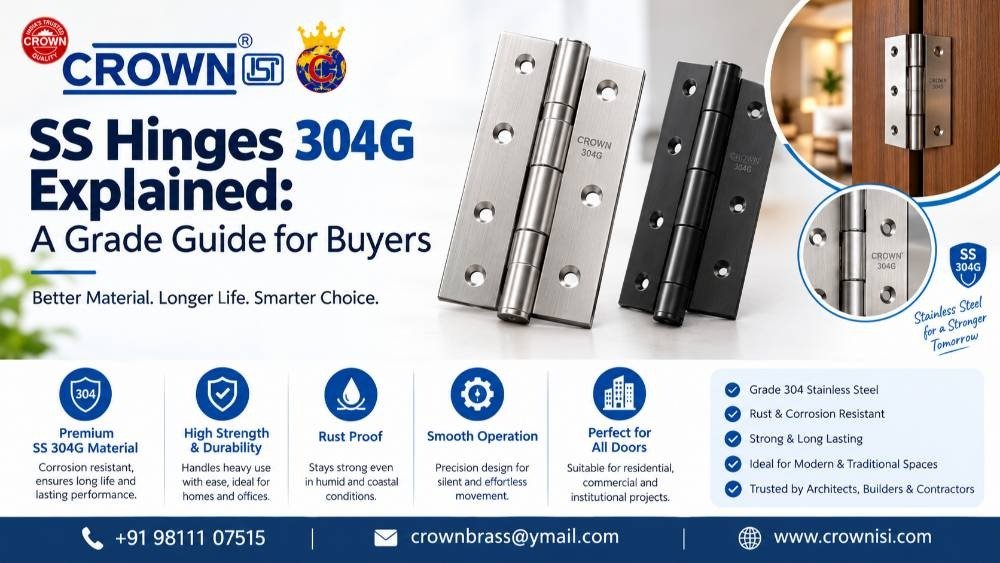
 SS Hinges 304G are stainless steel hinges made from Grade 304 stainless steel, typically associated with approximately 18% chromium and 8% nickel. In CROWN's product terminology, "304G" is used to identify its Grade 304 stainless-steel hinge range. "304" refers to the stainless-steel grade; "G" is a product designation used by CROWN rather than a separate stainless-steel grade or standalone international material standard. For covered hinge products in India, IS 12817:2020 applies and the Hinges Quality Control Order requires the BIS Standard Mark under a valid licence, subject to applicable exemptions and transition provisions. Buyers should verify material documentation, test reports, and certification status before approving any supplier.
What Does "304G" Actually Mean?
If you have been shopping for Stainless Steel Butt Hinges in India, you have likely come across the term "304G." It appears on product listings, packaging, and supplier quotations. But what does it actually mean?
SS Hinges 304G are hinges made from Grade 304 stainless steel. The "304" refers to the specific grade of stainless steel. The "G" is a product designation used by CROWN Industries to identify its Grade 304 hinge range.
It is not a separate grade of steel. It is not an international standard. It is a naming convention used within CROWN's product line. When you see Stainless Steel Hinges 304G, you are looking at a hinge made from Grade 304 stainless steel, marketed under a specific product range.
This distinction matters because some buyers assume "304G" means something more than it does. The important thing is the underlying material: Grade 304 stainless steel. That is what determines corrosion resistance, strength, and long-term performance.
Why Grade 304 Matters for Hinges
Before going deeper into SS Hinges 304G, it helps to understand why Grade 304 is commonly used for architectural hinges in India.
Stainless steel is not a single material. It is a family of alloys, each with different compositions and properties. The two most common grades you will encounter in the hinge market are Grade 304 and Grade 202.
Grade 304 contains chromium and nickel in proportions that create a passive oxide layer on the surface. This layer is invisible, but it is what protects the steel from corrosion. When the surface is scratched, the oxide layer reforms, continuing to protect the metal.
Grade 202 generally uses higher manganese and lower nickel than Grade 304. It looks similar. It costs less. It may offer different corrosion performance, particularly in humid or coastal environments.
For applications exposed to moisture, Grade 304 is commonly selected for its corrosion resistance, but the appropriate stainless-steel grade should be determined by the project's environmental conditions and performance requirements. Where chloride or severe corrosive exposure is significant, Grade 316 may be considered.
The difference may not be visible during a basic visual inspection. Corrosion performance can vary over time depending on the material grade and environment, which is why material documentation matters.
The Composition of Grade 304 Stainless Steel
Grade 304 stainless steel is an austenitic stainless steel. Its nominal composition typically includes:
| Element | Approximate Content |
|---|---|
| Chromium | 18–20% |
| Nickel | 8–10.5% |
| Carbon | 0.08% max |
| Manganese | 2% max |
| Silicon | 0.75% max |
| Phosphorus | 0.045% max |
| Sulfur | 0.03% max |
| Iron | Balance |
Chromium is the key alloying element responsible for the passive oxide layer that gives stainless steel its corrosion resistance. Nickel stabilizes the austenitic structure and contributes to properties such as toughness and formability. Together, they create a material that is strong, durable, and resistant to rust in many environments.
Exact composition limits should be checked against the applicable material specification, such as IS 6911 for stainless steel. The nominal 18/8 figures are a useful shorthand, but they are not a substitute for proper material certification.
For a hinge specified as Grade 304, ask the supplier for a mill test certificate or material test report confirming the material grade and chemical composition. If a supplier cannot provide this, buyers should seek clarification before approving the supplier.
What Makes SS Hinges 304G Different from Other Hinges?
Not all stainless steel hinges are created equal. Even within Grade 304, there are differences in manufacturing quality, dimensional accuracy, and testing.
When evaluating SS Hinges 304G from a manufacturer such as CROWN, buyers should look for:
- Documented Grade 304 stainless steel — with material conformity verified through appropriate documentation
- Dimensional accuracy — length, breadth, flap thickness, pin diameter, and knuckle configuration meeting the applicable standard
- Freedom from sharp edges and burrs — IS 12817:2020 requires this for safety and quality
- Proper marking — the manufacturer's name or trademark stamped on the hinge
- Testing — the manufacturer's documented quality-control programme may include load testing, corrosion testing, and cycle testing
CROWN's published quality-control information states that load testing, 200-hour salt-spray testing, and 50,000-cycle testing form part of its manufacturing process for Stainless Steel Hinges 304G. These are additional product-level quality-control tests; buyers should request the applicable test documentation and compare the test method and acceptance criteria with the relevant standard.
CROWN states that it holds BIS Licence No. 8700097320 under IS 12817:2020 for stainless steel butt hinges. Buyers should verify the licence's current status and scope directly through the BIS portal before relying on the claim for procurement or project approval.
IS 12817:2020: The Indian Standard for Stainless Steel Butt Hinges
For buyers in India, IS 12817:2020 is the relevant standard for Stainless Steel Butt Hinges. It is the third revision of the standard, and it specifies requirements for materials, dimensions, manufacture, finish, and performance.
The standard covers six types of stainless steel butt hinges:
- Light weight (narrow hinges)
- Light weight unequal flap hinges
- Medium weight hinges
- Medium weight (narrow hinges)
- Heavy weight unequal flat hinges
- Heavy weight hinges
It specifies the dimensions and tolerances for each type. The requirements include length, breadth, thickness of flap, diameter of hinge pin, number of knuckles, number of screw holes, and holes for screw number.
The standard requires that stainless steel for the flap conform to IS 6911 and stainless steel for the pin conform to IS 6528. It also requires that hinges be free from sharp edges and burrs and that they be legibly and indelibly marked with the manufacturer's name or trademark.
You can view the BIS standard document for IS 12817:2020 for more details.
BIS Certification and the Hinges Quality Control Order
In March 2025, the Ministry of Commerce and Industry issued the Hinges (Quality Control) Order, 2025. Under this order, Stainless Steel Butt Hinges must conform to IS 12817:2020 and bear the BIS Standard Mark (ISI Mark) under a valid licence from the Bureau of Indian Standards (BIS).
The implementation date was 1 July 2025. BIS has since issued subsequent exemption and transition-facilitation orders, including the Transition Facilitation (Quality Control) Order, 2026, issued in June 2026.
For procurement teams and buyers, this means that for covered products, BIS conformity is a regulatory requirement rather than a voluntary differentiator, subject to applicable exemptions and transition provisions.
The BIS Standard Mark demonstrates conformity with the applicable standard; buyers may still request additional material, testing and quality-control documentation when project specifications require evidence beyond basic conformity.
You can verify a manufacturer's BIS licence through the BIS Scheme-I certification information.
How SS Hinges 304G Are Tested
Testing provides evidence that a hinge meets its specified performance and quality requirements. Appearance alone cannot establish material grade or performance. Depending on the manufacturer's quality-control programme and the applicable project requirements, buyers may encounter tests such as load testing, corrosion testing, and cycle/endurance testing. For BIS-covered products, buyers should verify the applicable IS 12817:2020 conformity requirements and supporting test documentation.
Common testing areas include the following.
Load Testing
Load or performance testing can be used to assess how a hinge performs under specified loading conditions. The applicable test method, load and acceptance criteria should be checked against the relevant standard or project specification.
Salt Spray Testing
Salt spray testing evaluates corrosion resistance. The hinge is exposed to a concentrated salt solution under controlled conditions. This is an accelerated corrosion test used to assess corrosion performance under controlled laboratory conditions.
Cycle Testing
Cycle testing evaluates performance under repeated operation. The hinge is opened and closed repeatedly under specified test conditions to assess performance over the required number of cycles.
CROWN's Published Quality-Control Information
CROWN's published quality-control information states that its hinges undergo a 200-hour salt-spray test and a 50,000-cycle product test. These are additional product-level quality-control tests; buyers should request the applicable test documentation and compare the test method and acceptance criteria with the relevant standard.
Note on cycles: CROWN's published quality-control information refers to a 50,000-cycle product test. This should not be presented as a substitute for any endurance test required for BIS conformity under IS 12817:2020. For project approval, buyers should request the applicable BIS/test documentation and confirm the exact test method and acceptance criteria.
Grade 304 vs Grade 202 vs Grade 316: A Comparison
| Feature | Grade 304 | Grade 202 | Grade 316 |
|---|---|---|---|
| Chromium | 18–20% | 17–19% | 16–18% |
| Nickel | 8–10.5% | 4–6% | 10–14% |
| Molybdenum | No | No | Yes (2–3%) |
| Corrosion Resistance | Generally good | Generally lower than 304 | Generally higher, particularly for chloride exposure |
| Typical Applications | General architectural and many inland applications | Applications where specified and environmental exposure is suitable | Applications with significant chloride or severe corrosive exposure |
| Cost | Moderate | Lower | Higher |
Grade 304 is widely used for many inland architectural-hardware applications. The appropriate grade should still be selected according to the project's environmental and performance requirements.
Grade 316 contains molybdenum, which provides additional resistance to chlorides, making it more suitable for coastal or marine environments.
Grade 202 should not be substituted for a specified Grade 304 hinge where the project specification requires Grade 304. Material grade should be verified against the applicable standard and project requirements.
How to Verify SS Hinges 304G Quality Before Buying
Step 1: Check the BIS Licence
BIS provides online certification and product-certification information that buyers can use to verify applicable licence details and scope. If a manufacturer claims ISI certification but you cannot verify the relevant licence or scope through BIS, request clarification and supporting documentation before approval.
Step 2: Request the Material Test Certificate
For a hinge specified as Grade 304, ask the supplier for a mill test certificate or material test report confirming the material grade and chemical composition. Compare the reported chemical composition with the specified material grade and applicable material standard. Do not identify the grade from manganese content alone.
Step 3: Ask for Test Reports
Request load test reports, salt spray test reports, and cycle test reports for the specific hinge model. A credible supplier should be able to provide relevant test documentation or explain what testing and certification records are available for the specific hinge model.
Step 4: Inspect the Hinge Physically
Check for sharp edges, burrs, and uneven finishes. Inspect the knuckle for smooth operation. Look for the manufacturer's name or trademark stamped on the hinge. IS 12817:2020 requires that hinges be legibly and indelibly marked with the manufacturer's name or trademark.
Step 5: Compare Dimensions
The standard specifies dimensional requirements for hinge length, breadth, flap thickness, pin diameter, knuckle configuration and screw-hole arrangement. Buyers should compare supplier samples and technical drawings with the applicable requirements.
Common Mistakes When Buying SS Hinges 304G
Mistake 1: Assuming all stainless steel is the same. Grade 202 and Grade 304 look identical but perform differently. Always verify the grade.
Mistake 2: Treating the ISI Mark as a quality guarantee. The ISI Mark confirms conformity with the standard. It does not mean the manufacturer goes beyond the minimum.
Mistake 3: Skipping material documentation. Without appropriate material documentation or testing, buyers may not have sufficient evidence to verify the specified steel grade.
Mistake 4: Buying on price alone. The lowest purchase price does not necessarily represent the lowest lifecycle cost. Material grade, hinge construction, installation, usage and maintenance all influence long-term performance.
Mistake 5: Not verifying the manufacturer's BIS licence. A claim of ISI certification should be verified through BIS before relying on it for procurement or project approval.
Mistake 6: Ignoring the installation requirements. Even a high-quality hinge will fail if installed incorrectly or if the door weight exceeds the hinge's rated capacity.
Mistake 7: Not checking the door certificate for fire-rated applications. A high-quality Stainless Steel Hinge 304G is not automatically suitable for a fire-rated door. Fire-door suitability depends on the tested doorset and the applicable certification.
Frequently Asked Questions
What does "304G" mean in SS Hinges 304G?
The "304" refers to Grade 304 stainless steel. The "G" is a product designation used by CROWN Industries to identify its Grade 304 hinge range. It is not a separate grade of steel or an international standard. The important thing is the underlying material: Grade 304 stainless steel.
What is the difference between SS 304 and SS 304G hinges?
In CROWN's product terminology, "304G" identifies its Grade 304 stainless-steel hinge range. The "304" refers to the stainless-steel grade, while "G" is a product designation rather than a separate material grade. Buyers should still verify the material documentation for the specific product.
Is Grade 304 stainless steel good for hinges in India?
Grade 304 is widely used for architectural hardware in India and is suitable for many general-purpose and inland applications. It offers good corrosion resistance for many environments. Where chloride or severe corrosive exposure is significant, Grade 316 may be considered. The appropriate grade should be selected according to the project's environmental and performance requirements.
What is IS 12817:2020?
IS 12817:2020 is the Indian Standard for Stainless Steel Butt Hinges. It is the third revision of the standard and specifies requirements for materials, dimensions, manufacture, finish, and performance. It covers six types of stainless steel butt hinges.
Is BIS certification mandatory for SS Hinges 304G in India?
Under the Hinges (Quality Control) Order framework, Stainless Steel Butt Hinges must conform to IS 12817:2020 and bear the BIS Standard Mark under a valid licence, subject to applicable exemptions and transition provisions. Businesses dealing with covered hinge products should verify the applicable requirements before placing products on the Indian market.
How can I verify a manufacturer's BIS licence?
BIS provides online certification and product-certification information that buyers can use to verify applicable licence details and scope. Verify that the licence is operative and covers the relevant product.
What tests should SS Hinges 304G pass?
Testing should be assessed against the applicable IS 12817:2020 requirements and the manufacturer's documented quality-control programme. Depending on the product and project, buyers may also review load, corrosion, and cycle/endurance test reports. CROWN's published information states that its hinges undergo a 200-hour salt-spray test and a 50,000-cycle product test.
How do I check if a hinge is genuine Grade 304?
Marking can help identify a hinge, but it should not be treated as proof of material grade by itself. Ask for a mill test certificate or material test report and compare the reported composition with the specified material standard. Do not identify the grade from manganese content alone.
Can I use SS Hinges 304G on fire-rated doors?
Stainless steel hinges can be suitable for fire-rated doors, but only if they are part of the tested or certified doorset. The hinge itself does not carry a fire rating. The fire-door assembly is tested as a complete unit, including the hinges. Always refer to the doorset certification and manufacturer instructions.
What is the difference between Grade 304 and Grade 316 hinges?
Grade 304 contains approximately 18% chromium and 8% nickel. Grade 316 contains molybdenum in addition to chromium and nickel. The molybdenum provides additional resistance to chlorides, making Grade 316 more suitable for coastal or marine environments. Grade 304 is widely used for many inland architectural-hardware applications.
Final Thoughts
Grade 304 stainless-steel hinges are commonly selected for many architectural door applications in India, but the appropriate material grade and hinge specification should match the project's environment, door requirements, and applicable standards.
The quality of any hinge depends on more than the grade of steel. It depends on the manufacturing process, the dimensional accuracy, the testing regime, and the documentation the manufacturer can provide.
For products covered by the applicable QCO requirements, verify the BIS Standard Mark and licence status first. Then look beyond it. Ask for material certificates. Ask for test reports. Ask for the manufacturing location. Ask about fire-door suitability and doorset certification.
The lowest purchase price does not necessarily represent the lowest lifecycle cost. Material grade, hinge construction, installation, usage and maintenance all influence long-term performance.
CROWN Industries states that it manufactures Stainless Steel Hinges 304G in India and holds BIS Licence No. 8700097320 under IS 12817:2020. Buyers requiring certification evidence should verify the current licence status and scope directly through BIS and request the applicable product documentation from the manufacturer.
Need help specifying SS Hinges 304G for your project?
Share the following details:
- Hinge type and size required
- Door weight and usage frequency
- Project location and environmental conditions
- Required standard or certification
- Quantity required
Need documents for vendor approval? Request the applicable BIS documentation, product datasheet, material information and available test reports for the required hinge model. CROWN can help identify the relevant hinge specification and available product documentation based on your project requirements. Contact CROWN to discuss your requirements.