 16 Mar, 2026
 When you look at a door, what do you see? The wood, the paint, the handle, the lock. The things that catch your eye.
But what holds that door up? What takes the weight every time someone walks in or out? What keeps working silently, year after year, without ever getting noticed?
The hinges.
I have been working with doors and hardware for a long time. And I have seen the same mistake happen again and again. People spend money on beautiful doors and fancy handles. Then they pick the cheapest hinges they can find. Six months later, the door sags. The paint scrapes. The lock doesn't line up anymore. And they wonder what went wrong.
Here is the truth. SS Hinges are not something to cut corners on. They carry the weight. If they fail, everything else fails with them.
At Crown ISI, we make SS Handle 304G and hinges that actually last. Not just for a year. For decades. Let me walk you through the world of SS butt hinges—the types, the sizes, and where to use them. No jargon. Just practical stuff you can use.
What Are SS Butt Hinges?
First, let us get the name straight.
A butt hinge is the most common hinge you will see on doors. Two flat metal plates—called leaves—joined by a pin in the middle. One leaf screws into the door. The other screws into the frame. When the door opens, the leaves rotate around the pin.
The "SS" stands for stainless steel. That matters because stainless steel does not rust. It does not corrode. It stays strong even in humidity, rain, or salty air.
SS Butt Hinges are the workhorses of every home. They are simple, reliable, and when made right, they last forever.
Types of SS Butt Hinges
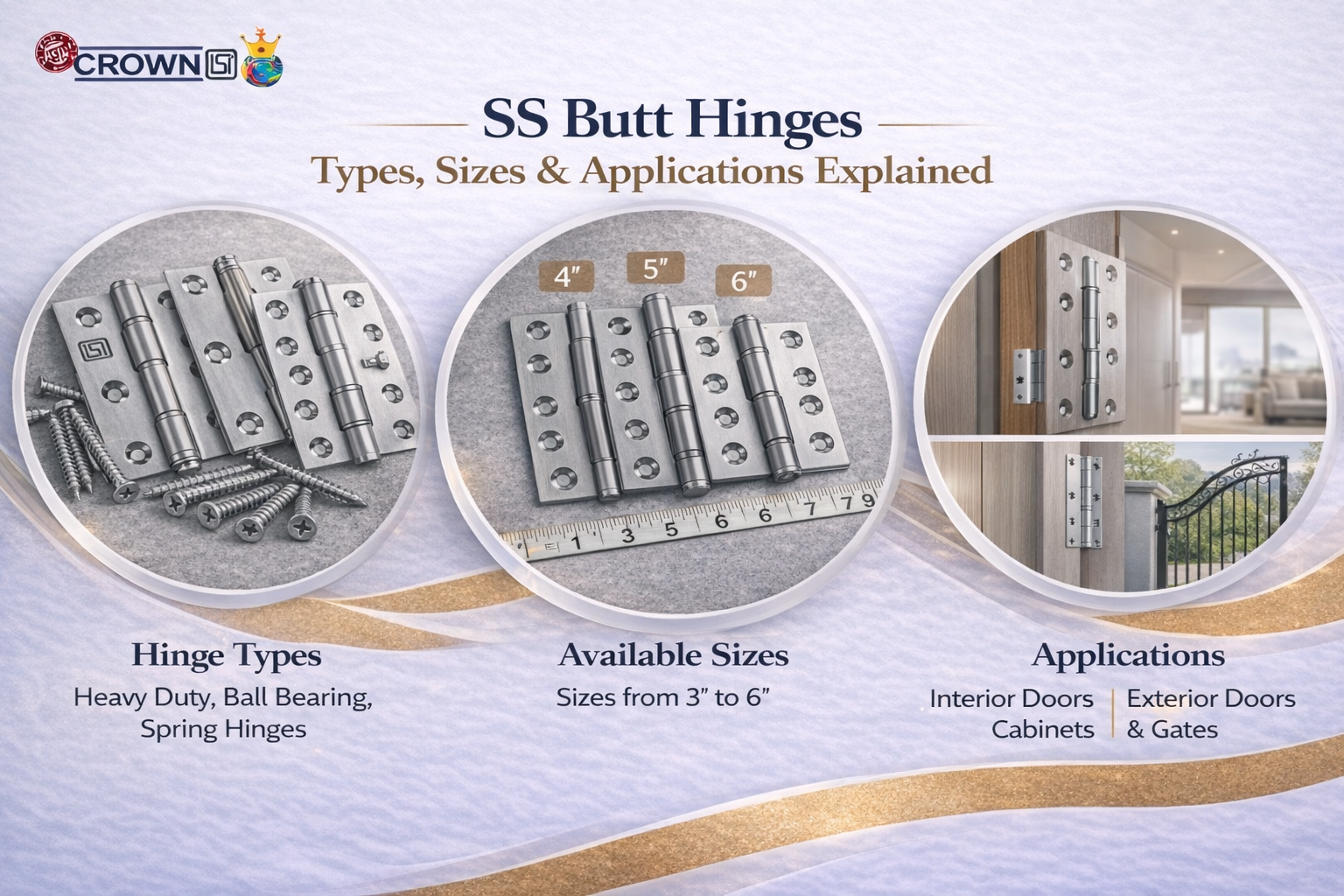
Not all butt hinges are the same. Here are the main types you will come across.
Standard Butt Hinge
This is the basic one. Two leaves, a pin, screw holes. You use it on internal doors, cupboard doors, light wooden doors. It is simple, strong, and does the job.
Heavy Duty Butt Hinge
This one is thicker. The steel is heavier. The pin is bigger. It is made for main doors, heavy wooden doors, commercial doors. If the door is solid wood and heavy, you need heavy duty.
all Bearing Butt Hinge
This one has ball bearings inside the knuckles where the pin goes through. The bearings reduce friction. The door moves smoothly even under heavy weight. These are tested to last for hundreds of thousands of cycles . For doors that get used constantly—office doors, main doors—ball bearing hinges are worth the extra money.
Rising Butt Hinge
This one has a clever design. As the door opens, the hinge lifts it slightly. As it closes, it lowers back down. Why does that matter? If you have thick carpets, the door used to scrape. The rising hinge lifts it clear. No scraping. No damage .
Fire Rated Butt Hinge
These are specially tested to withstand fire for a certain time—usually 60 minutes, 120 minutes, or 240 minutes . They are made for fire doors in commercial buildings, apartments, hotels. In a fire, ordinary hinges can fail. Fire rated hinges hold.
Removable Pin Hinge
On these hinges, the pin comes out. You can take the door off without unscrewing anything. Useful for moving furniture in and out, or for maintenance. Standard hinges often have fixed pins. Removable pins add convenience.
Sizes: Which One Do You Need?
Hinges come in sizes. The size is the length of the hinge leaf. Common sizes are 3 inch, 4 inch, 5 inch, and 6 inch.
Here is a simple rule of thumb.
|
Door Type |
Recommended Size |
Thickness |
Number of Hinges |
|
Cupboard door, small cabinet |
2 inch or 3 inch |
2mm to 2.5mm |
2 |
|
Bathroom door, small internal door |
3 inch |
2.5mm to 3mm |
3 |
|
Standard bedroom door |
4 inch |
3mm |
3 |
|
Main door, heavy wooden door |
5 inch or 6 inch |
3mm to 4mm |
3 |
|
Commercial door, high traffic |
5 inch or 6 inch with ball bearings |
3mm to 4mm |
3 |
For very heavy doors, go with 6 inch heavy duty. And always use three hinges. Two might hold at first, but over time, the weight distribution is uneven. Three hinges share the load. The door stays straight.
Applications: Where to Use Different Hinges
Different doors need different hinges. Here is where each type works best.
Internal Bedroom Doors
Standard 4-inch SS butt hinges, three per door. If the door is lightweight, 3-inch might work. But 4-inch is safe. No need for ball bearings unless the door is unusually heavy.
Main Entrance Doors
Heavy duty 5-inch or 6-inch SS butt hinges. Thick steel, strong pins. If the door gets a lot of use, ball bearing hinges are a good upgrade. They move smoothly and last longer .
Bathroom Doors
Bathrooms are humid. Moisture in the air, water splashes. Standard SS 304 hinges work fine here because they resist rust. Size depends on door weight—usually 3-inch or 4-inch.
Kitchen Doors
Kitchens have grease and moisture. SS hinges handle it easily. For kitchen cabinet doors, you might use smaller butt hinges or concealed hinges. For the main kitchen door, standard butt hinges are fine.
Offices and Commercial Spaces
High traffic means hinges wear out faster. Ball bearing butt hinges are the right choice here. They are tested for heavy use. Some are rated for 200,000 cycles or more .
Fire Doors
If you have fire doors, you need fire rated hinges. They look like regular hinges, but they are tested to hold in a fire. Check the rating—60 minutes, 120 minutes—and match it to your door .
Doors with Thick Carpets
If you have wall-to-wall carpets or thick rugs, the door might scrape. Rising butt hinges solve this. They lift the door as it opens. No scraping, no damage to the carpet .
Material Matters: Why 304G?
You will see hinges marked SS304, SS202, SS201. The number matters.
SS 304 has 18% chromium and 8% nickel . That combination creates a protective layer that stops rust. If the surface gets scratched, the layer heals itself. That is why SS 304 is the standard for good hardware.
Lower grades like 201 or 202 use less nickel. They are cheaper. But in humid conditions, in coastal areas, in bathrooms, they can rust. The brown spots show up. The hinge weakens.
When you buy SS Hinges, look for 304 grade. Ask the seller. Check the packaging. If it does not say 304, be careful.
At Crown ISI, we use genuine 304G stainless steel. Our SS Handle 304G and hinges are made to last in Indian conditions—the heat, the humidity, the dust, the salt.
How to Choose the Right Hinge
Here is a simple checklist.
- Weigh the door. Heavy door? Go heavy duty.
- Measure the door thickness. Thicker doors need bigger hinges.
- Count the hinges. Three per door. Always.
- Check the material. SS 304. Not 201, not 202.
- Consider the use. High traffic? Ball bearings. Fire door? Fire rated. Carpet? Rising hinge.
Installation Tips
Even good hinges fail if installed badly.
Mortise Them
Do not just screw the hinge onto the surface. Cut a shallow recess so the hinge sits flush with the wood. This is called mortising. It looks clean and transfers the weight properly.
Use the Right Screws
The screws that come with the hinge are the right length. Use them. If you use a screw that is too long, it can poke through the door. Too short, and it won't hold.
Check Alignment
Close the door slowly. Look at the gap around the door. It should be even—about 2 to 3 millimeters. If it is uneven, adjust by bending the hinge slightly or adding thin packing behind it.
Lubricate the Pin
Before you put the pin in, rub a pencil lead on it. Graphite is a dry lubricant. It keeps the hinge moving smoothly without attracting dust. Do not use oil.
Why Crown ISI?
Look, there is no shortage of cheap hinges in the market. Imported ones from China. Local ones made from recycled steel. They look shiny in the store. The problems start later.
Crown ISI has been making hardware for Indian homes since 1975 . That is nearly fifty years. We know what works here. Our SS Hinges are made from genuine 304G stainless steel. The thickness is consistent. The pins are strong. The finishes hold up.
When you buy Crown ISI, you are buying peace of mind. You will not have to replace these hinges in five years. You will not have to deal with rust or sagging. You fit them once and forget them.
Our SS Handle 304G range includes everything you need—handles, hinges, tower bolts, all matching in quality and finish.
Final Thoughts
Hinges are small. Easy to ignore. But they carry the weight of every door in your house. If the hinges fail, the door fails. The lock misaligns. The handle scrapes. Everything goes wrong.
Do not gamble on cheap hardware. Spend a little extra. Buy good SS Butt Hinges from Crown ISI. Choose the right type and size for your door. Install them properly. And then enjoy doors that work smoothly for decades.
That is what quality feels like. You do not notice it. It just works.
Frequently Asked Questions
1. What are the different types of SS Butt Hinges?
The main types are standard butt hinges, heavy duty butt hinges, ball bearing butt hinges, rising butt hinges, fire rated butt hinges, and removable pin hinges. Each is designed for a specific use .
2. What size SS hinge do I need for my door?
For standard bedroom doors, 4-inch hinges work. For main doors, go with 5-inch or 6-inch. For cupboard doors, 3-inch is enough. Always use three hinges per door .
3. What is the difference between SS304 and SS201 hinges?
SS304 has higher chromium and nickel content, making it much more rust-resistant. SS201 is cheaper but more likely to rust over time, especially in humid or coastal areas .
4. Are ball bearing hinges worth the extra cost?
For heavy doors or doors that get used constantly, yes. Ball bearing hinges move more smoothly and last longer. They are tested for hundreds of thousands of cycles .
5. What are rising butt hinges used for?
Rising butt hinges are used on doors that need to clear thick carpets or rugs. As the door opens, the hinge lifts it slightly, so it does not scrape the floor .
6. How many hinges should I use on a door?
Always use three hinges for a standard door. Two might hold a lightweight door temporarily, but three distribute the weight evenly and prevent sagging.
7. Do I need fire rated hinges?
If your door is a fire door, yes. Fire rated hinges are tested to hold in a fire for a certain time. Check the rating required for your building .
8. Can I use SS butt hinges outdoors?
Yes, SS 304 hinges are excellent for outdoor use. They resist rain and sun. For gates, welded hinges are usually better, but for outdoor wooden doors, SS butt hinges work fine.
9. How do I stop my hinge from squeaking?
Rub a pencil lead on the hinge pin. The graphite acts as a dry lubricant. If that does not work, remove the pin, clean it, and apply graphite powder. Do not use oil.
10. Does Crown ISI make SS Handle 304G products?
Yes. Crown ISI manufactures a full range of SS Handle 304G products, including hinges, handles, and tower bolts, all made from genuine 304 grade stainless steel.