 19 Sep, 2026
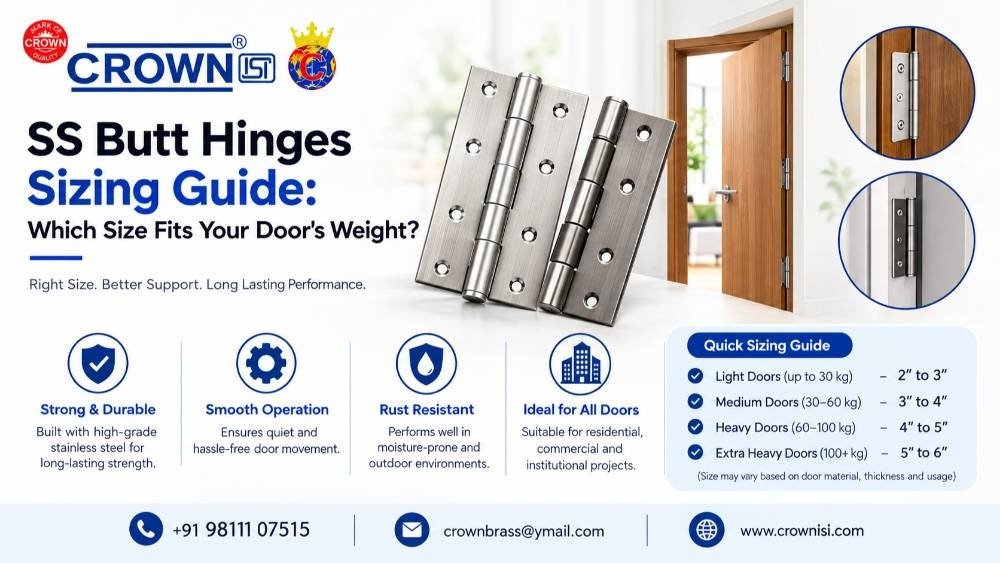
SS Butt Hinges should be selected according to door weight, door width and height, door thickness, usage frequency, fixing conditions and the manufacturer's tested load rating. As a general starting point, 75 mm hinges are commonly used for lighter doors, 100 mm hinges for standard architectural doors, and 125 mm hinges for wider or heavier applications. Hinge thickness also affects suitability, but there is no universal door-weight limit for every hinge size. For covered products in India, Stainless Steel Butt Hinges must conform to IS 12817:2020 and bear the BIS Standard Mark under a valid licence, subject to applicable exemptions and transition provisions.
Why Hinge Sizing Matters More Than You Think
A door hinge looks simple. Two metal leaves, a pin, a few screws. How complicated can it be?
The complication is not in the hinge itself. It is in what happens when the hinge is the wrong size for the door.
An undersized hinge on a heavy door does not fail immediately. It sags slowly. The door drops a few millimetres. Then a few more. Within a year, the door may be scraping the floor. The frame is damaged. The hinge screws are loose. Replacing the hinge is no longer enough. The frame may need repair, and possibly the door itself may need planing or replacement.
An oversized hinge may not fit the mortise cut into the door and frame, leading to installation difficulty and a poor fit.
The right SS Butt Hinge size sits in the middle: strong enough to carry the door without strain, sized to fit the mortise properly, and matched to the expected usage of the door.
This guide explains how to find that middle point.
The Factors That Determine Hinge Size
Hinge sizing starts with four core factors—door weight, door dimensions, door thickness and usage—but closer forces, fixing conditions, hinge construction and doorset requirements can also affect the final selection.
Door Weight
Door weight is the primary factor. A heavier door needs a larger, thicker hinge. The material of the door also matters. A solid teak door weighing 50 kg and a hollow-core door weighing 15 kg may have the same dimensions, but they require very different hinges.
Weighing the door is not always practical before installation. A better approach is to estimate the weight based on the door material and dimensions, then add a safety margin.
| Door Material | Approximate Weight (kg per square metre) |
|---|---|
| Hollow core flush door | 10–15 kg |
| Solid wood (softwood) | 20–30 kg |
| Solid wood (hardwood) | 30–50 kg |
| Fire door (solid core) | 25–45 kg |
| Glass door (10 mm) | 25–30 kg |
Indicative only. Actual door weight varies substantially with construction, core, thickness, glazing, reinforcement and hardware. Use the door manufacturer's documented weight whenever available.
Door Width and Height
A wider door places more leverage on the hinge. The hinge at the top of the door has to resist not just the downward force of the door's weight, but also the twisting force created by the door's width.
For doors wider than 950 mm, the adjusted door weight increases. One published hinge-selection method uses the following width adjustments for doors wider than 950 mm:
- 951 mm to 1,050 mm: add 10%
- 1,051 mm to 1,150 mm: add 20%
- 1,151 mm to 1,250 mm: add 30%
Door height also matters. Taller doors distribute weight differently. NFPA 80 provides hinge count provisions based on door height, with additional hinges required for taller doors. A door up to 60 inches (1,524 mm) high requires at least two hinges, with an additional hinge for each additional 30 inches (762 mm) of height or fraction thereof.
Door Thickness
Door thickness affects how much material is available for the hinge to grip. A thin door (30 mm or less) cannot accommodate a large hinge with a wide leaf. The hinge leaf must be narrower than the door thickness.
| Door Thickness | Recommended Hinge Leaf Width |
|---|---|
| 30–35 mm | 50–60 mm |
| 35–45 mm | 60–75 mm |
| 45 mm or more | 75–100 mm |
Usage Frequency
A door that opens 50 times a day needs a more durable hinge than a cupboard door that opens twice a day. High-traffic doors may benefit from ball-bearing or other low-friction hinge designs, depending on the manufacturer's specification and expected duty cycle.
The BS EN 1935 durability classification addresses this: Grade 4 hinges are rated for 25,000 cycles, Grade 7 hinges for 200,000 cycles.
IS 12817:2020 Hinge Sizes and Dimensions
For buyers in India, IS 12817:2020 is the relevant standard for Stainless Steel Butt Hinges. It specifies the dimensions and tolerances for six types of hinges. The standard covers dimensions and tolerances including hinge length, breadth, flap thickness, hinge-pin diameter, number of knuckles, number of screw holes, and screw-hole size.
The table below shows common hinge sizes used in Indian construction. These are drawn from standard sizes specified in CPWD schedules and IS 12817 documentation.
| Hinge Size (mm) | Type | Common Thickness (mm) | Typical Door Application |
|---|---|---|---|
| 50 x 37 x 1.50 | Light weight | 1.5 | Cabinet doors, light interior doors |
| 75 x 47 x 1.80 | Light weight | 1.8 | Light interior doors |
| 75 x 50 x 2.50 | Heavy weight | 2.5 | Medium interior doors |
| 100 x 58 x 1.90 | Light weight | 1.9 | Standard interior doors |
| 100 x 60 x 2.50 | Heavy weight | 2.5 | Standard doors, medium weight |
| 125 x 64 x 1.90 | Light weight | 1.9 | Wide interior doors |
| 125 x 64 x 2.50 | Heavy weight | 2.5 | Heavy doors, main entrance doors |
These sizes are for reference. The exact dimensions and tolerances should be confirmed against the applicable standard and the manufacturer's product specification.
You can view the BIS standard document for IS 12817:2020 for more details.
How to Calculate Your Door's Adjusted Weight
Selecting a hinge by the door's actual weight alone can lead to undersizing. Several factors increase the load on the hinge. The industry approach is to calculate the adjusted door weight.
Step 1: Estimate the Actual Door Weight
Estimate the door weight based on material and dimensions. For a solid teak door measuring 2,100 mm x 900 mm x 40 mm, the volume is approximately 0.0756 cubic metres. Teak has a density of roughly 650 kg per cubic metre, so the door weighs approximately 49 kg.
Step 2: Add for Door Closer
One published hinge-selection method, such as Lockwood's, adds 20% for a standard door closer. Where back-check is used, that method applies a higher allowance. The exact adjustment should follow the hinge manufacturer's published selection method.
Adjusted weight with door closer = 49 kg + 20% = 58.8 kg.
Step 3: Add for Excessive Door Width
One published hinge-selection method uses the following width adjustments for doors wider than 950 mm:
- 951 mm to 1,050 mm: add 10%
- 1,051 mm to 1,150 mm: add 20%
- 1,151 mm to 1,250 mm: add 30%
For a door 1,000 mm wide, the adjustment is 10%.
Adjusted weight = 58.8 kg + 10% = 64.7 kg.
Step 4: Match to Hinge Capacity
The resulting adjusted weight is approximately 64.7 kg. The next step is to compare this figure with the manufacturer's tested hinge-selection table and confirm the appropriate hinge size, thickness and number of hinges.
The formula is:
Adjusted Door Weight = Actual Weight + Door Closer Adjustment + Width Adjustment
Matching Hinge Size to Door Weight: A Practical Guide
The table below provides a general starting point for matching SS Butt Hinges to door weight. Hinge size and thickness alone do not establish a universal door-weight capacity.
| Hinge Size | Typical Thickness | General Application | Final Selection |
|---|---|---|---|
| 75 mm | 1.8–2.5 mm | Light interior doors | Check manufacturer rating |
| 100 mm | 1.9–2.5 mm | Standard architectural doors | Check manufacturer rating |
| 100 mm | 3.0 mm | Heavier applications | Check manufacturer rating |
| 125 mm | 2.5–3.0 mm | Wider or heavier doors | Check manufacturer rating |
Hinge size and thickness alone do not establish a universal door-weight capacity. Actual capacity depends on hinge design, bearing arrangement, fixing method, number and position of hinges, door dimensions, usage and the manufacturer's tested rating. Use the manufacturer's published load rating for final selection.
For fire-rated doors, hinge selection must also comply with the tested doorset certification. A high-quality Stainless Steel Butt Hinge is not automatically suitable for a fire-rated door. The hinge must be part of the tested or certified doorset assembly.
Hinge Thickness: One Part of Hinge Construction
Hinge thickness is measured in millimetres and indicates the gauge of the steel. Hinge thickness is one important part of hinge construction. A thicker leaf can provide greater resistance to deformation, but thickness alone does not establish the hinge's load capacity. Hinge design, material, pin and knuckle construction, fixing method, bearing arrangement and tested performance also affect suitability.
Common thicknesses for SS Butt Hinges in India are:
- 1.5 mm: Light-duty hinges for cabinet doors and very light applications.
- 1.8 mm: Light-duty hinges for standard interior doors.
- 1.9 mm: Light-weight hinges for standard doors.
- 2.5 mm: Heavy-weight hinges for medium to heavy doors.
- 3.0 mm: Heavy-duty hinges for heavy doors, high-traffic areas, and fire doors.
The CPWD schedule for IS 12817 marked Stainless Steel Butt Hinges lists heavy-weight hinges in 2.5 mm thickness for sizes 75 mm, 100 mm, and 125 mm. A 3.0 mm thickness is available in some product ranges for heavier applications, including the CROWN stainless steel butt and welded hinges range.
For heavier or high-use applications, 2.5 mm and 3.0 mm hinge options may be available, but the appropriate thickness should be selected according to the door, hinge type, usage, fixing conditions and manufacturer's rating. For fire-rated doors, selection must follow the tested or certified doorset requirements rather than thickness alone.
Grade Selection: 304 vs 202 vs 316
Hinge sizing is not just about dimensions. The grade of stainless steel affects corrosion resistance and long-term performance.
| Grade | Chromium | Nickel | Molybdenum | Corrosion Resistance | Best For |
|---|---|---|---|---|---|
| 304 | 18–20% | 8–10.5% | No | Good | General architectural, inland, humid environments |
| 202 | 17–19% | 4–6% | No | Lower than 304 | Applications where specified and environmental exposure is suitable |
| 316 | 16–18% | 10–14% | Yes (2–3%) | Excellent | Coastal, marine, chloride-rich environments |
Grade 304 is widely used for many inland architectural applications in India. It offers good corrosion resistance for most environments. For coastal projects with high salt exposure, Grade 316 may be preferred.
Grade 202 should not be substituted for a specified Grade 304 hinge where the project specification requires Grade 304. Material grade should be verified against the applicable standard and project requirements.
CROWN Industries manufactures SS 304 Stainless Steel Butt Hinges using genuine Grade 304 stainless steel, according to the applicable product specification.
CROWN Stainless Steel Butt Hinges: Sizes and Specifications
CROWN Industries has been manufacturing door fittings and hardware for over 39 years. The company produces CROWN Stainless Steel Butt Hinges in a range of sizes and thicknesses to suit different door weights and applications.
CROWN's published product information includes butt hinges in sizes of 75 mm, 100 mm, and 125 mm, with thicknesses ranging from 1.5 mm to 3.0 mm. The product range includes both standard butt hinges and ball-bearing hinges.
CROWN states that it holds BIS Licence No. 8700097320 under IS 12817:2020 for stainless steel butt hinges. Buyers should verify the licence's current status and scope directly through the BIS portal before relying on the claim for procurement or project approval.
CROWN's published quality control information states that load testing, 200-hour salt-spray testing, and 50,000-cycle testing form part of its manufacturing process. These are additional product-level quality-control tests; buyers should request the applicable test documentation and compare the test method and acceptance criteria with the relevant standard.
For projects that require documented evidence, CROWN can provide product datasheets and test information for the specific hinge model. You can learn more about the company on the About CROWN page.
Step-by-Step Hinge Sizing Framework
Here is a practical framework for selecting the right SS Butt Hinges for any door.
Step 1: Determine the Door Material and Estimated Weight
Identify the door material and estimate the weight based on dimensions and density. If the door manufacturer provides a weight specification, use that figure.
Step 2: Measure the Door Width and Height
Measure the door width and height. If the width exceeds 950 mm, calculate the width adjustment. If the height exceeds 1,524 mm (60 inches), check whether additional hinges are required.
Step 3: Account for Door Closer
If a door closer will be fitted, add 20% to the door weight for a standard closer, or a higher percentage for a closer with back-check.
Step 4: Calculate Adjusted Door Weight
Add the door closer adjustment and the width adjustment to the actual door weight.
Step 5: Select the Hinge Size and Thickness
Compare the adjusted door weight with the manufacturer's tested hinge-selection table and confirm the appropriate hinge size, thickness and number of hinges. For heavier applications, consult the manufacturer for specific load ratings.
Step 6: Determine the Number of Hinges
As a general rule, use three hinges for standard doors. For taller doors, add an additional hinge. NFPA 80 provides hinge count provisions based on door height for fire-rated assemblies.
Step 7: Select the Grade of Stainless Steel
Choose Grade 304 for most inland applications. Choose Grade 316 for coastal or highly corrosive environments. Verify the material grade through a mill test certificate or material test report.
Step 8: Verify Certification and Documentation
For covered products in India, verify the BIS Standard Mark and licence status through the BIS Scheme-I certification information. Request the product datasheet, material certificate, and test reports for the specific hinge model.
Common Sizing Mistakes to Avoid
Mistake 1: Selecting hinges by door dimensions alone. Two doors of the same size can weigh very different amounts depending on material. Always consider the material and weight.
Mistake 2: Forgetting the door closer adjustment. A door closer adds significant load to the hinges. Adding 20% to the door weight is a standard industry practice.
Mistake 3: Ignoring door width. A wider door creates more leverage on the hinges. The width adjustment for doors over 950 mm is important for correct sizing.
Mistake 4: Using too few hinges. Two hinges are the minimum for a standard door. For heavier doors or taller doors, three or more hinges may be required.
Mistake 5: Choosing a hinge that is too thin for the door weight. A 1.8 mm hinge is not suitable for a heavy solid wood door. Match the hinge thickness to the door weight, usage and manufacturer's rating.
Mistake 6: Assuming all stainless steel is the same. Grade 202 and Grade 304 can look very similar during a basic visual inspection, but their composition and corrosion performance differ. Always verify the specified grade through appropriate documentation or testing.
Mistake 7: Using a product-level hinge on a fire-rated door without checking the doorset certification. The hinge must be part of the tested or certified doorset assembly.
Mistake 8: Not verifying the manufacturer's BIS licence. A claim of ISI certification should be verified through BIS before relying on it for procurement or project approval.
Frequently Asked Questions
What size SS Butt Hinge do I need for a standard door?
For a standard interior door, a 100 mm hinge with 2.5 mm thickness is commonly used. For heavier doors, a 125 mm hinge with 2.5 mm or 3.0 mm thickness may be appropriate. The final selection should be based on the adjusted door weight, the manufacturer's published load limits, and the applicable standard.
How do I calculate the adjusted door weight for hinge selection?
Adjusted door weight = actual door weight + door closer adjustment (add 20% for a standard closer) + width adjustment (add 10% for doors 951–1,050 mm wide, 20% for 1,051–1,150 mm, and 30% for 1,151–1,250 mm). These adjustments follow one published hinge-selection method; the exact figures should be confirmed against the hinge manufacturer's published method.
What is the difference between 75 mm, 100 mm, and 125 mm hinges?
These sizes refer to the hinge length (the height of the hinge leaf). A 75 mm hinge is smaller and suited to light doors. A 100 mm hinge is the standard size for most interior doors. A 125 mm hinge is larger and suited to heavier or wider doors.
How many hinges do I need for a heavy door?
For a standard door, three hinges are commonly used. For doors over 60 inches (1,524 mm) in height, an additional hinge may be required. NFPA 80 provides hinge count provisions based on door height for fire-rated assemblies. The manufacturer's instructions and the applicable standard should be checked.
What thickness of SS Butt Hinge is best for a heavy door?
For heavy doors, a thickness of 2.5 mm or 3.0 mm may be appropriate. The CPWD schedule for IS 12817 marked heavy-weight hinges lists 2.5 mm thickness for sizes 75 mm, 100 mm, and 125 mm. A 3.0 mm thickness is available for heavier applications. The manufacturer's rating and the applicable standard should be checked.
Can I use SS Butt Hinges on fire-rated doors?
Stainless steel hinges can be suitable for fire-rated doors, but only if they are part of the tested or certified doorset. The hinge itself does not carry a fire rating. The fire-door assembly is tested as a complete unit, including the hinges. Always refer to the doorset certification and manufacturer instructions.
What is the difference between Grade 304 and Grade 316 hinges?
Grade 304 contains approximately 18% chromium and 8% nickel. Grade 316 contains molybdenum in addition to chromium and nickel. The molybdenum provides additional resistance to chlorides, making Grade 316 more suitable for coastal or marine environments. Grade 304 is widely used for many inland architectural applications.
How do I verify the quality of SS Butt Hinges before buying?
Ask for a mill test certificate or material test report confirming the steel grade. Request load test reports, salt spray test reports, and cycle test reports for the specific hinge model. Check that the hinge is marked with the manufacturer's name or trademark. For covered products in India, verify the BIS Standard Mark and licence status through the BIS portal.
What is IS 12817:2020?
IS 12817:2020 is the Indian Standard for Stainless Steel Butt Hinges. It is the third revision of the standard and specifies requirements for materials, dimensions, manufacture, finish, and performance. It covers six types of stainless steel butt hinges.
Does hinge size affect door operation?
Yes. An undersized hinge may cause the door to sag, scrape the floor, and eventually fail. An oversized hinge may not fit the mortise properly and can be difficult to install. The correct hinge size ensures smooth operation and long service life.
Final Thoughts
Sizing SS Butt Hinges correctly requires attention to several factors: door weight, door width, door thickness, usage frequency, and the manufacturer's tested load rating. An adjusted door-weight calculation can provide a useful starting point for hinge selection when it follows the manufacturer's published method and accounts for factors such as door closers and door width.
For buyers in India, IS 12817:2020 is the relevant standard for Stainless Steel Butt Hinges. The standard specifies dimensions and tolerances for common sizes including 75 mm, 100 mm, and 125 mm, in light-weight and heavy-weight types. Hinge thickness, material grade, and certification all contribute to suitability. The appropriate specification should be selected according to the door, hinge type, usage, fixing conditions and manufacturer's rating.
Grade 304 stainless steel is widely used for inland applications. Grade 316 may be preferred for coastal or highly corrosive environments. Material grade should be verified through mill test certificates or material test reports.
For covered products in India, verify the BIS Standard Mark and licence status first. Then look beyond it. Ask for material certificates. Ask for test reports. Ask about fire-door suitability and doorset certification.
CROWN Industries manufactures CROWN Stainless Steel Butt Hinges in India and states that it holds BIS Licence No. 8700097320 under IS 12817:2020. Buyers requiring certification evidence should verify the current licence status and scope directly through BIS and request the applicable product documentation from the manufacturer.
Need help sizing SS Butt Hinges for your project?
Share the following details:
- Door material and estimated weight
- Door width and height
- Door thickness
- Usage frequency
- Whether a door closer will be fitted
- Project location and environmental conditions
- Required standard or certification
- Quantity required
Need documents for vendor approval? Request the applicable BIS documentation, product datasheet, material information and available test reports for the required hinge model. CROWN can help identify the relevant hinge specification and available product documentation based on your project requirements. Contact CROWN to discuss your requirements.