 24 Nov, 2026
Are mild steel door accessories good?
Yes, for indoor and sheltered doors where strength matters. They need a good coating and basic care to resist rust.
How do I stop mild steel door accessories from rusting?
Choose zinc plated pieces, keep them dry, touch up scratches early and oil moving parts regularly.
When should I choose stainless steel instead?
Choose stainless steel for bathrooms, kitchens, coastal homes and any door exposed to regular moisture.
Why Trust This Guide?
| Trust Signal | Details |
|---|---|
| Updated for 2026 | Reflects current practice in Indian workshops, homes and commercial buildings |
| Hands-On Knowledge | Written by a team that works with mild steel, stainless steel, brass and aluminium |
| Reference Sources | Steel overview and Rust overview |
| Transparent Authorship | Prepared by Crown Industries, who manufacture mild steel door accessories |
Last Reviewed: November 2026
Introduction
Mild steel is the quiet workhorse of door hardware. It is strong, easy to form and kinder to a tight budget than many other metals, which is why mild steel door accessories turn up in warehouses, workshops, schools, farms and everyday homes. The catch is simple and well known: unprotected steel rusts.
Rust is not a mystery, though. It is a coating problem, a placement problem and a maintenance problem, and all three can be managed. This guide explains where mild steel door accessories make sense, how zinc plating and other coatings protect them and how to stop rust before it starts.
What Are Mild Steel Door Accessories?
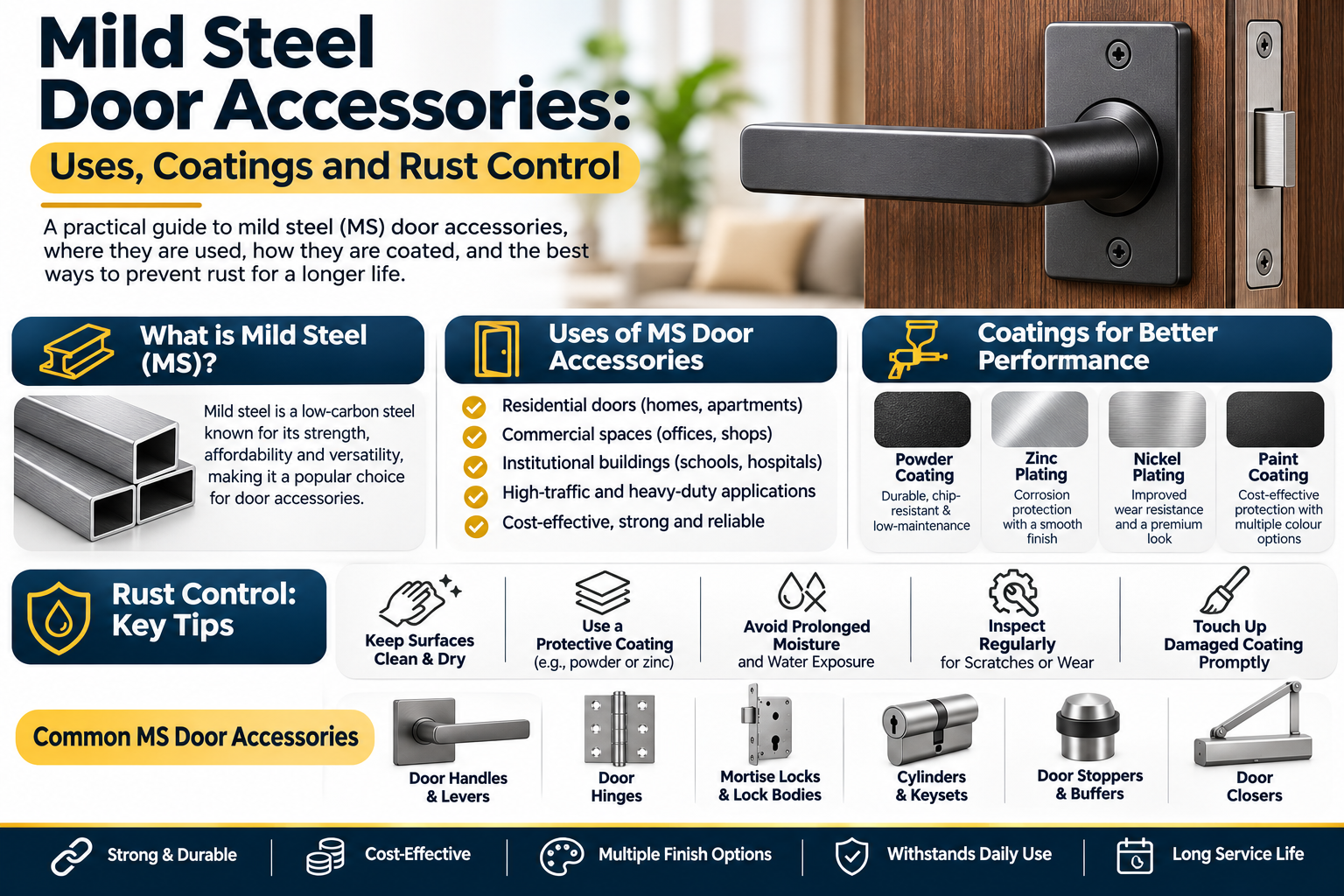
Mild steel is a low-carbon steel that is tough, weldable and easy to shape. In door hardware it is used for hinges, aldrops, tower bolts, hasps, telescopic channels, latches and heavy-duty brackets. The Crown Industries mild steel door accessories range includes items such as arrow hinges and zinc plated telescopic channels. For background on the metal, see Wikipedia.
Where Mild Steel Door Accessories Work Well
| Location | Why Mild Steel Suits It | Protection Needed |
|---|---|---|
| Indoor utility doors | Strong and economical for everyday use | Zinc plating or paint |
| Workshops and godowns | Handles rough treatment | Plating plus occasional oiling |
| Gates and grills | Weldable and heavy duty | Primer and paint |
| Cupboards and cabinets | Neat, hidden fittings | Light plating |
| Sheltered balconies | Acceptable when coated | Zinc plating and regular checks |
Mild steel door accessories are not the best fit for bathrooms, kitchens near wet zones or coastal exteriors, where stainless steel or brass will last longer. See stainless steel door accessories or brass door accessories for those spots.
How Rust Starts
Rust forms when iron reacts with oxygen and moisture. A scratch in the coating, a damp wall or a salty breeze is enough to begin the process, which then spreads under the surface. Understanding the basics, as covered under rust, helps you choose the right protection.
Protective Coatings Compared
| Coating | How It Protects | Strengths | Limits |
|---|---|---|---|
| Zinc plating | Thin zinc layer sacrifices itself before the steel | Neat finish, economical | Can wear at hinges and edges |
| Hot-dip galvanising | Thicker zinc coating | Strong outdoor protection | Rougher appearance |
| Paint or powder coat | Barrier against water | Colour options | Chips expose bare steel |
| Oil or wax | Temporary film | Simple maintenance | Needs repeating |
Zinc plated mild steel door accessories are popular because they balance strength and protection for indoor and sheltered use. For heavier exposure, thicker coatings or a change of metal are wiser.
How to Choose Good Mild Steel Door Accessories
- Check the thickness of the steel. Thin pressed pieces bend and fatigue.
- Look at the coating for evenness, with no bare spots or flaking.
- Test moving parts and make sure they swing without grinding.
- Make sure screw holes are clean, because rough holes damage the coating during fitting.
- Confirm that the weight matches the door, since heavier doors need heavier hinges.
- Buy fixings of the same finish to avoid weak links.
Preventing Rust on Mild Steel Door Accessories
- Fit correctly: avoid scratching the coating with the screwdriver.
- Keep dry: wipe away splashes and fix leaks near the door.
- Touch up early: a dab of zinc-rich paint on a scratch stops rust spreading.
- Oil moving parts: a drop of light machine oil keeps pins free and repels water.
- Inspect each season: check hinges, bolts and channels after the monsoon.
- Replace in time: a badly rusted hinge can fail without warning.
Mild Steel vs Stainless Steel
| Factor | Mild Steel | Stainless Steel |
|---|---|---|
| Rust resistance | Needs coating and care | Naturally resistant, depends on grade |
| Strength | High | High |
| Best for | Indoor, utility and industrial doors | Wet, coastal and high-visibility doors |
| Maintenance | Regular checks | Minimal |
Many projects mix both. They use mild steel door accessories where fittings stay dry and stainless steel where moisture is likely. If you also use stainless steel butt and welded hinges, keep the screws consistent too.
Where to Buy Mild Steel Door Accessories
Crown Industries produces mild steel door accessories alongside aluminium, stainless steel and brass in Sahibabad, Ghaziabad. Quality checks cover raw material, production and packing, as outlined on the quality control page. Dealers and contractors can enquire through the contact page.
Expert Tip
Check the coating at the edges and inside screw holes before you accept a delivery of mild steel door accessories. That is where plating wears thinnest and where rust usually begins.
Reviewed By
Door hardware specialists with practical experience in metal fabrication, finishing and quality inspection. This content is reviewed periodically to match current standards and market practice.
Frequently Asked Questions (FAQs)
1. What are mild steel door accessories used for?
They are used for hinges, bolts, aldrops, channels and brackets on indoor, utility and industrial doors.
2. Is zinc plating enough for outdoor use?
Zinc plating suits sheltered areas. For fully exposed doors, thicker galvanising or stainless steel is a better choice.
3. Will mild steel rust in a bathroom?
It can, because of constant moisture. Stainless steel or brass is safer for bathrooms.
4. How long do mild steel door accessories last?
With good coating and dry conditions they last for years. Neglected, damp installations fail much sooner.
5. Can I paint mild steel door accessories?
Yes. Clean the surface, apply a primer and then paint. Paint adds a barrier and allows colour matching.
6. What is a telescopic channel?
It is a sliding channel fitting used on doors and shutters. Zinc plated versions resist corrosion in dry, covered areas.
7. Are mild steel hinges strong enough for heavy doors?
Yes, when the steel is thick and the hinge is correctly sized. Heavy doors should have three hinges.
8. Does mild steel need maintenance?
Yes. Check coatings each season, touch up scratches and add a drop of oil to moving parts.
9. Can mild steel and stainless steel be combined?
They can, but keep them from touching constantly in damp areas, because mixed metals can accelerate corrosion.
10. Where can I see Crown Industries mild steel products?
Visit the mild steel door accessories page or call the team to request the catalogue.
Conclusion
Mild steel door accessories are strong, practical and sensible when they stay dry and wear a good coating. Check the steel thickness, the plating and the moving parts, and keep up simple seasonal checks.
For dependable hardware, explore Crownisi, made in Ghaziabad and supplied across India. Call +91 98111 07515 or read more on our blog.