 27 Sep, 2026
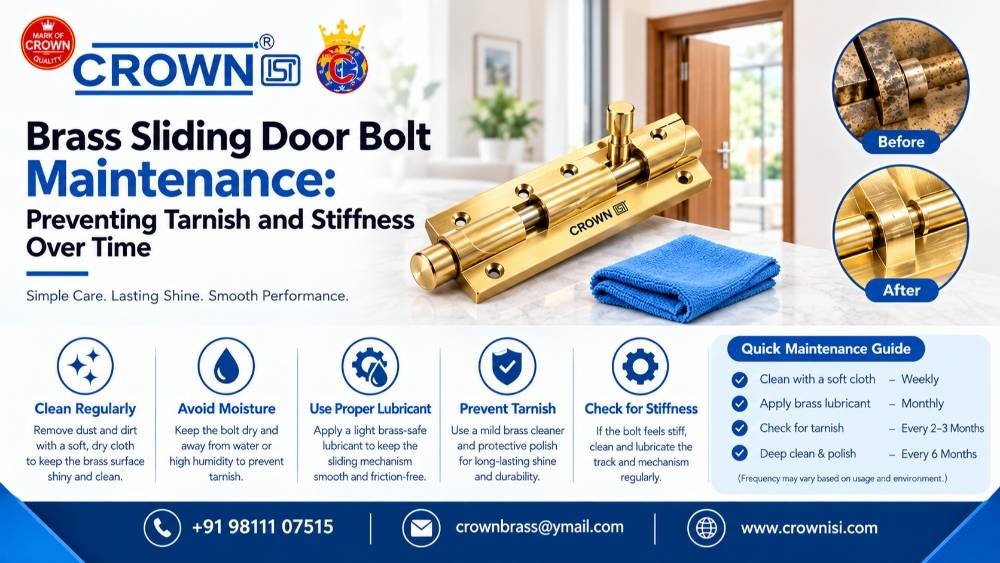
 A Brass Sliding Door Bolt needs two kinds of care: surface care to prevent tarnish and mechanical care to prevent stiffness. For surface care, dust the bolt regularly with a soft cloth, clean with mild soap and water, dry immediately, and apply a protective wax every few months. For unlacquered brass, a light polish once or twice a year restores shine. For lacquered brass, use only a soft cloth and wax, never abrasive polish. For mechanical care, clean the sliding mechanism first and use a small amount of a lubricant compatible with the hardware and finish, following the manufacturer's recommendations. Inspect and lubricate when movement becomes dry or resistant rather than treating twice-yearly lubrication as a universal requirement. In coastal or humid environments, increase cleaning frequency. CROWN's published product information lists its brass sliding door bolts under IS 2681:1993, and proper maintenance can help preserve their appearance and operation over time.
Why Brass Sliding Door Bolts Are Worth Maintaining
A brass sliding door bolt requires little routine attention, but periodic cleaning and inspection help prevent surface deterioration and operating problems. It sits on the door, does its job quietly, and rarely asks for attention.
But brass reacts gradually with moisture, oxygen and contaminants in its environment, so its surface appearance changes over time. Left unattended, the sliding mechanism can tighten up, making the bolt difficult to operate.
The good news is that brass is also one of the more forgiving metals used in architectural hardware. Ordinary surface tarnish is generally cosmetic rather than the same type of iron-oxide rust associated with steel. With a small amount of routine care, a brass sliding door bolt can stay smooth and attractive for decades.
This guide explains how to prevent both tarnish and stiffness, using methods that are safe for the material and practical for everyday use. Whether you have a Brass Sliding Door Bolt in a home, office, or commercial building, the principles are the same.
The Science Behind Brass Tarnish
Brass is an alloy of copper and zinc. Its warm golden appearance comes from its copper-rich composition, while exposure to oxygen, moisture, pollutants, fingerprints and other environmental contaminants can gradually alter the surface. The result may appear as darkening, tarnish or patina.
This is not the same as rust. Rust on iron or steel penetrates the metal and causes structural deterioration. Ordinary brass tarnish is generally a surface discolouration rather than the same type of iron-oxide rust associated with steel. However, brass can also experience other forms of corrosion, such as dezincification, so persistent green deposits, pitting or unusual surface damage should not simply be treated as cosmetic tarnish.
The rate of tarnish depends on several factors:
| Factor | Effect on Tarnish |
|---|---|
| Humidity | Higher humidity accelerates tarnish |
| Airborne pollutants | Sulphur compounds and chlorides speed up the process |
| Skin contact | Oils and salts from hands can leave marks and accelerate tarnish |
| Surface finish | Polished brass tarnishes more visibly than satin or antique finishes |
| Protective coating | Lacquer or wax slows tarnish but does not stop it permanently |
For interior doors in dry climates, tarnish may develop slowly over months or years. For exterior doors or coastal locations, surface discoloration and deposits can develop more quickly because of greater exposure to moisture, salts and pollutants.
The Canadian Conservation Institute notes that cleaning brass helps reduce further deterioration by removing grease, dust, metal polish residues, and fingerprints, all of which can contribute to corrosion. For a detailed reference, see the Canadian Conservation Institute guidance on brass and copper care.
Why Brass Sliding Door Bolts Become Stiff — and How to Fix Them
Ordinary tarnish is primarily a surface appearance issue. Stiffness is a functional one. A stiff brass sliding door bolt is not just inconvenient. It puts extra strain on the fixing screws, the door frame, and the bolt itself.
There are several reasons why a brass sliding door bolt becomes stiff over time:
Dust and grit accumulation. Dust settles in the sliding channel between the bolt and its guide. Over time, this dust combines with moisture and creates a sticky residue that increases friction.
Dried lubricant. If the bolt was lubricated at installation, the lubricant may have dried out or become gummy. Old lubricant attracts dust and can actually increase friction rather than reduce it.
Corrosion inside the mechanism. While brass tarnish is usually superficial, the internal sliding surfaces can develop a thin oxide layer that increases friction.
Misalignment. If the door has shifted slightly over time, the bolt may no longer align perfectly with its keeper. This creates resistance that feels like stiffness but is actually a fit issue.
Lack of use. A bolt that is rarely operated can become stiff simply because it has not moved. Regular operation keeps the mechanism free.
Lubrication requirements vary by hardware design and manufacturer. When a bolt becomes stiff, clean the sliding channel first and use a compatible lubricant according to the manufacturer's instructions.
A Practical Maintenance Schedule for Brass Sliding Door Bolts
Maintenance does not need to be complicated. The table below shows a simple schedule that covers both surface care and mechanical care.
| Frequency | Task | What to Use |
|---|---|---|
| Weekly (high-traffic/coastal) | Dust with soft cloth | Dry microfibre cloth |
| Monthly | Wipe with mild soap and water | Soft cloth, mild detergent |
| Every 3 months | Apply protective wax | Non-abrasive protective wax compatible with the finish |
| Every 6 months | Lubricate sliding mechanism | Lubricant compatible with the hardware |
| Every 6–12 months | Polish (unlacquered brass only) | Quality brass polish, soft cloth |
| As needed | Deep clean and re-wax | Mild soap, wax, soft cloth |
The intervals above are practical starting points rather than universal manufacturer requirements. Actual frequency should be adjusted for the finish, exposure, humidity, traffic and manufacturer instructions.
For interior doors in dry environments, the frequency can be reduced. For exterior doors, bathroom doors, or coastal locations, increase the frequency. The key principle is to inspect the bolt regularly and clean it before deposits accumulate.
How to Clean a Brass Sliding Door Bolt (Lacquered vs Unlacquered)
The cleaning method depends on whether your brass bolt has a lacquered finish or is unlacquered.
Lacquered Brass
Many Brass Door Fittings are coated with a clear protective lacquer at the factory. This lacquer slows tarnish but does not prevent it permanently. Over time, the lacquer can wear away, chip, or degrade.
For lacquered brass:
- Dust regularly with a soft, dry cloth.
- Wipe with mild soap and water using a soft cloth. Do not use abrasive cleaners or scouring pads.
- Dry immediately with a clean cloth to prevent water spots.
- If compatible with the finish, apply a non-abrasive protective wax according to the finish or manufacturer's instructions.
- Never use brass polish on lacquered surfaces. Polishing removes the lacquer.
If the lacquer has deteriorated significantly, refinishing may require removing the old coating and either polishing or recoating the brass. For installed architectural hardware, this is usually better handled according to the manufacturer's refinishing guidance or by a qualified refinishing professional.
Unlacquered Brass
Unlacquered brass is designed to develop a natural patina over time. Some people prefer this aged look. Others prefer to keep the brass bright and polished.
For unlacquered brass:
- Dust regularly with a soft cloth.
- Clean with mild soap and water, then dry immediately.
- Polish when desired using a quality brass polish and a soft cloth. Follow the manufacturer's directions.
- Apply a protective wax after polishing to slow future tarnish.
The Canadian Conservation Institute recommends the gentlest cleaning procedure: lightly rubbing the surface with a paste of precipitated chalk and water on a soft cloth. For everyday maintenance, mild soap and water is sufficient. Remember that polishing is an abrasive process, so repeated polishing should be limited.
What to Avoid
- Ammonia-containing or aggressive metal cleaners. Some formulations can adversely affect copper alloys or protective finishes. Avoid them unless the finish manufacturer specifically approves them.
- Abrasive cleaners or scouring pads. These scratch the surface and remove protective coatings.
- Acidic cleaners such as vinegar or lemon juice, unless you intend to strip the finish. These can remove patina and lacquer.
- Harsh chemicals. Solvents and strong detergents can damage the metal and any protective coating.
How to Lubricate a Brass Sliding Door Bolt
Lubrication keeps the sliding mechanism moving freely. The right lubricant is important. The wrong one can attract dust and make the problem worse.
What to Use
Compatible silicone-based lubricant. For many sliding mechanisms, a light silicone lubricant can provide smooth movement without the heavy residue associated with some oils. However, the correct lubricant depends on the hardware design and manufacturer instructions.
White lithium grease. A light application can be suitable for some metal-to-metal sliding mechanisms, but it may retain more dust than a lighter lubricant.
What to Avoid
General-purpose penetrating or water-displacing sprays. Avoid treating a general-purpose penetrating or water-displacing spray as a substitute for the manufacturer's recommended long-term lubricant. Such products may provide temporary freeing action but may not be the appropriate ongoing lubricant for every sliding mechanism.
Cooking oil or motor oil. These are not designed for hardware and can become gummy over time.
Excessive lubricant. More is not better. A small amount is sufficient. Excess lubricant attracts dust and creates a sticky mess.
How to Apply
- Clean the mechanism first. Remove dust and old lubricant with a soft brush or cloth.
- Apply a small amount of a compatible lubricant to the sliding channel and the bolt shaft.
- Operate the bolt several times to distribute the lubricant.
- Wipe away any excess with a clean cloth.
For residential doors, periodic inspection is a better starting point than following a fixed lubrication interval; lubricate when movement becomes dry or resistant, subject to the manufacturer's instructions.
How to Prevent Brass Tarnish: Wax, Lacquer and Patina
Prevention is easier than restoration. There are three main approaches to preventing tarnish on a Brass Sliding Door Bolt.
Protective Wax
Applying a thin coat of non-abrasive wax is the simplest and safest way to slow tarnish. Use a non-abrasive protective wax that is compatible with the brass finish and follow the product or manufacturer instructions. The wax creates a barrier between the brass and the atmosphere. It needs to be reapplied periodically, especially in humid or coastal environments. The Canadian Conservation Institute notes that protective wax can reduce the frequency of cleaning and polishing.
Lacquer Coating
Many brass fittings come with a factory-applied lacquer coating. This is a clear finish that seals the brass and slows oxidation. The lacquer will eventually degrade or wear away, at which point it can be stripped and the brass polished or recoated.
Living with Patina
Some people prefer the aged look of tarnished brass. Unlacquered brass can develop a natural patina over time. A stable patina may be largely cosmetic, but unusual green deposits, pitting or powdery corrosion should be investigated rather than assumed to be harmless.
The key point is that none of these methods require expensive products or special skills. A soft cloth, mild soap, a little wax, and a compatible lubricant will cover almost every maintenance need.
CROWN Brass Door Fittings: Built for Long-Term Performance
CROWN states that it has been manufacturing door fittings and hardware for over 39 years. The company produces Brass Door Fittings, including brass sliding door bolts, under its CROWN brass door accessories range.
CROWN's published product information lists its sliding door bolt under IS 2681:1993. BIS identifies IS 2681:1993 as the Indian Standard for non-ferrous metal sliding door bolts (aldrops) for use with padlocks. This standard covers requirements for material, dimensions, manufacture, finish, and operational smoothness. For the applicable Indian Standard and BIS certification framework, buyers can refer to the BIS Product Manual for IS 2681:1993.
IS 2681:1993 specifies requirements for non-ferrous sliding door bolts in defined types and sizes; the applicable size and configuration should be checked against the standard and the manufacturer's product specification.
For a detailed look at the features, sizes, and benefits of CROWN's brass sliding door bolts, you can read the brass sliding door bolt features guide on the CROWN blog. For information on where brass sliding door bolts are used and why they are preferred, the brass sliding door bolt uses and benefits guide provides a useful overview.
CROWN's published quality control information states that load testing, 200-hour salt-spray testing, and 50,000-cycle testing form part of its manufacturing process for its door hardware range. These are additional product-level quality-control tests; buyers should request the applicable test documentation and compare the test method and acceptance criteria with the relevant standard.
For projects that require documented evidence, CROWN can provide product datasheets and test information for the specific brass sliding door bolt model. You can learn more about the company on the About CROWN page.
Common Mistakes in Brass Sliding Door Bolt Maintenance
Mistake 1: Using abrasive cleaners on lacquered brass. Abrasive cleaners scratch the lacquer and expose the brass underneath, leading to uneven tarnish.
Mistake 2: Using ammonia-based cleaners. Some formulations can adversely affect copper alloys or protective finishes. Avoid them unless the finish manufacturer specifically approves them.
Mistake 3: Over-lubricating. Excess lubricant attracts dust and creates a sticky residue that makes the bolt stiffer, not smoother.
Mistake 4: Using penetrating oil instead of a proper lubricant. Penetrating or water-displacing sprays may provide temporary freeing action but are not the appropriate ongoing lubricant for every sliding mechanism.
Mistake 5: Skipping cleaning for long periods. Dust and grit accumulate in the sliding channel and act as an abrasive, wearing down the mechanism.
Mistake 6: Polishing unlacquered brass too often. Polishing is an abrasive process that removes a small amount of surface metal each time. Frequent polishing can erode details and thin the metal over years.
Mistake 7: Ignoring stiffness. A stiff bolt is an early warning sign. If addressed early with cleaning and lubrication, it can often be resolved without disassembly. If ignored, it may require replacement.
Mistake 8: Not adjusting the keeper. If the bolt is stiff because the keeper is misaligned, no amount of lubrication will fix it. Check the alignment and adjust if necessary.
Frequently Asked Questions
How often should I clean my brass sliding door bolt?
For interior doors, a monthly wipe with a soft cloth and mild soap is usually sufficient. For exterior or coastal locations, clean weekly or as needed to remove salt and grime. The key is to clean before deposits accumulate.
What is the best way to remove tarnish from a brass sliding door bolt?
For unlacquered brass, use a quality brass polish and a soft cloth. For lacquered brass, do not use polish. Instead, clean with mild soap and water, dry immediately, and apply a non-abrasive wax. If the lacquer is damaged, it can be stripped and the brass polished or recoated.
How do I stop my brass sliding door bolt from becoming stiff?
Clean the sliding channel to remove dust and old lubricant, then apply a small amount of a compatible lubricant. Operate the bolt several times to distribute the lubricant. If stiffness persists, check the alignment of the bolt and keeper.
Can I use WD-40 on a brass sliding door bolt?
Avoid treating a general-purpose penetrating or water-displacing spray as a substitute for the manufacturer's recommended long-term lubricant. Such products may provide temporary freeing action but may not be the appropriate ongoing lubricant for every sliding mechanism.
Should I polish lacquered brass?
No. Polishing removes the lacquer coating. For lacquered brass, clean with mild soap and water, dry immediately, and apply a protective wax. If the lacquer is worn, you can strip it and polish the brass regularly, or recoat it with a new lacquer.
How do I protect brass from tarnishing?
Apply a thin coat of non-abrasive wax compatible with the finish to create a barrier between the brass and the atmosphere. Reapply periodically, especially in humid or coastal environments. Keep the surface clean and dry. Avoid touching the brass with bare hands, as skin oils can accelerate tarnish.
What is the difference between lacquered and unlacquered brass?
Lacquered brass has a factory-applied clear coating that slows tarnish. Unlacquered brass has no coating and will develop a natural patina over time. Lacquered brass requires gentler cleaning, while unlacquered brass can be polished to restore shine.
Can brass sliding door bolts be repaired if they become too stiff?
Often, yes. Cleaning and appropriate lubrication can resolve stiffness caused by dust, residue or dry sliding surfaces. If the bolt is bent, damaged, corroded, or misaligned, adjustment or replacement may be necessary.
What lubricant is best for brass door hardware?
There is no universal lubricant that suits every brass sliding bolt. For many sliding mechanisms, a light silicone lubricant can provide smooth movement, but the correct lubricant depends on the hardware design and manufacturer instructions. Always check the manufacturer's recommendations.
Does brass sliding door bolt maintenance affect the warranty?
Maintenance requirements vary by manufacturer. CROWN's brass sliding door bolts are manufactured to IS 2681:1993. For specific warranty terms, check the product documentation or contact the manufacturer directly.
Final Thoughts
A Brass Sliding Door Bolt is a small piece of hardware with a long service life, provided it receives basic care. The two main threats are tarnish and stiffness. Both are preventable.
Tarnish is a surface reaction. Regular dusting, occasional cleaning with mild soap and water, and a protective wax coating will keep it under control. For unlacquered brass, periodic polishing restores the shine. For lacquered brass, gentle cleaning and wax are the right approach.
Stiffness is a mechanical issue. Dust, dried lubricant, and lack of use are the usual causes. Cleaning the sliding channel and applying a compatible lubricant will keep the bolt moving freely.
CROWN's published information identifies its brass sliding door bolts with IS 2681:1993. With proper maintenance, the hardware can be kept clean, protected and operating smoothly over time.
Routine inspection and basic cleaning take little time compared with dealing with a seized, damaged or heavily tarnished fitting later. Regular maintenance is the simpler path.
Need help selecting the right brass sliding door bolt for your project?
Share the following details:
- Application (interior, exterior, commercial, residential)
- Door type and thickness
- Required size and finish
- Quantity required
Need documents for vendor approval? Request the applicable product datasheet, material information and available test reports for the required brass sliding door bolt model. CROWN can help identify the relevant specification and available product documentation based on your project requirements. Contact CROWN to discuss your requirements.